

Bitcoin price tops $111K despite bear market fears
Bitcoin price surged to a new November high, crossing above $111,000 for the first time this month, but analysts remain cautious as fears of a bear market linger. The weekend rally has ignited debate across the crypto community over whether the move signals the start of a new bullish phase or just another short-lived pump before a correction.
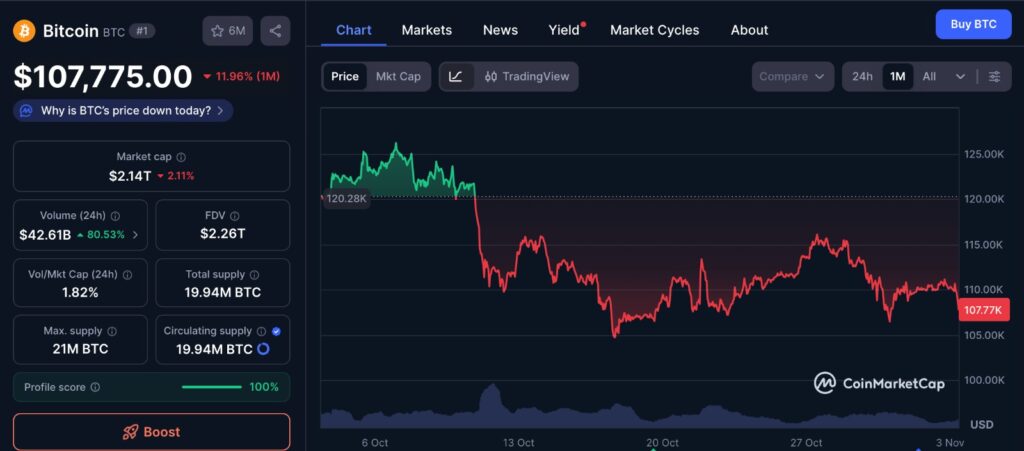
Recent data from CoinMarketCap shows that Bitcoin price has maintained a volatile upward trend over the past month. The one-month chart highlights a steady climb from near $98,000 in early October to above $111,000 by early November, with several short-term corrections along the way. This movement reflects increasing market activity as traders respond to shifting macroeconomic signals and growing speculation about Bitcoin’s next breakout. The visual data reinforces how Bitcoin’s consolidation periods have gradually formed higher lows, a sign that bullish sentiment, while cautious, continues to underpin the market.
Bitcoin price began climbing late in the week, extending gains into the weekend as trading volumes on major exchanges increased. On the Bitstamp exchange, Bitcoin touched approximately $111,129, marking its highest level for November so far. Traders quickly reacted to the move, with some seeing it as a technical breakout, while others warned that market conditions still favor caution.
Market participants noted that the rally coincided with a period of reduced trading activity in traditional financial markets, which often allows for exaggerated crypto price movements. With thinner liquidity on weekends, large trades can move prices more easily, creating what some analysts refer to as a “weekend pump.” The question now is whether this latest surge can hold once regular trading resumes on Monday.
Exchange data suggested that buying interest has picked up. On major platforms like Binance and Coinbase, stronger bids were observed around the $110,000 level. According to crypto investor Ted Pillows, both exchanges showed increased accumulation over the weekend, signaling renewed enthusiasm among retail traders. However, he cautioned that the momentum may fade quickly if whales or institutional players decide to sell into strength.
Adding complexity to the picture, one large Bitcoin wallet resumed distributing coins to exchanges. This wallet, which had been inactive for weeks, has now moved over $650 million worth of Bitcoin since October. In the latest transaction, roughly $55 million worth of BTC was sent to the Kraken exchange. Large movements like these can indicate that long-term holders are taking profits or preparing to sell, which can weigh on market sentiment.
The technical picture for Bitcoin price also shows important resistance ahead. The 21-week exponential moving average (EMA), a key trend indicator for Bitcoin cycles, currently sits near $111,230. Historically, this level has acted as both strong support and resistance during market transitions. Popular crypto analyst Rekt Capital commented that while Bitcoin is close to reclaiming this key EMA, it needs to close above it decisively to confirm a sustainable breakout.
Ted Pillows echoed similar thoughts, suggesting that Bitcoin must flip the $112,000 level into firm support. Without that, he warned, the market could see a renewed downturn. A failure to hold this zone could trigger another wave of selling, especially if short-term traders take profits.
The timing of the price increase also fueled skepticism. Pillows referred to it as “another Sunday pump,” a pattern where Bitcoin rallies during quiet weekend trading hours, only to retrace when markets reopen. Historically, weekend surges without strong volume follow-through often lead to corrections within days. Analysts estimate that the upside could briefly extend toward $113,000 or $114,000 if momentum continues, but confidence remains low.
Despite the optimism surrounding Bitcoin’s recent performance, underlying concerns persist about the broader market structure. On-chain analytics firm CryptoQuant observed that Bitcoin recently tested the 38.2% Fibonacci retracement level near $100,000, a point that often acts as support during downtrends. If the cryptocurrency closes below that level on a monthly timeframe, it would signal weakness and could confirm that the market remains in a broader bear phase.
Large holders, or whales, have been contributing to uncertainty. Even as prices rise, several major addresses have continued to distribute Bitcoin rather than accumulate it. This trend has historically preceded pullbacks and suggests that experienced investors are using the rallies to reduce exposure rather than increase it.
In the broader context, macroeconomic factors also play a role. Global financial conditions remain tight, and risk assets like Bitcoin tend to struggle when interest rates are high or investor sentiment turns defensive. Some analysts argue that until monetary policy becomes more accommodative, Bitcoin may find it difficult to sustain long-term rallies beyond key resistance zones.
For traders, the most important short-term levels to monitor are between $111,000 and $112,000. A confirmed daily close above these levels could open the door to a test of $115,000 or even $120,000. However, failure to maintain this breakout could push prices back toward $105,000 or lower. Many traders are adopting a wait-and-see approach, opting to watch how Bitcoin behaves during the first full week of November.
Long-term investors, on the other hand, remain focused on accumulation opportunities and market structure. While short-term volatility remains high, many still view Bitcoin as a store of value and hedge against traditional financial instability. Yet even among optimists, there is agreement that the current rally alone is not enough to declare the bear market over.
Looking ahead, several factors will determine Bitcoin’s next move. These include daily trading volume, whale activity, and global macro sentiment. Sustained volume growth during weekdays would signal that more institutional money is entering the market, providing support for further upside. Conversely, a quick fade in momentum would reinforce the idea that this was merely a temporary bounce.
Key levels to watch include:
- $112,000 resistance: must turn into support for confirmation of a breakout.
- $100,000 zone: critical Fibonacci retracement area that should not be lost.
- Whale selling: if it accelerates, the rally may quickly lose strength.
- Daily trading volume: must increase significantly to maintain bullish momentum.
In conclusion, Bitcoin price has shown impressive strength by reaching a new November high above $111,000, but analysts remain divided on whether the move is sustainable. Technical resistance, whale activity, and persistent market skepticism suggest that the road ahead could remain volatile. Traders and investors alike are advised to stay cautious, monitor support and resistance closely, and avoid over-leveraging as the market decides its next direction.
Keep yourself updated with the latest crypto news with FYI Gazette
 Bitcoin
  Ethereum
  Tether
  BNB
BNB  XRP
XRP  Solana
  TRON
TRON  Dogecoin
  Litecoin
  Pepe
Pepe