Trump Crypto Gold Rush: $800M Revelation
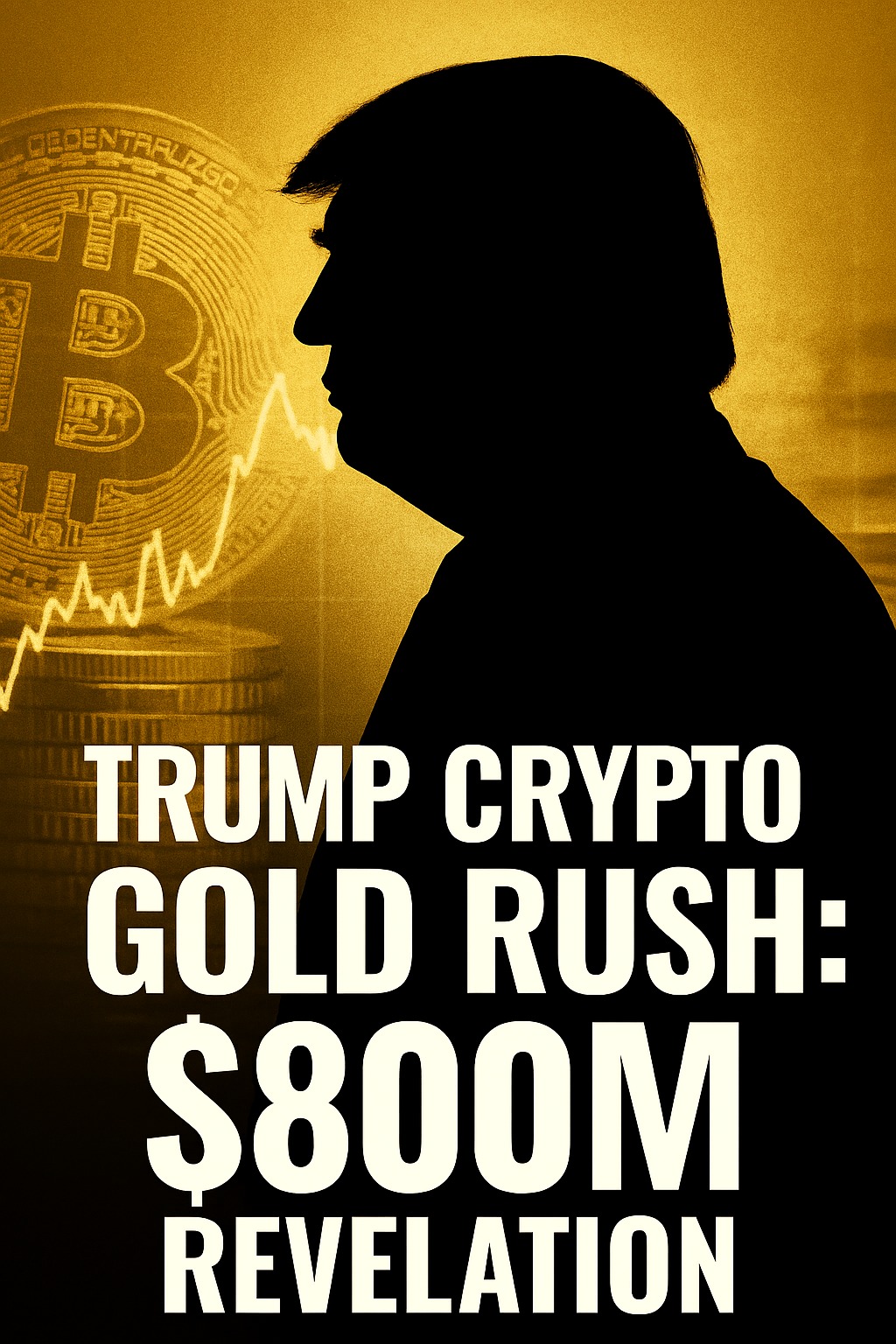
Trump Crypto has become one of the most talked-about financial stories of 2025, marking a surprising transformation of digital assets into major income streams for the Trump family. According to recent reports, ventures tied to Donald Trump and his family generated roughly $802 million in the first half of 2025 alone. That figure is more than ten times their traditional business income of about $62 million during the same period. Much of this windfall came from token sales under a company called World Liberty Financial (WLFI), the launch of a memecoin called $TRUMP, and a stablecoin named USD1. Together, these projects have fueled what some observers call an unprecedented Trump Crypto gold rush.
The rise of Trump Crypto ventures
WLFI and its token structure
At the center of the Trump Crypto ecosystem sits World Liberty Financial (WLFI), a token project introduced in late 2024. WLFI was promoted as a way to “democratize finance,” but documents such as its so-called “Gold Paper” revealed that a Trump-linked company would receive up to 75 % of token-sale revenues after expenses. This arrangement meant that the family would directly benefit from each token issued or sold. Industry analysts estimate that WLFI token sales alone brought in several hundred million dollars by mid-2025.
The WLFI token sales operated globally and attracted a wide mix of buyers. Large-scale investors reportedly included foundations and offshore entities that purchased substantial amounts of the token, further driving up both price and publicity.
The $TRUMP memecoin boom
Another pillar of the Trump Crypto phenomenon was the $TRUMP memecoin, launched on January 17, 2025. Within days, the coin exploded in trading volume across platforms such as Meteora. Analysts estimate that trading activity in the first two weeks produced between $86 million and $100 million in fees. Assuming that Trump-related entities captured even half of this revenue, that alone represented hundreds of millions in profits. The $TRUMP memecoin’s appeal rested largely on branding, its association with the former president and his populist image, rather than on any specific utility or technology. Yet this was enough to spark a frenzy among retail traders, crypto influencers, and speculative investors.
USD1 stablecoin and interest income
The USD1 stablecoin provided a steadier and more traditional income stream within the Trump Crypto framework. Pegged to the U.S. dollar and reportedly backed by cash and U.S. Treasuries, USD1 generated returns from interest on its reserves. Custodial oversight was handled by BitGo, while Trump-linked companies held partial ownership stakes. Estimates suggested that USD1 could yield about $80 million per year in interest. In addition, an Abu Dhabi–backed investment firm was said to be preparing a $2 billion deal settled in USD1, signaling that the stablecoin might also function as a geopolitical and financial tool, not just a domestic one. This aligns with broader Middle East investment activity in crypto, such as Abu Dhabi’s MGX $2 billion investment into Binance.
How the money flowed
Token sales and foreign participation
Much of the Trump Crypto income originated from direct token sales rather than secondary trading. Investigations highlighted that some major purchases came from large foreign entities. For example, the Aqua1 Foundation reportedly invested $100 million into WLFI tokens. Donald Trump Jr. and Eric Trump were actively involved in global investor roadshows promoting WLFI, illustrating how the family used their personal brand to attract capital.
Conversion into real-world value
The Trump Crypto structure converted digital hype into tangible financial returns. While memecoins typically rely on speculative trading, the inclusion of WLFI and USD1 created mechanisms for actual cash flow. Treasury-linked deals, token-sale allocations, and investor purchases all allowed token value to be realized in fiat terms. This hybrid model, combining speculative excitement with structured investments, helped convert digital tokens into hundreds of millions of dollars in measurable income.
Policy environment and ethical debate
Political influence and regulatory tone
The timing of the Trump Crypto surge coincided with a noticeable softening in U.S. cryptocurrency regulation. The Department of Justice reportedly disbanded its National Cryptocurrency Enforcement Team, and the Securities and Exchange Commission paused several major enforcement actions. Critics argued that such moves could benefit Trump-related ventures, particularly if crypto policy decisions aligned with the family’s financial interests. This overlap between public power and private profit sparked intense ethical debate about potential conflicts of interest.
Transparency and accountability issues
Skeptics have raised concerns about transparency within the Trump Crypto projects. WLFI’s governance structure grants limited voting rights to token holders, giving real control to affiliated corporations. Ownership details and profit-sharing arrangements remain opaque, and independent audits have yet to verify the reported figures. The combination of high revenues, political power, and unclear reporting has drawn scrutiny from journalists, ethics experts, and financial regulators alike.
Assessing the Trump Crypto phenomenon
The reported $800 million figure may not all be realized profit, but it reflects the enormous sums circulating within this ecosystem. WLFI token sales, $TRUMP trading activity, and USD1’s interest income together demonstrate how the Trump brand can convert public attention into direct financial gain. By comparison, traditional Trump business operations, real estate, hospitality, and branding deals, produced relatively modest income during the same period.
Observers note that while no laws appear to have been broken, the Trump Crypto model blurs the line between politics, marketing, and investment. It reveals how a powerful brand can dominate new financial frontiers, using cultural influence to attract capital faster than conventional companies can.
Why it matters
The Trump Crypto surge offers a revealing snapshot of the evolving relationship between celebrity, technology, and wealth creation. It shows that in modern markets, brand trust, or notoriety, can substitute for traditional due diligence. Investors may rush in based on personality rather than product. For policymakers, it raises pressing questions: how should conflicts of interest be handled when national leaders or their families participate directly in financial technologies they help regulate? For the crypto industry, it highlights how quickly a well-known name can reshape liquidity, sentiment, and price dynamics.
What to watch next
Looking forward, analysts will monitor several key developments. First, whether WLFI delivers on its promised platform or fades as another short-term token hype cycle. Second, whether U.S. and international regulators tighten scrutiny around politically linked crypto ventures. Third, whether other public figures follow the Trump Crypto playbook by launching branded coins or stablecoins of their own. Finally, investors will be watching market resilience, can these tokens maintain value once the initial publicity subsides?
In summary, Trump Crypto represents a unique fusion of branding, digital finance, and political influence. By leveraging token sales, memecoin marketing, and stablecoin interest, the Trump family reportedly amassed an $800 million fortune in just six months. Whether seen as innovation or opportunism, the phenomenon underscores how personal brands can dominate the financial frontier in an age where attention itself has become a currency.
Keep yourself updated with the latest crypto news with FYI Gazette
 Bitcoin
  Ethereum
  Tether
  BNB
BNB  XRP
XRP  Solana
  TRON
TRON  Dogecoin
  Litecoin
  Pepe
Pepe