
Stablecoin Regulation: Bank of England Aligns With US
Stablecoin Regulation is taking center stage as the Bank of England (BoE) pledges to match the United States in implementing rules for the growing $310 billion stablecoin market. Deputy Governor Sarah Breeden emphasized that it is “really important” for the two nations to stay synchronized on regulatory standards, reinforcing the UK’s commitment to maintaining global parity in digital asset oversight.
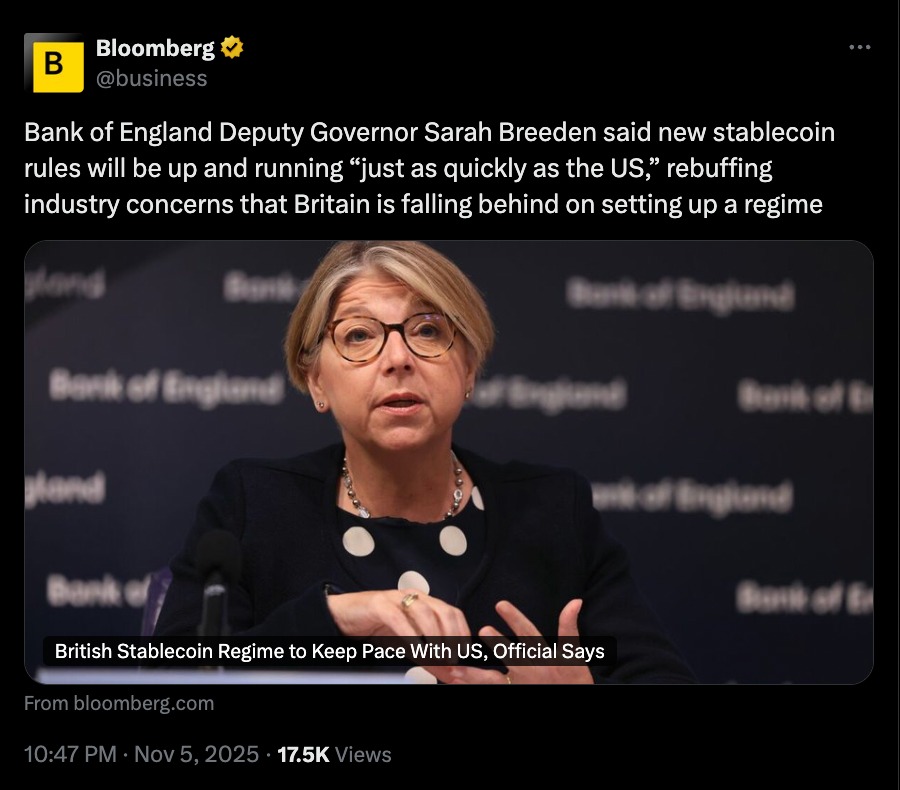
A tweet from Bloomberg’s official business account on November 5 confirmed Breeden’s remarks, quoting her assurance that Britain’s stablecoin framework would move “just as quickly as the US.” The statement, widely shared online, reinforced confidence among market participants that the UK is committed to keeping pace with its American counterpart in digital asset regulation.
UK and US Seek Alignment on Stablecoin Regulation
During the SALT conference in London, Breeden stated that the UK intends to roll out its stablecoin regulation framework “just as quickly as the US.” Her remarks came amid industry concerns that the UK could be falling behind after the United States passed the groundbreaking GENIUS Act in July, setting a precedent for stablecoin oversight.
Breeden reassured that the BoE is in active dialogue with American regulators to ensure that the two countries’ approaches remain compatible. “I’ve been talking to the Federal Reserve,” she said, noting that financial authorities on both sides of the Atlantic are coordinating through their respective ministries to streamline stablecoin policy development.
Consultation Paper on Stablecoin Regulation Coming Soon
The Bank of England is expected to publish its official stablecoin consultation paper on November 10. This release is anticipated to outline the UK’s proposed framework for supervising stablecoin issuers, reserve requirements, and transaction limits.
The announcement follows months of increasing cooperation between UK and US officials. In September, UK Chancellor Rachel Reeves and US Treasury Secretary Scott Bessent met to strengthen coordination on digital asset policies, including stablecoin oversight. That meeting reinforced both governments’ commitment to transparent, innovation-friendly regulation.
Industry Pressure on the UK to Move Faster
The UK’s crypto community has been vocal about what it sees as a slow-moving regulatory environment. Advocacy groups have warned that the country risks losing its competitive edge in the digital finance sector unless it accelerates its adoption of clear rules for stablecoin operations.
Last year, the Bank of England faced criticism for suggesting strict limits on individual stablecoin holdings—between 10,000 and 20,000 British pounds ($13,050 to $26,100). Critics argued that such caps would be both costly and technically difficult to enforce, potentially stifling the country’s fintech growth.
Global Expansion of Stablecoin Regulation
Stablecoin Regulation is becoming a global priority, not just a transatlantic one. On Tuesday, Canada unveiled plans to establish its own framework for stablecoin oversight. The proposal would require fiat-backed issuers to maintain adequate reserves and adopt strong risk management measures.
Although Canada did not specify when it would introduce the legislation, the move is part of a larger effort to modernize the nation’s payment systems. The initiative aims to make digital transactions faster, cheaper, and safer for Canada’s 41.7 million citizens.
This push follows similar global trends, with jurisdictions around the world recognizing the need for consistent standards to prevent misuse and promote innovation in the stablecoin market.
The Rising Influence of Institutional Stablecoin Use
Institutional and corporate adoption of stablecoins continues to gain traction. Major financial players such as Western Union, SWIFT, MoneyGram, and Zelle have either integrated or announced plans to integrate stablecoin payment solutions in recent months.
This trend reflects growing confidence in blockchain-based settlement systems, which offer faster processing times and lower transaction fees compared to traditional banking rails. The momentum also suggests that stablecoins could soon become a cornerstone of global payments infrastructure.
Stablecoin Market Poised for Growth
According to estimates from the US Treasury, the current $310 billion stablecoin market could surge to $2 trillion by 2028. This projection underscores the urgency for regulators to establish frameworks that balance innovation with consumer protection.
Stablecoin Regulation, therefore, represents more than just compliance—it’s a strategic pillar for the future of international finance. With both the US and UK taking coordinated action, the likelihood of global regulatory convergence is increasing, reducing the risk of fragmentation that could hinder cross-border digital transactions.
Why Synchronizing Stablecoin Regulation Matters
Keeping pace with the US is crucial for the UK for several reasons. First, aligned regulation ensures interoperability between financial systems, minimizing the risk of regulatory arbitrage. Second, it fosters market confidence, encouraging institutional investors and fintech firms to operate under predictable and comparable rules.
Breeden’s comments suggest that the UK recognizes the strategic value of regulatory synchronization. By working closely with the US, the UK positions itself as a global leader in digital finance—balancing prudence with innovation.
Challenges Ahead for Stablecoin Regulation
Despite the optimistic tone, several challenges remain. Key issues include defining reserve standards, managing systemic risk, and determining whether stablecoin issuers should have access to central bank payment systems.
Another concern is how to regulate algorithmic stablecoins, which do not rely on fiat reserves and have been linked to past market collapses. Both the UK and US are likely to take a cautious approach, focusing initially on asset-backed models that demonstrate stability and transparency.
A Turning Point for Global Digital Finance
Stablecoin Regulation marks a pivotal step in the evolution of global finance. The Bank of England’s pledge to align with the United States demonstrates a broader recognition that digital currencies are no longer peripheral—they are becoming integral to the financial ecosystem.
As countries like Canada join the regulatory wave, the groundwork is being laid for a unified global standard that promotes both safety and innovation. For now, all eyes are on November 10, when the BoE’s consultation paper will reveal how the UK plans to navigate this transformative moment for financial technology.
Keep yourself updated with the latest crypto news with FYI Gazette
 Bitcoin
  Ethereum
  Tether
  BNB
BNB  XRP
XRP  Solana
  TRON
TRON  Dogecoin
  Litecoin
  Pepe
Pepe