
Institutional Investors Drive Crypto Adoption Amid Slump
Institutional Investors are increasing their involvement in digital assets even as crypto markets experience a downturn. Bitcoin’s price recently slipped below the 100,000 dollar mark, pulling the broader market downward, yet major financial institutions and global companies continue to build, invest and expand their crypto offerings. This determination signals that long-term strategic plans outweigh short-term volatility, and institutions remain committed to digital asset integration. The following sections explore how Institutional Investors are shaping the market, strengthening infrastructure and launching new products despite the price slump.
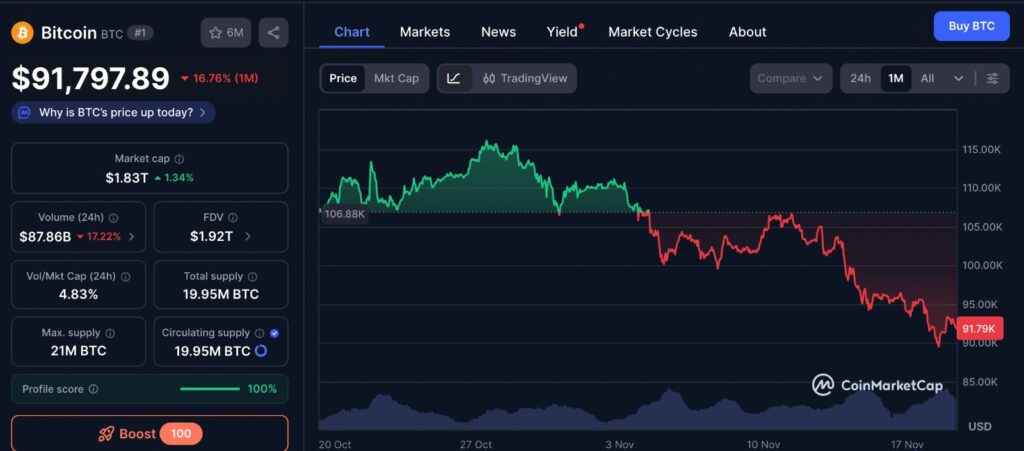
The latest one-month Bitcoin chart from CoinMarketCap reinforces the current market narrative, showing a steady downward trend that reflects broader risk-off sentiment across digital assets. The chart highlights several failed recovery attempts as BTC struggled to regain momentum, ultimately settling near its recent lows. This sustained decline illustrates the caution seen among retail traders. Yet, despite the pullback, institutional activity continues to grow, suggesting that major players are viewing the downturn as a strategic accumulation window rather than a reason to retreat.
Institutional Investors continue activity during market weakness
Markets may be facing significant pressure, but Institutional Investors show no signs of retreat. Bitcoin’s recent slide below 100,000 dollars has created a period of correction, yet developments across the United States and Asia suggest that institutions are treating this environment as an opportunity to expand rather than withdraw. In the United States, a nationally chartered digital trading platform has opened crypto trading services to institutional clients. Meanwhile, the derivatives arm of the Singapore Exchange is preparing to launch perpetual futures for major cryptocurrencies, marking another step toward mainstream financial adoption.
Institutional Investors and Bitcoin supply concentration
Corporations expand their Bitcoin holdings
Corporations and institutions now control an estimated 14 percent of Bitcoin’s fixed 21 million coin supply. This figure includes both public and private companies that hold Bitcoin directly on their balance sheets as part of their strategic reserves or product offerings. Notably, it excludes holdings owned by mining companies, sovereign governments such as El Salvador and various decentralized finance protocols.
While Institutional Investors entering the market can provide stability and demand, the growing concentration of Bitcoin among corporate entities has sparked debates around decentralization. Crypto analyst Willy Woo has suggested that Bitcoin may be following a pattern similar to gold in the 1970s, where increasing institutional and governmental involvement created a form of nationalization of the asset. Such commentary has fueled ongoing discussions about whether corporate accumulation threatens Bitcoin’s decentralized ethos.
However, not all experts share this concern. Nansen research analyst Nicolai Sondergaard has emphasized that institutional custody does not alter Bitcoin’s fundamental decentralized nature. According to him, even if more Bitcoin is held by centralized entities, the network remains technically decentralized due to its global node distribution and open-source structure. This perspective highlights how Institutional Investors can participate at scale without structurally compromising the network.
Institutional Investors and the rollout of new crypto products
SoFi introduces crypto trading to U.S. clients
Digital financial services firm SoFi announced on November 11 that it is launching crypto trading for retail clients in the United States. CEO Anthony Noto stated that SoFi is the only nationally chartered bank offering such trading capabilities. He explained that updated guidelines from the U.S. Office of the Comptroller of the Currency created a clearer regulatory environment for banks engaging with digital assets.
Before the new policies, federally chartered banks were restricted from offering crypto custody and trading services. In March, however, the OCC clarified that activities involving crypto custody, certain stablecoins and participation in distributed verification networks are permissible. This regulatory shift gives Institutional Investors such as SoFi the green light to expand their digital asset offerings.
Singapore Exchange prepares perpetual futures
The derivatives arm of the Singapore Exchange announced that it will launch perpetual futures trading on November 17, with the contracts officially going live on November 24. The initiative is driven by rising Institutional Investors demand and the increasing overlap between traditional finance and crypto-native markets.
The Bitcoin and Ether perpetual futures will be limited to accredited and expert investors and will fall under the supervision of the Monetary Authority of Singapore. This marks only the second perpetual futures offering in the country, following the July launch of perpetual futures and 44 other trading products by EDXM International. Perpetual futures are highly popular among global crypto traders because they allow leveraged, continuous speculation on asset prices without expiration dates.
Institutional Investors benefit from IRS approval of staking ETPs
The Internal Revenue Service recently approved rules that allow crypto exchange-traded trusts holding single digital assets, such as Ethereum, to earn staking rewards while maintaining their classification as grantor trusts. This decision is a significant milestone for Institutional Investors seeking to offer staking within regulated financial products.
Law firm Willkie Farr & Gallagher noted that grantor trust status simplifies tax reporting for both institutions and retail investors. Treasury Secretary Scott Bessent emphasized that the move enhances U.S. competitiveness and encourages innovation in the digital asset sector. With clarity around taxation and structure, staking-enabled ETPs are expected to grow as demand increases among Institutional Investors.
Institutional Investors embrace Hong Kong’s blockchain bonds
The Hong Kong government has issued its third blockchain-based bond offering, valued at 10 billion Hong Kong dollars. These digital bonds, available in multiple currencies including the Hong Kong dollar, renminbi, U.S. dollar and euro, have attracted strong interest from Institutional Investors worldwide. Asset managers, banks, insurance companies and private banks were among the participants, including many first-time buyers of digital bonds.
According to the Hong Kong Monetary Authority, the demand highlights confidence in blockchain-based financial infrastructure. The bonds also demonstrate how Institutional Investors are expanding beyond cryptocurrencies and into blockchain-enabled capital markets.
Outlook for Institutional Investors in crypto
Despite current price declines, Institutional Investors appear focused on long-term development rather than short-term price movements. New products such as perpetual futures, staking-enabled ETPs and blockchain bonds signal that institutions are building the next generation of financial markets on blockchain technology. Infrastructure, regulatory clarity and rising interest in digital assets continue to pull major players deeper into the ecosystem.
Markets may be rough now, but the steady march of Institutional Investors suggests a broader transformation is underway. Their involvement is helping shape a more mature, regulated and globally integrated crypto landscape.
Keep yourself updated with the latest crypto news with FYI Gazette
Read more about Memecoins with FYI Gazette
Keep yourself updated with the latest Altcoin News with FYI Gazette
 Bitcoin
  Ethereum
  Tether
  BNB
BNB  XRP
XRP  Solana
  TRON
TRON  Dogecoin
  Litecoin
  Pepe
Pepe