ZEC Surge: Privacy Coin Momentum Explained
ZEC Surge is quickly becoming a defining theme in the renewed rise of privacy coins, as Zcash reclaims attention in a shifting cryptocurrency landscape. After years of relative quiet, privacy-focused networks are gaining traction again, and Zcash now sits at the center of that resurgence. Its rapid price movement, institutional attention, and new real-world partnerships point toward a changing narrative for one of crypto’s most debated categories.
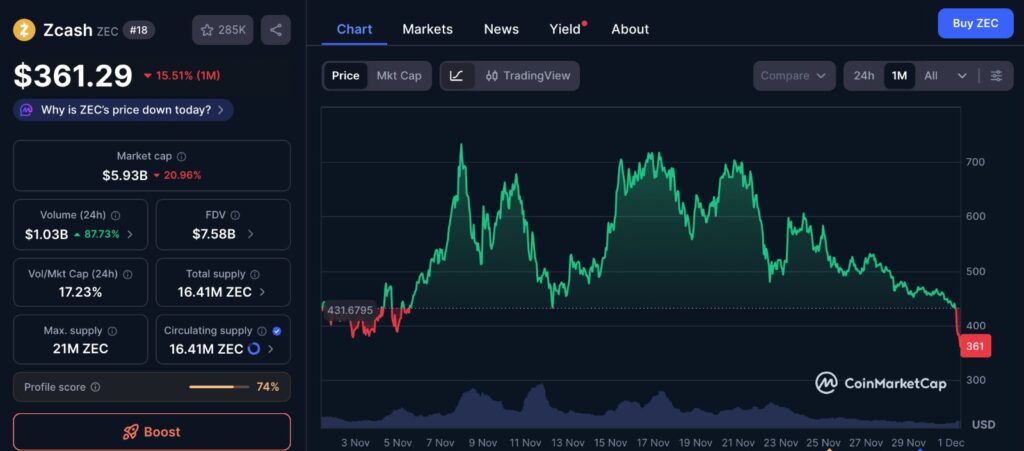
The chart above shows Zcash’s one-month price performance, highlighting a period of significant volatility. Following a strong rally in late Q4, ZEC experienced sharp swings, underscoring both renewed investor interest and the speculative pressures common in the privacy-coin market. The recent dip after the surge serves as a reminder that despite growing institutional backing, ZEC’s price remains sensitive to broader market sentiment and investor behavior.
ZEC Surge And The Return Of Privacy Coins
For much of the year, Zcash moved without major headlines. That changed dramatically in recent months as ZEC posted one of the strongest rallies among major privacy coins. In the fourth quarter, ZEC rose roughly 500 percent, far outpacing Monero’s approximate 41 percent gain during the same period. These two assets alone now make up around one-quarter of the estimated sixty-billion-dollar privacy coin market, highlighting their outsized influence in a sector that had previously fallen out of mainstream focus.
Still, the momentum has not been completely stable. Despite its breakthrough performance, ZEC also saw a pullback of around 40 percent following its series of green weekly candles. Analysts caution that part of the dramatic price rise may have been fueled by concentrated buying rather than widespread organic demand. Even so, the renewed activity surrounding ZEC signals a broader shift: privacy coins are regaining relevance, and investors are reconsidering their place within the digital asset ecosystem.
Institutional Confidence Reinforces The ZEC Surge
One of the strongest signals driving the ZEC Surge is the growing level of institutional involvement. Grayscale, a major digital asset manager, filed with the United States Securities and Exchange Commission to convert its long-standing Zcash Trust into what would be the first spot Zcash exchange-traded fund in the United States. The proposed fund, to be listed under the ticker ZCSH, would trade on NYSE Arca and represent a significant milestone as the first privacy-focused cryptocurrency to seek such recognition.
This development is particularly notable because it arrives at a time when privacy technologies often face regulatory skepticism. Despite the challenges, the ETF proposal shows that institutions see long-term strategic value in Zcash. The filing also came after ZEC’s price experienced selling pressure, suggesting that institutional confidence is not tied to short-term price movement but to structural factors and adoption potential.
Beyond the ETF, additional support is emerging. Reliance Global Group reportedly designated ZEC as a core holding within its digital asset treasury. This move reflects a growing belief that privacy-centric cryptocurrencies may serve important roles in the evolution of digital finance, especially for organizations that value secure and confidential transaction capabilities.
ZEC Surge Driven By More Than Just Market Speculation
The ZEC Surge is not solely the result of price activity. It is also tied to a series of technological improvements and ecosystem partnerships that have strengthened Zcash’s underlying utility. Developers at the Electric Coin Company, which maintains the Zcash protocol, have continued updating and enhancing the network’s privacy features. These improvements reinforce the protocol’s capacity for shielded transactions, which allow users to transact without exposing their financial activity on-chain.
Additionally, new partnerships aim to expand Zcash beyond being a simple transactional asset. A recent collaboration between Zcash and UXLINK focuses on integrating Zcash-style privacy into broader Web3 infrastructure. This suggests that ZEC’s role may evolve from a niche digital currency into a foundational privacy tool that supports decentralized applications and services.
These advancing use cases point to an ecosystem where privacy is treated as a standard rather than an exception. The growing importance of data protection across industries further reinforces why Zcash’s technology is gaining renewed attention.
ZEC Surge And Its Impact On The Crypto Sector
The broader implications of Zcash’s rise extend beyond its individual performance. Several key themes are emerging as privacy coins reenter mainstream conversation.
First, privacy is no longer viewed as an ideology reserved for fringe communities. With institutions exploring ETFs and treasuries holding ZEC as a long-term asset, privacy coins are becoming more widely accepted as legitimate financial tools.
Second, real-world integrations show that privacy networks can serve meaningful functions within Web3 ecosystems. As decentralized platforms seek stronger protections for user data, integrating privacy-centric protocols could become increasingly common.
Third, the rise of tools that enable confidential transactions challenges existing norms of complete blockchain transparency. As regulatory pressure and on-chain monitoring intensify, many users may turn to privacy-enabled solutions for everyday transactions, reigniting discussions around the balance between privacy rights and compliance obligations.
Finally, increased usage of Zcash’s shielded pools indicates that more users are adopting private transaction features rather than relying solely on transparent addresses. Although the percentage of fully shielded transactions remains modest, the trend is upward and suggests a gradual shift in user behavior.
ZEC Surge Faces Ongoing Risks And Barriers
Even with renewed momentum, several challenges still lie ahead for ZEC and other privacy-focused assets. Regulatory scrutiny remains among the most significant concerns. While Zcash offers optional privacy, global regulators are increasingly focused on monitoring digital asset flows. Any substantial increase in adoption could trigger further oversight or new compliance requirements.
Market volatility is another key risk. ZEC’s sharp rise and subsequent correction demonstrate how quickly sentiment can shift. Critics warn that sudden speculative surges should not be interpreted as long-term strength without sustained user adoption and technological progress.
Moreover, user behavior continues to shape the ecosystem. Privacy features are only effective when people choose to use them. Although shielded transaction activity has grown, widespread adoption requires overcoming user friction and ensuring wallet support, education, and ease of use.
Conclusion: What The ZEC Surge Represents For The Future
The ZEC Surge marks a turning point for privacy coins. Institutional engagement, meaningful partnerships, technical upgrades, and growing user interest indicate that privacy-centric cryptocurrencies may play an important role in the next stage of digital finance. If current developments continue, Zcash could help redefine how privacy functions within the broader crypto environment. The revival of ZEC suggests that the market still values confidential and secure digital transactions, making this resurgence more than just a temporary cycle.
Keep yourself updated with the latest crypto news with FYI Gazette
Read more about Memecoins with FYI Gazette
Keep yourself updated with the latest Altcoin News with FYI Gazette
 Bitcoin
  Ethereum
  Tether
  BNB
BNB  XRP
XRP  Solana
  TRON
TRON  Dogecoin
  Litecoin
  Pepe
Pepe