
Bitcoin Liquidity Reacts to Lowest US CPI Since 2021
Bitcoin Liquidity became the main focus of the crypto market after new US inflation data showed consumer prices rising at the slowest pace since 2021. The release of the Consumer Price Index triggered sharp price movements in Bitcoin as traders reacted to changing expectations around interest rates and monetary policy. With inflation cooling faster than expected, Bitcoin price action reflected a clear hunt for liquidity across key levels.
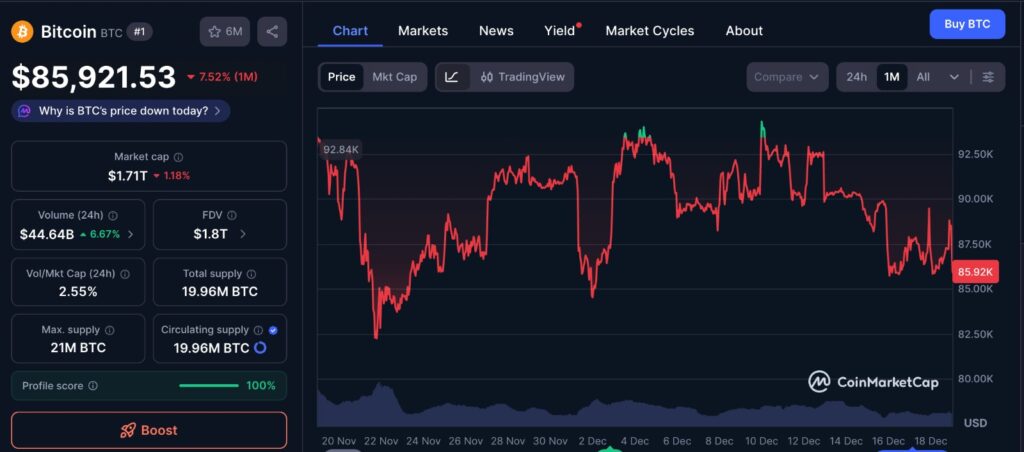
The chart above shows Bitcoin’s price performance over the past month, highlighting the increased volatility that followed recent US inflation data. Price movements during this period reflect how Bitcoin Liquidity has shifted around key support and resistance levels, with sharp moves occurring as traders reacted to macroeconomic signals. The rapid swings visible on the chart align with broader market behavior, where short-term momentum and liquidity zones played a greater role than sustained directional trends.
Bitcoin Liquidity and the Latest US CPI Data
Bitcoin Liquidity shifted rapidly following the release of US CPI data showing inflation at 2.7 percent year over year. This marked the lowest inflation reading in nearly three years and came as a surprise to many market participants. Core inflation, which excludes food and energy, also declined and reached levels not seen since 2021.
This inflation data was especially important because it influenced expectations around future interest rate decisions by the Federal Reserve. Lower inflation strengthens the case for rate cuts, which are generally seen as supportive for risk assets such as Bitcoin. As a result, traders quickly adjusted their positions, leading to increased volatility across crypto markets.
How Bitcoin Liquidity Affected Price Action
Bitcoin Liquidity became visible in price movements immediately after the CPI announcement. Bitcoin surged upward, briefly moving above major resistance levels before reversing sharply. This type of movement is typical during high impact macro events, where price is drawn toward areas with large clusters of stop orders and pending positions.
These liquidity zones exist both above and below the current price and often act as magnets during periods of uncertainty. As Bitcoin moved rapidly between these levels, it became clear that the market lacked strong directional conviction. Instead, price action was driven by short term trading and liquidation events.
Bitcoin Liquidity and Derivatives Market Reactions
Bitcoin Liquidity was also evident in derivatives markets, where a large number of leveraged positions were forced to close. In the 24 hours following the CPI release, total crypto liquidations exceeded hundreds of millions of dollars. Both long and short traders were affected, highlighting how unpredictable the market became after the inflation data.
When liquidity is thin and leverage is high, even small price moves can trigger cascading liquidations. This dynamic played a major role in amplifying Bitcoin’s volatility. The rapid liquidation of positions added fuel to price swings, reinforcing the importance of liquidity awareness during major economic events.
Market Sentiment Around Bitcoin Liquidity
Market analysts noted that Bitcoin Liquidity conditions reflected broader uncertainty rather than clear bullish or bearish control. While lower inflation is generally positive for Bitcoin, traders remained cautious due to ongoing macro risks and the possibility of future policy changes.
Some market observers pointed out that inflation falling closer to the Federal Reserve’s target could create a more flexible policy environment. This has the potential to benefit Bitcoin over the long term. However, short term price action showed that traders were more focused on immediate liquidity opportunities than long term positioning.
Bitcoin Liquidity and Technical Patterns
Bitcoin Liquidity was also discussed in relation to technical price patterns. Some analysts observed similarities between current price behavior and previous market structures seen earlier in the year. These repeating patterns, often called fractals, suggest that Bitcoin may still be in a broader consolidation phase.
According to this view, the recent CPI driven move may not mark a definitive trend reversal. Instead, Bitcoin could continue searching for liquidity at lower levels before establishing a stronger directional move. This interpretation aligns with the idea that markets often need time to absorb major macroeconomic changes.
Bitcoin Liquidity in the Broader Risk Market
Bitcoin Liquidity trends mirrored movements in other risk assets following the inflation data. Equity markets, bond yields, and currency markets all reacted to the lower CPI reading. A weaker dollar and falling bond yields typically support higher risk appetite, which can benefit cryptocurrencies.
Despite this supportive backdrop, Bitcoin did not immediately break into a sustained rally. This suggests that while macro conditions improved, internal market factors such as positioning, leverage, and liquidity distribution continued to influence price behavior.
Why Bitcoin Liquidity Still Matters Going Forward
Bitcoin Liquidity remains a key factor for traders and investors as markets adjust to changing inflation trends. Even with inflation at its lowest level since 2021, uncertainty around future economic data and central bank actions persists.
The CPI release showed how quickly sentiment can shift and how aggressively price can move when liquidity is targeted. For Bitcoin, this reinforces the importance of monitoring macro events alongside on chain and technical indicators.
Conclusion: Bitcoin Liquidity After the CPI Shock
Bitcoin Liquidity defined market behavior after the US CPI dropped to its lowest level since 2021. The data triggered sharp price swings, heavy liquidations, and a clear hunt for liquidity across major levels. While lower inflation supports a more favorable environment for Bitcoin in the long run, short term volatility remains high.
As markets move forward, the interaction between inflation data, interest rate expectations, and Bitcoin liquidity will continue to shape price action. Understanding where liquidity sits and how price reacts to macro events will remain critical for navigating the evolving crypto market.
Keep yourself updated with the latest crypto news with FYI Gazette
Read more about Memecoins with FYI Gazette
Keep yourself updated with the latest Altcoin News with FYI Gazette
 Bitcoin
  Ethereum
  Tether
  BNB
BNB  XRP
XRP  Solana
  TRON
TRON  Dogecoin
  Litecoin
  Pepe
Pepe