Uniswap fee switch set to launch before 2026
Uniswap fee switch discussions have reached a decisive stage as the decentralized exchange prepares to activate one of its most important governance upgrades. The proposal, backed by a strong majority of UNI token holders, signals a major shift in how Uniswap distributes fees and rewards participants. If finalized, the fee switch will go live before 2026 and introduce long awaited changes to the protocol’s economic model.
For years, Uniswap has generated massive trading volume while directing most fees exclusively to liquidity providers. Although this structure helped the platform grow rapidly, it limited the ways UNI token holders could benefit from protocol activity. The Uniswap fee switch aims to change that by allowing part of the fees generated on the platform to support token holders and long term ecosystem growth.
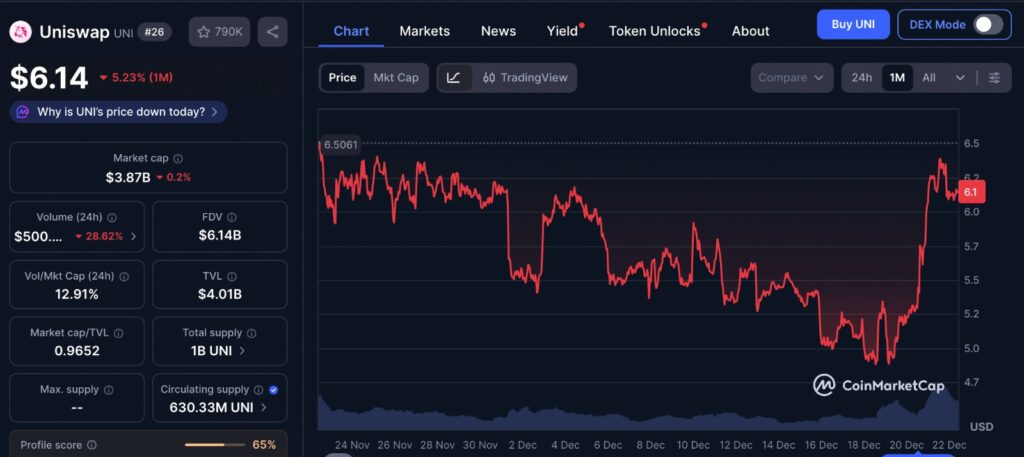
The recent price chart for Uniswap (UNI) reflects heightened market attention following governance developments around the fee switch proposal. Over the past month, UNI has experienced increased volatility, with noticeable upward momentum aligning with key voting milestones and community updates. This price movement suggests growing trader interest and short-term demand, as market participants assess how upcoming protocol changes could influence Uniswap’s long-term value structure. While price action remains sensitive to broader market conditions, the chart highlights how governance events continue to play a meaningful role in shaping sentiment around the UNI token.
What the Uniswap fee switch is designed to do
The Uniswap fee switch is a governance controlled mechanism that allows the protocol to redirect a portion of swap fees away from liquidity providers. Instead of all fees going directly to liquidity pools, a share can be allocated to protocol level initiatives such as token burns or ecosystem funding.
This change does not eliminate rewards for liquidity providers. Instead, it introduces a more balanced system where the protocol itself also captures value from its activity. The goal is to better align incentives between users, liquidity providers, developers, and UNI holders.
Governance vote and approval process
The current governance proposal has already passed the required voting threshold, with overwhelming support from the Uniswap community. Once the vote officially concludes and the mandatory time lock period ends, the Uniswap fee switch can be activated.
This vote also includes several related changes under a broader initiative often referred to as UNIfication. These changes are meant to improve Uniswap’s tokenomics while ensuring the protocol remains competitive in the rapidly evolving decentralized finance landscape.
Token burns and supply reduction
One of the most notable elements tied to the Uniswap fee switch is the planned burning of UNI tokens. The proposal includes a large one time burn from the Uniswap Foundation treasury, significantly reducing the total token supply.
By lowering the number of tokens in circulation, the protocol aims to strengthen UNI’s value proposition. Token burns are commonly used in crypto ecosystems to reduce inflationary pressure and improve long term scarcity, making holding the token more attractive.
In addition to the initial burn, ongoing fee based burns will occur once the switch is live. As trading activity continues, a portion of collected fees will be used to permanently remove UNI tokens from circulation.
Impact on liquidity providers
Liquidity providers play a central role in Uniswap’s success, and the fee switch introduces changes to how their rewards are structured. While some fees will be redirected at the protocol level, new incentive mechanisms are designed to help liquidity providers maintain competitive returns.
One such mechanism is a fee discount auction system. This system allows participants to bid for discounted trading fees, helping internalize value that would otherwise be lost to external actors. These changes are intended to balance reduced direct fees with new earning opportunities.
Strengthening the Uniswap ecosystem
Beyond token burns, the Uniswap fee switch also supports ecosystem growth. A portion of UNI tokens is allocated to fund development, innovation, and community initiatives. This growth budget is designed to support new tools, integrations, and features that strengthen Uniswap’s position in decentralized finance.
By reinvesting protocol value into development, Uniswap aims to remain adaptable and competitive as new exchanges and trading models emerge.
Market response and sentiment
Market reaction to news of the Uniswap fee switch has been positive. UNI’s price saw strong upward movement following the announcement and during the governance vote period. This response reflects growing investor confidence in the protocol’s evolving economic model.
The rally also highlights renewed interest in governance driven value capture, where token holders benefit more directly from protocol success rather than relying solely on speculative demand.
Why the Uniswap fee switch matters long term
The activation of the Uniswap fee switch represents a turning point for decentralized exchanges. It demonstrates how mature DeFi protocols can evolve beyond early growth models and adopt more sustainable value distribution systems.
By tying protocol revenue to token economics, Uniswap strengthens the relationship between governance participation and financial outcomes. This alignment encourages long term engagement from token holders and reinforces decentralized decision making.
Challenges and considerations
Despite broad support, the fee switch has not been without debate. Some community members have raised concerns around regulatory implications and how fee redirection might affect compliance or classification risks. Others have focused on ensuring liquidity providers remain adequately incentivized.
The current proposal reflects compromises intended to address these concerns while still delivering meaningful improvements to Uniswap’s economic structure.
Looking ahead to activation before 2026
Assuming the final steps proceed as planned, the Uniswap fee switch is expected to be activated well before 2026. Once live, it will begin reshaping how value flows through the protocol and how participants benefit from its continued growth.
This milestone underscores the power of decentralized governance and sets a precedent for other DeFi platforms exploring similar upgrades. As Uniswap enters this new phase, the fee switch may become one of the most influential changes in the platform’s history.
Keep yourself updated with the latest crypto news with FYI Gazette
Read more about Memecoins with FYI Gazette
Keep yourself updated with the latest Altcoin News with FYI Gazette
 Bitcoin
  Ethereum
  Tether
  BNB
BNB  XRP
XRP  Solana
  TRON
TRON  Dogecoin
  Litecoin
  Pepe
Pepe