
Web3 Gamer Shift From Play-to-Earn to Risk-to-Earn
Web3 Gamer culture is entering a new phase as blockchain games move away from simple reward systems and toward models that demand real risk from players. Early crypto games promised steady income just for participation, but that approach has proven difficult to sustain. Today, leading projects are experimenting with higher-stakes gameplay, deeper competition and mechanics designed to attract not only crypto users but mainstream gaming audiences as well.
Web3 Gamer Evolution Beyond Play-to-Earn
For several years, play-to-earn defined the Web3 Gamer experience. Players earned tokens or NFTs simply by spending time in a game, which attracted massive user numbers during crypto market booms. However, as markets cooled, weaknesses in the model became clear. Inflationary rewards, declining token values and repetitive gameplay reduced long-term engagement.
Developers have since realized that rewarding time alone does not create compelling games. Instead, they are focusing on fun, competition and emotional investment. This shift is pushing Web3 Gamer projects to rethink incentives and introduce systems that reward skill, strategy and risk rather than passive participation.
Web3 Gamer and the Rise of Risk-to-Earn
What Risk-to-Earn Means
Risk-to-earn changes the basic contract between player and game. Instead of guaranteed rewards, players must put valuable digital assets at stake to compete for prizes. Winning brings meaningful gains, but losing can result in permanent asset loss. This structure mirrors traditional competitive gaming, where only the best players succeed, while others must improve or exit.
Illuvium is one of the most prominent games adopting this approach. Its planned deathmatch mode allows up to 100 players to enter a single competition using their in-game creatures. Winners receive prizes drawn directly from defeated players, creating real consequences for every decision made during gameplay.
Designed for Spectators and Streamers
Risk-to-earn is not just about player incentives. It is also designed to create high-tension moments that are exciting to watch. Developers believe that dramatic wins and losses can generate viral clips and streaming content, which helps Web3 Gamer titles reach broader audiences beyond crypto-native communities.
Illuvium’s team has emphasized that these intense matches could be key to making blockchain games feel closer to mainstream esports rather than financial experiments.
Community-Driven Rules
Another important element of this model is player involvement in design decisions. Illuvium has actively asked its community to help define how risk-to-earn rules should work, including entry requirements and reward distribution. This approach reflects Web3 principles, where users act as stakeholders instead of passive consumers.
Axie Infinity and Learning From the Past
Axie Infinity played a major role in shaping early Web3 Gamer history. At its peak, the game attracted millions of users and became a source of income for players in multiple countries. However, its economy struggled when token prices fell and new players stopped entering at the same pace.
One of Axie Infinity’s founders has openly stated that the project played it too safe in recent years. In response, the team now plans to take bolder creative and economic risks. The goal is to bring back excitement and innovation rather than relying on outdated play-to-earn mechanics.
This willingness to experiment signals a broader industry shift. Even the most successful early Web3 Gamer projects recognize that survival depends on change, not nostalgia.
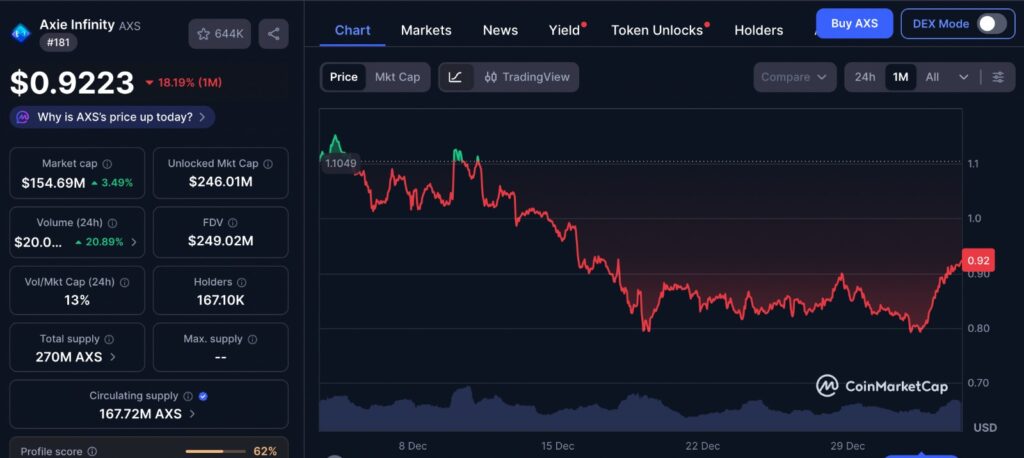
Short-term price charts like this often reflect sentiment more than fundamentals, especially in gaming tokens tied closely to player confidence. Over the past month, AXS price movement appears to mirror a market still weighing past disappointments against signs of renewed experimentation within the ecosystem. Rather than signaling a clear direction, this range-bound behavior suggests hesitation, with participants waiting for concrete gameplay changes to translate into sustained user activity. In this context, price volatility becomes less about speculation and more about how credibility is gradually rebuilt through execution.
Animoca Brands and the Bigger Web3 Picture
While individual games are adjusting their mechanics, major companies in the space are thinking much bigger. Animoca Brands, a leading investor in blockchain gaming, views games as just one part of a larger Web3 ecosystem.
The company sees long-term growth in areas such as digital property rights, decentralized infrastructure and emerging technologies tied to blockchain ownership. Gaming remains important, but it is increasingly connected to a wider vision of how digital economies could function across industries.
Animoca Brands has also highlighted the importance of clearer regulations, especially in major markets like the United States. Better legal clarity could encourage more traditional companies to enter the Web3 Gamer space and invest in blockchain-based entertainment.
What This Means for Web3 Gamers
Higher Stakes, Higher Engagement
For players, the shift toward risk-to-earn means gaming decisions matter more than ever. Instead of grinding repetitive tasks, players must evaluate risk, improve skills and understand game mechanics deeply. While this may discourage casual earners, it creates stronger engagement for competitive players who value challenge and mastery.
Less Focus on Guaranteed Income
One major change is the reduced promise of easy money. Web3 Gamer projects are no longer marketing themselves as passive income tools. Instead, they are positioning games as entertainment first, with earning potential as a secondary benefit tied to performance.
This adjustment may reduce short-term hype but could improve long-term sustainability.
Ongoing Challenges for Web3 Gaming
Despite progress, challenges remain. Market volatility still affects player confidence, and onboarding new users can be complex due to wallets, tokens and security concerns. Additionally, blockchain games must compete with traditional games that offer polished graphics, strong narratives and seamless user experiences.
Developers now face the difficult task of matching mainstream quality while maintaining decentralized ownership and economic innovation. Failure to balance these elements could limit adoption beyond niche audiences.
What often goes unspoken in Web3 gaming discussions is how player motivation shifts once real loss becomes possible. Many early participants were attracted less by games themselves and more by the certainty of returns, which reduced emotional attachment to outcomes. Risk-to-earn changes that dynamic by reintroducing tension, hesitation and personal judgment, elements familiar to traditional competitive gaming. These emotional responses, while uncomfortable for some, are often what separates short-term participation from long-term engagement.
Conclusion
Web3 Gamer culture is moving away from simplistic reward models and toward deeper, risk-based gameplay. With projects like Illuvium embracing risk-to-earn, Axie Infinity preparing bold changes and companies like Animoca Brands expanding the broader Web3 vision, blockchain gaming is entering a more mature phase.
While risk introduces uncertainty, it also brings excitement, competition and emotional investment. If executed well, this evolution could help Web3 games stand alongside traditional titles as legitimate entertainment rather than short-lived financial trends.
Disclaimer: This content is for informational purposes only and does not constitute financial advice.
Keep yourself updated with the latest crypto news with FYI Gazette
Read more about Memecoins with FYI Gazette
Keep yourself updated with the latest Altcoin News with FYI Gazette
 Bitcoin
  Ethereum
  Tether
  BNB
BNB  XRP
XRP  Solana
  TRON
TRON  Dogecoin
  Litecoin
  Pepe
Pepe