
Venezuela Bitcoin Reserve Claims and What We Really Know
Venezuela Bitcoin Reserve rumors have captured global attention after reports suggested the Venezuelan government may secretly control an enormous Bitcoin stash worth as much as $60 billion. If true, this would place Venezuela among the largest Bitcoin holders in the world. However, despite the dramatic headlines, the claim remains unverified and is viewed with caution by blockchain analysts and market experts.
The discussion intensified following recent political developments involving Venezuela’s leadership, raising questions about hidden state assets and how they may be used or seized. Supporters of the theory argue that Venezuela quietly accumulated Bitcoin over many years to bypass financial sanctions and protect national wealth. Critics, however, say the numbers do not match publicly available blockchain data.
What Is the Venezuela Bitcoin Reserve Theory?
The Venezuela Bitcoin Reserve theory claims the country holds up to 600,000 Bitcoin in undisclosed wallets. At current prices, this would equal roughly $60 billion. This figure is vastly larger than the Bitcoin holdings that can be publicly tracked and attributed to Venezuela through blockchain monitoring tools.
Public data shows only a small amount of Bitcoin connected to official Venezuelan addresses. The massive difference between known holdings and the rumored amount is the core reason this theory is so controversial. Proponents believe the Bitcoin is deliberately hidden through complex wallet structures, intermediaries, or offshore arrangements that prevent easy identification.
Why the Reserve Would Be Hidden
Advocates of the Venezuela Bitcoin Reserve idea point to the country’s long-standing economic crisis. Hyperinflation, strict capital controls, and international sanctions have severely limited access to global financial systems. Bitcoin, with its borderless and censorship-resistant design, may have offered a way to store value outside traditional banking networks.
Venezuela has a history of experimenting with digital assets, most notably through the Petro cryptocurrency initiative. While the Petro ultimately failed, it demonstrated the government’s willingness to explore unconventional financial tools.
Evidence Supporting the Venezuela Bitcoin Reserve
Supporters argue that Venezuela had both motive and opportunity to build a large Bitcoin reserve. Over the past decade, the country sold substantial amounts of gold and sought alternative settlement methods for oil exports. Some believe proceeds from these activities could have been converted into Bitcoin when prices were much lower than today.
Others suggest that crypto-based oil transactions and the use of stablecoins may have indirectly contributed to Bitcoin accumulation. Over time, even gradual conversions could theoretically result in large holdings.
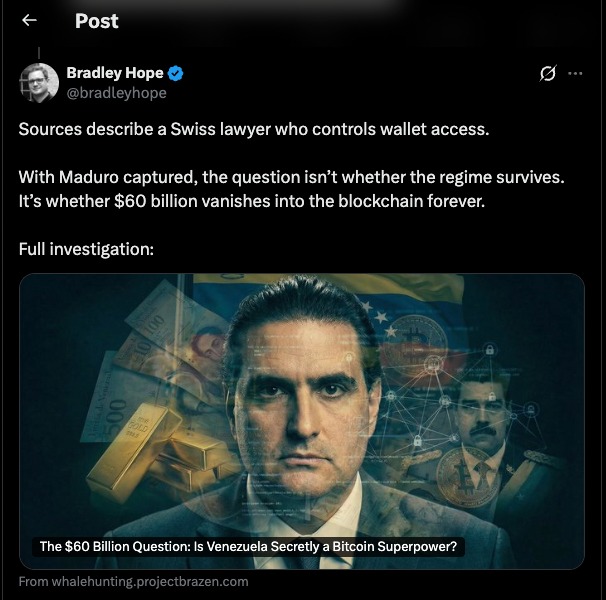
The tweet reflects how much of the Venezuela Bitcoin Reserve narrative is being driven by investigative sourcing rather than publicly verifiable data. References to intermediaries, private custodians, or individuals controlling access help explain why definitive proof remains elusive, but they also highlight the limits of what can be confirmed without on-chain attribution. For market observers, this kind of reporting sits in a gray area where plausibility and proof diverge. It adds texture to the story, while still falling short of confirmation.
However, these arguments rely heavily on assumptions rather than concrete blockchain proof.
Why Analysts Remain Skeptical
Despite the theories, most blockchain experts remain unconvinced. Large Bitcoin holdings are difficult to hide indefinitely due to the transparent nature of the blockchain. While wallet ownership can be obscured, movements involving hundreds of thousands of Bitcoin would likely attract attention from analytics firms.
No major blockchain intelligence company has confirmed the existence of wallets holding Bitcoin volumes anywhere near the claimed amount on behalf of Venezuela. Without verifiable wallet attribution or transaction records, analysts argue the estimate is speculative.
Some experts also note that managing and securing such a vast Bitcoin reserve would require technical coordination and infrastructure that would be difficult to conceal completely.
How Venezuela Might Have Accumulated Bitcoin
Even skeptics acknowledge possible methods Venezuela could have used to acquire Bitcoin discreetly, though not at the scale claimed.
One method involves converting gold reserves into digital assets during periods of low Bitcoin prices. Another possibility is settling international trade, particularly oil sales, using crypto-related channels instead of traditional banks. Smaller contributions may also come from domestic mining operations or seized mining equipment.
Still, none of these explanations provide verifiable evidence for a $60 billion Bitcoin reserve.
Market Impact of the Venezuela Bitcoin Reserve Claims
The Venezuela Bitcoin Reserve story matters because of its potential impact on global markets. If such a large Bitcoin stash existed and became frozen, seized, or removed from circulation, it could significantly affect supply dynamics.
Traders closely watch sovereign Bitcoin holdings because government actions can influence market liquidity and investor sentiment. However, since the reserve remains unproven, most market participants treat the claim cautiously rather than reacting aggressively.
The speculation alone has fueled debate about how governments may already be using Bitcoin behind the scenes.
Editor’s View: Why These Claims Persist
Stories like the Venezuela Bitcoin Reserve endure not because of hard evidence, but because they align with how market participants think about power, secrecy, and money. Bitcoin’s design allows for the possibility that large actors can operate quietly, which invites speculation whenever a politically isolated state is involved. In uncertain markets, people tend to fill information gaps with narratives that feel plausible, especially when transparency is limited. That psychological pull often keeps such claims alive long after factual verification stalls.
What Happens Next?
For now, the Venezuela Bitcoin Reserve remains an unresolved mystery. Analysts are watching for any legal disclosures, blockchain forensic breakthroughs, or official confirmations that could validate or disprove the claim.
Until solid evidence emerges, the theory remains speculative. What is clear, however, is that Bitcoin has become deeply intertwined with geopolitics, sanctions, and state-level financial strategies.
Whether Venezuela truly holds a massive Bitcoin reserve or not, the discussion highlights how digital assets are increasingly viewed as tools for national financial survival in a rapidly changing global system.
Disclaimer: This content is for informational purposes only and does not constitute financial advice.
Keep yourself updated with the latest crypto news with FYI Gazette
Read more about Memecoins with FYI Gazette
Keep yourself updated with the latest Altcoin News with FYI Gazette
 Bitcoin
  Ethereum
  Tether
  BNB
BNB  XRP
XRP  Solana
  TRON
TRON  Dogecoin
  Litecoin
  Pepe
Pepe