
Ethereum Risk Builds Ahead of the FOMC Meeting
Ethereum Risk is becoming a key concern in the crypto market as traders pile into leveraged positions ahead of the upcoming Federal Open Market Committee meeting. Nearly $3 billion in leverage has built up around Ethereum in a short period, raising questions about whether the recent price movement represents strength or a fragile setup vulnerable to sudden volatility.
Ethereum recently experienced a modest pullback after reaching weekly highs. Despite this decline, the asset remained significantly higher on a weekly basis, indicating that the broader trend had not yet broken down. This price action suggests that the market may simply be pausing after a strong rally rather than entering a full reversal. However, the growing use of leverage complicates the picture and increases downside risk if sentiment shifts quickly.
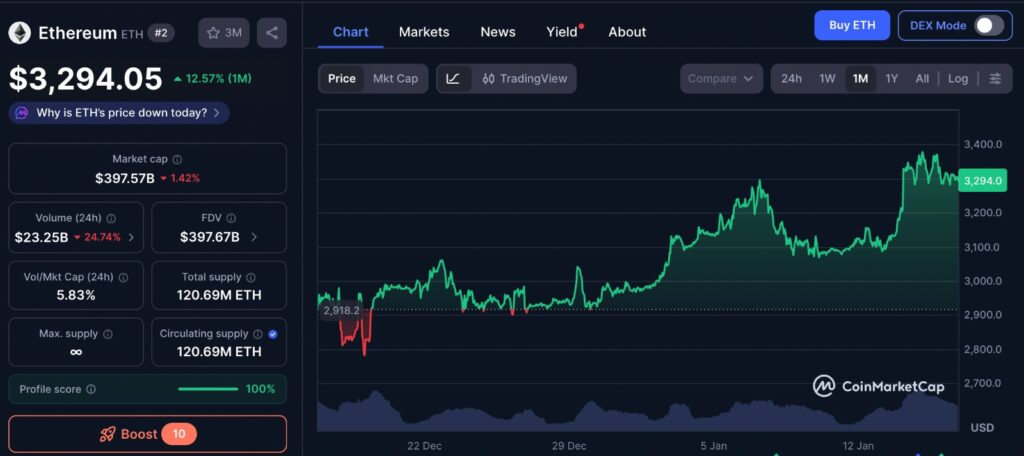
Over the past month, Ethereum’s price action shows a market that has been moving with intent but without urgency. The chart reflects higher engagement and sharper reactions around key levels, yet follow-through has been uneven, suggesting participants are still probing rather than committing fully. This kind of structure often appears when traders are responsive to short-term signals while remaining cautious about broader conditions. In that context, the recent movements look less like indecision and more like a market waiting for confirmation beyond price alone.
Ethereum Risk and the Surge in Leverage
Why Leverage Matters for Ethereum Risk
Ethereum risk has intensified primarily due to a sharp increase in derivatives activity. Over the past week, open interest across Ethereum futures rose by roughly $3 billion, reflecting aggressive positioning by traders. A large portion of this leverage has leaned toward long positions, meaning many participants are betting on further price appreciation.
When leverage builds rapidly, markets become more sensitive to sudden moves. Even a relatively small price drop can trigger liquidations, which then push prices lower and cause a cascading effect. This dynamic is especially relevant when macroeconomic events, such as the FOMC meeting, are approaching and uncertainty is elevated.
Price Stability Versus Speculative Positioning
While Ethereum’s price has shown resilience, holding above key support levels, speculative positioning has outpaced organic price growth. This divergence is a classic setup for volatility. If price continues to move sideways or declines slightly, leveraged traders may be forced to exit, increasing Ethereum risk in the short term.
At the same time, the market has not yet shown signs of panic. Funding rates and price structure suggest confidence remains intact, but that confidence is heavily dependent on favorable macro conditions.
The FOMC and Its Impact on Ethereum Risk
Macro Uncertainty Ahead
The upcoming FOMC meeting represents a major source of uncertainty for all risk assets, including cryptocurrencies. Interest rate decisions and policy guidance often influence liquidity conditions, which play a crucial role in speculative markets.
If the Federal Reserve signals tighter financial conditions or maintains a cautious stance, risk assets may experience short-term pressure. In such a scenario, Ethereum risk could rise sharply due to the already elevated leverage levels. Traders positioned aggressively may be forced to reduce exposure, amplifying market moves.
Why Timing Is Critical
The timing of this leverage buildup is particularly important. Markets often become unstable when speculative exposure increases right before major macro events. Even if Ethereum’s fundamentals remain strong, short-term price action may still be driven by fear, positioning, and liquidity rather than long-term value.
Editor’s View: Ethereum Risk Beyond the Charts
Ethereum risk at moments like this is often less about price levels and more about trader behavior. When leverage builds quickly ahead of known macro events, it usually reflects confidence mixed with impatience rather than conviction. Many participants are positioned not because conditions are clear, but because they fear missing a move if clarity arrives suddenly. That tension between uncertainty and positioning tends to matter more in the short term than any single indicator on a chart.
Network Activity Offsets Some Ethereum Risk
Rising On-Chain Usage
Despite concerns surrounding leverage, Ethereum’s on-chain data paints a more constructive picture. Network activity has surged, with daily transactions reaching record levels. New wallet creation has also increased significantly, signaling renewed interest and participation in the ecosystem.
This growth in activity suggests that Ethereum’s network utility remains strong. Increased usage often reflects genuine demand for block space, decentralized applications, and value transfers rather than pure speculation.
What Strong Fundamentals Mean
From a longer-term perspective, rising transaction counts and wallet growth help reduce Ethereum risk by supporting price stability. A broader and more active user base tends to absorb volatility more effectively than a market dominated by short-term traders.
While leverage can create sharp moves, strong fundamentals provide a cushion that may prevent deeper corrections from turning into prolonged downtrends.
Is Ethereum Risk Signaling a Reset or a Breakdown?
Arguments for a Healthy Reset
Several factors support the idea that Ethereum is experiencing a normal consolidation rather than a breakdown. Price remains well above recent lows, weekly gains are still intact, and on-chain metrics continue to improve.
In previous market cycles, similar pullbacks during strong uptrends often served as resets that cleared excess speculation before the next leg higher. If leverage gradually unwinds without triggering mass liquidations, Ethereum risk could decrease over time.
Risks of a Deleveraging Event
On the other hand, the concentration of leverage cannot be ignored. If price drops sharply due to macro news or market-wide risk aversion, liquidations could accelerate losses. This would increase Ethereum risk temporarily, even if fundamentals remain unchanged.
Monitoring leverage levels, funding rates, and market reactions around the FOMC will be critical for understanding which scenario unfolds.
Conclusion: Managing Ethereum Risk Going Forward
Ethereum risk currently sits at the intersection of strong fundamentals and elevated speculation. While the network shows clear signs of growth through rising transactions and new users, the buildup of leveraged positions introduces vulnerability ahead of a major macroeconomic event.
The recent pullback does not yet suggest structural weakness, but it highlights how sensitive the market has become. Traders and investors should remain cautious, focusing on risk management rather than chasing short-term momentum.
Ultimately, Ethereum’s long-term outlook remains supported by network adoption and activity. However, in the short term, Ethereum risk will largely depend on how leverage unwinds and how markets respond to signals from the FOMC.
Disclaimer: This content is for informational purposes only and does not constitute financial advice.
Keep yourself updated with the latest crypto news with FYI Gazette
Read more about Memecoins with FYI Gazette
Keep yourself updated with the latest Altcoin News with FYI Gazette
 Bitcoin
  Ethereum
  Tether
  BNB
BNB  XRP
XRP  Solana
  TRON
TRON  Dogecoin
  Litecoin
  Pepe
Pepe