
Coinbase Negotiations With the White House Continue
Coinbase Negotiations are continuing between the major cryptocurrency exchange and the White House, according to Coinbase CEO Brian Armstrong, who recently denied reports of a serious clash with the Biden administration. Armstrong clarified that discussions remain active and constructive, despite growing public speculation that tensions had escalated over a proposed crypto market structure bill known as the CLARITY Act. The situation highlights the complexity of regulating digital assets in the United States and the challenges of aligning industry innovation with government oversight.
Coinbase Negotiations Amid White House Dispute Claims
Reports recently surfaced claiming that the White House was angry with Coinbase for withdrawing its support of the CLARITY Act. According to those claims, the administration was considering pulling its backing for the bill altogether due to disagreements with the exchange. These reports quickly spread across the crypto industry and raised concerns about the future of crypto regulation in the US.
Brian Armstrong directly addressed these rumors, stating that the idea of a clash was inaccurate. He explained that conversations with the White House have been ongoing and productive. Rather than hostility, Armstrong described the administration’s approach as collaborative, encouraging Coinbase and other industry participants to work toward compromises that address the concerns of various stakeholders, including community banks and regulators.
Why Coinbase Negotiations Led to Withdrawn Support
Coinbase’s decision to withdraw its support from the CLARITY Act was driven by concerns over several provisions included in the current draft. Armstrong explained that the bill, as written, could negatively impact key areas of the crypto ecosystem. These include decentralized finance, tokenized stocks, and the ability for companies to share stablecoin yield with customers.
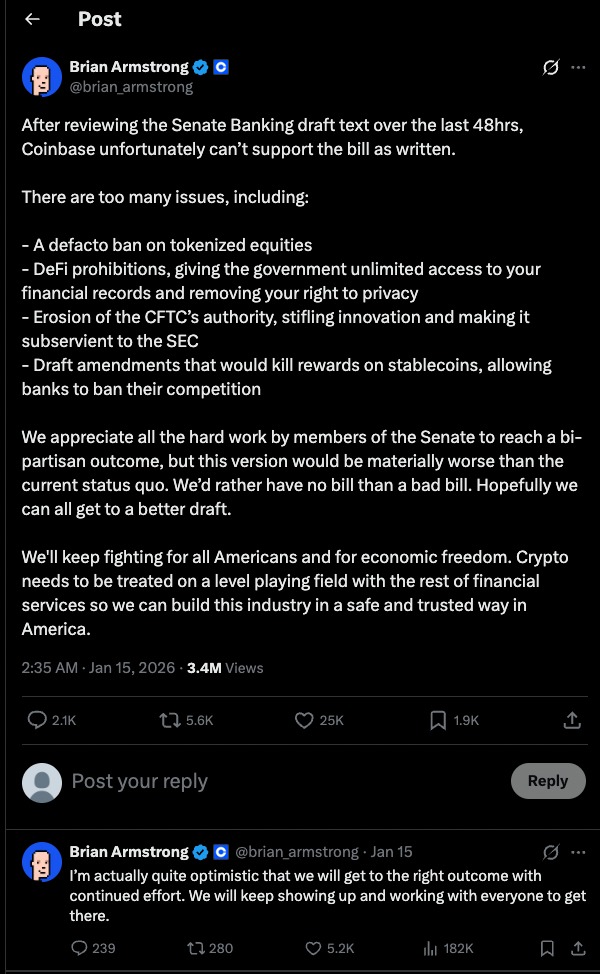
The statement reflects Coinbase’s position that the proposed legislation introduces risks beyond regulatory oversight. Armstrong’s emphasis on tokenized equities, DeFi restrictions, and stablecoin rewards suggests that the company views the draft not as neutral regulation but as a structural shift favoring traditional financial institutions. While the tone is critical, it also leaves room for continued negotiation, reinforcing Coinbase’s broader message that the issue is not regulation itself but the direction of the current draft. The follow-up comment expressing optimism further underscores that the company still sees a path toward compromise rather than confrontation.
From Coinbase’s perspective, these provisions could limit innovation and reduce consumer benefits. Armstrong emphasized that supporting flawed legislation could do more harm than good. He stated that Coinbase would rather see no bill passed than support one that undermines the growth and competitiveness of the digital asset industry.
The White House Role in Coinbase Negotiations
Despite public speculation, Armstrong emphasized that the White House has not walked away from the legislative process. Instead, it continues to engage with Coinbase and other industry players to refine the bill. According to Armstrong, the administration has encouraged dialogue and revisions rather than issuing ultimatums.
This involvement reflects the White House’s broader goal of establishing a regulatory framework that balances innovation with investor protection and financial stability. While disagreements exist, Armstrong’s comments suggest that both sides are committed to finding workable solutions rather than abandoning negotiations entirely.
Senate Banking Committee Delays the CLARITY Act
In response to the controversy and feedback from industry participants, the Senate Banking Committee decided to delay the scheduled markup of the CLARITY Act. The delay was intended to provide more time for lawmakers to review concerns and work with stakeholders to improve the bill.
This postponement was viewed positively by many in the crypto industry, as it allows space for revisions that could address the most controversial elements. Armstrong expressed optimism that discussions would continue over the coming weeks and that a revised version of the bill could eventually move forward with broader support.
Industry Response to Coinbase Negotiations
The CLARITY Act has generated mixed reactions across the crypto industry. Some believe that even an imperfect bill is better than continued regulatory uncertainty. Others argue that certain provisions favor traditional financial institutions while placing unnecessary restrictions on crypto-native companies.
One major point of contention is the proposed ban on sharing stablecoin yield with customers. Critics argue that this measure protects banks rather than consumers. DeFi advocates have also raised concerns that vague or restrictive language could hinder innovation in decentralized financial services, which have become a core part of the crypto economy.
Coinbase’s decision to publicly oppose the bill in its current form has positioned the company as a leading voice in the regulatory debate. Supporters praise the company for standing firm, while critics argue that no single company should have outsized influence over legislation affecting the entire industry.
What Comes Next for Coinbase Negotiations
As Coinbase Negotiations continue, attention remains focused on whether lawmakers and industry leaders can find common ground. Key issues such as stablecoin regulation, DeFi oversight, and tokenized assets are expected to remain central topics in future discussions.
Armstrong’s insistence that talks are ongoing suggests that compromise is still possible. If successful, the outcome could be a regulatory framework that provides clarity while preserving innovation. Such an outcome would benefit not only Coinbase but also the broader crypto ecosystem operating in the US market.
Editor’s View: Why These Negotiations Became Public
What stands out in this situation is not the disagreement itself, but the decision to let it surface publicly. Regulatory negotiations are usually quiet, technical, and deliberately slow. When they spill into public view, it often reflects internal pressure on both sides rather than a breakdown in communication. Coinbase’s response suggests an attempt to shape the narrative early, while lawmakers appear cautious about being seen as favoring one set of interests over another. The visibility of the debate hints at how politically sensitive crypto regulation has become, even before final rules are written.
Conclusion: Coinbase Negotiations Remain Active
In conclusion, Coinbase Negotiations with the White House are still underway, despite reports suggesting a breakdown in relations. Brian Armstrong has denied claims of a clash, emphasizing that discussions remain constructive and focused on improving the CLARITY Act. With lawmakers delaying the bill’s markup to allow for further dialogue, there is still an opportunity to develop balanced crypto legislation.
The ongoing negotiations underscore the difficulty of crafting effective digital asset regulation. However, they also highlight the importance of continued engagement between policymakers and industry leaders as the US works toward defining the future of cryptocurrency regulation.
Disclaimer: This content is for informational purposes only and does not constitute financial advice.
Keep yourself updated with the latest crypto news with FYI Gazette
Read more about Memecoins with FYI Gazette
Keep yourself updated with the latest Altcoin News with FYI Gazette
 Bitcoin
  Ethereum
  Tether
  BNB
BNB  XRP
XRP  Solana
  TRON
TRON  Dogecoin
  Litecoin
  Pepe
Pepe