
Bitcoin price drop rattles markets as gold futures rise
Bitcoin price drop set the tone for global markets as investors reacted to rising geopolitical tension and growing fears of a trade conflict between Europe and the United States. The cryptocurrency market moved sharply lower while traditional safe haven assets, especially gold, surged as traders shifted into lower risk positions. The contrasting moves highlighted how digital assets continue to respond to broader macroeconomic stress.
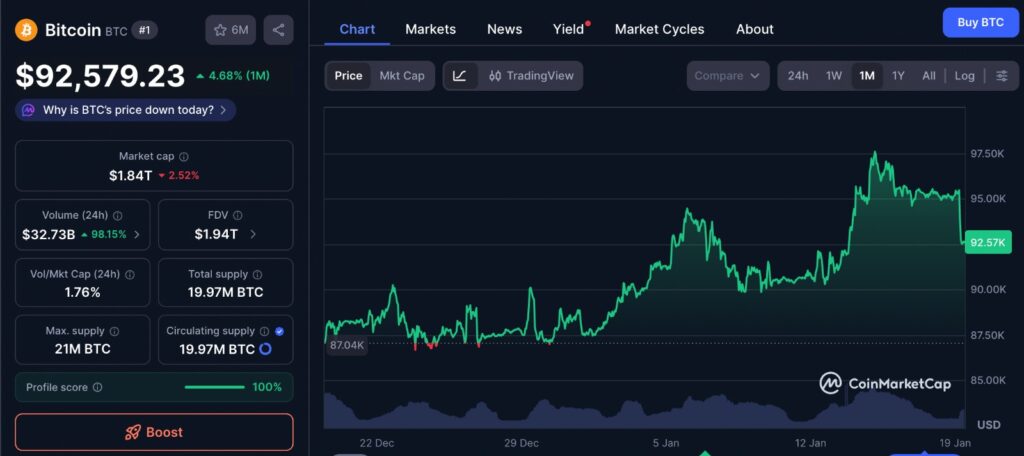
Viewed over the past month, the price action shows how quickly sentiment can shift even without a single dominant catalyst. Periods of steady consolidation were interrupted by sharp moves, suggesting traders were reacting to headlines and positioning rather than following a clear trend. The absence of sustained follow-through in either direction points to hesitation, with participants frequently stepping back instead of committing capital. This kind of structure often reflects uncertainty, where short-term reactions outweigh longer-term conviction.
Bitcoin price drop hits crypto markets
Bitcoin price drop accelerated at the start of the week as selling pressure intensified across major exchanges. The leading cryptocurrency fell by several thousand dollars in a short period, marking one of its sharpest intraday declines in recent weeks. The move wiped out a large amount of leveraged positions, triggering forced liquidations that added to the downward momentum.
The selloff was not isolated to Bitcoin. Other major cryptocurrencies followed the same direction as traders reduced exposure to volatile assets. Market participants described the move as a classic risk off reaction, with investors prioritizing capital preservation over growth.
Bitcoin price drop and rising liquidation pressure
One of the key drivers behind the Bitcoin price drop was the rapid increase in liquidations. As prices fell, long positions were automatically closed by exchanges, pushing prices lower and creating a feedback loop. This type of market behavior often appears during periods of sudden uncertainty.
High leverage in crypto markets can amplify both gains and losses. When sentiment shifts quickly, price movements become more extreme. Analysts noted that the scale and speed of liquidations suggested many traders were caught off guard by the sudden change in macro conditions.
Trade tensions trigger market anxiety
The broader trigger behind the Bitcoin price drop was renewed tension between Europe and the United States. The US announced plans to impose new tariffs on imports from several European countries, with further increases threatened if negotiations fail. These measures raised fears of a wider trade confrontation that could affect global economic growth.
European leaders responded by signaling they could use strong countermeasures to protect their economic interests. This rhetoric increased uncertainty across financial markets and pushed investors toward defensive strategies.
Historically, trade disputes tend to pressure risk assets such as equities and cryptocurrencies. In contrast, assets perceived as stores of value often benefit during such periods.
Gold futures rise as Bitcoin price drop continues
While the Bitcoin price drop weighed on digital assets, gold futures moved sharply higher. Investors seeking safety pushed gold prices to record levels, reinforcing its role as a traditional hedge during times of geopolitical stress. Silver futures also reached historic highs, confirming strong demand for precious metals.
The divergence between Bitcoin and gold highlighted how investor perceptions differ between newer digital assets and long established safe havens. Although Bitcoin is often described as digital gold, its short term behavior continues to resemble that of a high risk asset during periods of uncertainty.
Investor behavior during risk off markets
During risk off environments, investors tend to reduce exposure to assets with higher volatility. The Bitcoin price drop reflected this behavior as capital rotated into assets viewed as more stable. Gold benefited from its long history as a store of value, while Bitcoin faced selling pressure due to its price swings.
Market participants also pointed out that uncertainty itself can be enough to trigger defensive positioning. Even without immediate economic damage, the threat of escalating trade measures was enough to alter investor sentiment.
Broader market impact of the Bitcoin price drop
The effects of the Bitcoin price drop extended beyond the crypto market. Traditional financial markets showed signs of stress as equities weakened and volatility increased. Some institutional investors signaled caution, indicating they may continue to limit exposure to speculative assets if tensions remain unresolved.
Crypto markets remain closely connected to global liquidity conditions and investor confidence. When confidence weakens, assets with higher perceived risk often face the strongest selling pressure.
Short term outlook for Bitcoin
In the short term, analysts expect Bitcoin to remain sensitive to developments related to trade policy and global economic stability. Any signs of de escalation could help restore confidence and support a recovery. However, continued uncertainty may keep pressure on prices.
Despite the Bitcoin price drop, long term supporters argue that broader adoption and limited supply still support its underlying value. However, short term price movements are likely to remain driven by macroeconomic headlines rather than internal crypto fundamentals.
Editor’s View: How traders actually react under stress
When markets react to geopolitical headlines, price action often reflects uncertainty more than conviction. Many traders do not immediately reassess long-term value; instead, they focus on reducing exposure until conditions feel clearer. In crypto, where leverage is common and liquidity can thin quickly, this instinct tends to amplify short-term moves. The result is that price declines frequently say more about positioning and risk tolerance than about a sudden shift in underlying belief.
Conclusion
The recent Bitcoin price drop demonstrates how quickly global events can influence cryptocurrency markets. Rising trade tensions between Europe and the United States triggered a shift toward safer assets, lifting gold futures while pushing Bitcoin and other digital assets lower.
As long as geopolitical uncertainty persists, investors may continue to favor traditional safe havens over higher risk alternatives. Whether Bitcoin can regain momentum will depend on improvements in market confidence and clarity around global trade relations. For now, the contrast between gold’s strength and Bitcoin’s weakness highlights the evolving role of digital assets in times of economic stress.
Disclaimer: This content is for informational purposes only and does not constitute financial advice.
Keep yourself updated with the latest crypto news with FYI Gazette
Read more about Memecoins with FYI Gazette
Keep yourself updated with the latest Altcoin News with FYI Gazette
 Bitcoin
  Ethereum
  Tether
  BNB
BNB  XRP
XRP  Solana
  TRON
TRON  Dogecoin
  Litecoin
  Pepe
Pepe