Dash Pullback Signals More Than a Simple Dip
Dash Pullback has become a key topic among traders as recent price behavior suggests the move may be more than a routine correction. After a strong rally that pushed prices sharply higher, DASH failed to sustain its momentum and began to retreat. While pullbacks are common in crypto markets, several warning signs indicate this Dash pullback could reflect deeper structural weakness rather than a healthy pause.
The rapid rise in DASH attracted short-term interest, but the equally fast reversal has raised concerns. Instead of consolidating at higher levels, the price slipped back toward previous ranges. This behavior often signals fading demand and growing uncertainty among market participants, especially when supported by technical and on-chain data.
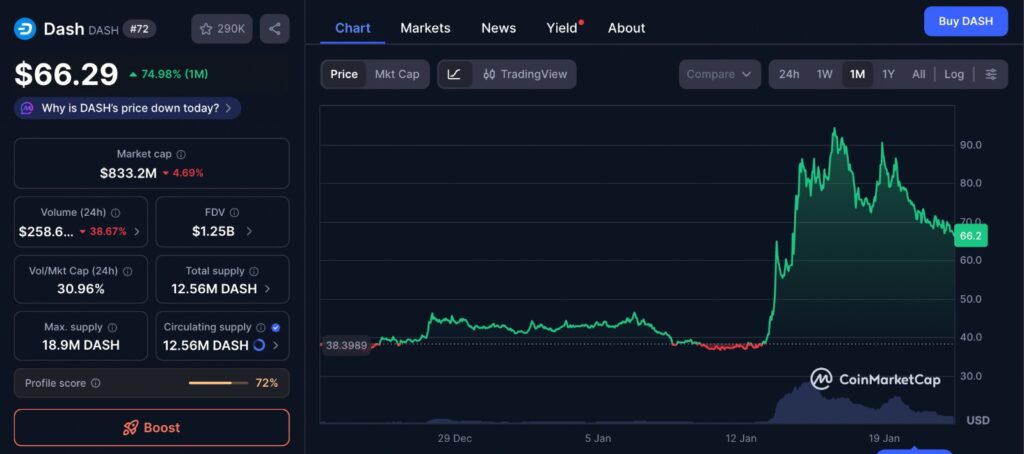
Viewed over the past month, the price action highlights how quickly sentiment shifted after the rally peaked. The steep rise was followed by a retreat that unfolded with less urgency from buyers, suggesting that interest thinned as price moved lower. Rather than forming a clear base, the chart shows uneven follow-through, reflecting hesitation rather than panic. This kind of structure often appears when traders are reassessing value after a fast move, not rushing to reenter immediately.
Understanding the Dash Pullback in Price Action
Dash Pullback and weakening momentum
Following its sharp rally, DASH struggled to hold its gains. Although the asset remained above key long-term moving averages, short-term momentum indicators began to cool. The Relative Strength Index moved down from overbought levels toward neutral territory, suggesting that buying pressure was easing.
At the same time, momentum indicators showed declining strength. This combination often appears when bullish control weakens and buyers become hesitant. Rather than stepping in aggressively to buy the dip, traders appeared cautious, allowing the price to slide further.
This loss of momentum is one of the first signs that the Dash pullback may not be a simple retracement within a strong uptrend.
Failed continuation after a strong rally
In strong bullish markets, assets that rally hard often enter a consolidation phase before continuing higher. DASH, however, struggled to establish such a base. The failure to stabilize at higher price levels suggests that the rally may have been driven more by speculative activity than long-term conviction.
When price rises quickly without sufficient support, it becomes vulnerable to sharp pullbacks. The current Dash pullback reflects this vulnerability, as buyers were unable or unwilling to defend recent highs.
Derivatives Data and Trader Sentiment
Dash Pullback and declining participation
Another important signal comes from the derivatives market. Open interest, which measures the total number of active futures contracts, stopped growing during the pullback. Instead of new positions entering the market, traders closed existing ones.
This behavior shows declining engagement. In healthy dips, open interest often rises as traders position for a rebound. Here, the opposite occurred, pointing to uncertainty and reduced confidence in a near-term recovery.
Negative funding rates add pressure
Funding rates also turned negative during the Dash pullback. Negative funding means short sellers are paying to keep their positions open, reflecting bearish sentiment. This shift indicates that many traders expect further downside rather than a quick bounce.
Together, flat open interest and negative funding rates suggest that market participants are stepping back rather than buying the dip aggressively. This supports the idea that the pullback is driven by more than short-term noise.
Long-Term Holder Activity Raises Red Flags
Dash Pullback and dormant coins
One of the most notable signals during this period was a spike in activity from long-dormant DASH coins. This was measured through a metric that tracks when older coins move on-chain after long periods of inactivity.
Historically, such movements often occur near important market turning points. When long-term holders who have not sold for years begin to move their assets, it can indicate profit-taking or a shift in long-term outlook.
Why long-term selling matters
Long-term holders typically sell later in market cycles, not during early or mid-stage rallies. Their participation during this Dash pullback suggests that some experienced investors may believe the recent highs represent an area of reduced upside potential.
Although this activity later cooled, the initial spike remains important. It shows that selling pressure is not limited to short-term traders, adding weight to concerns about the sustainability of the recent rally.
Why This Dash Pullback Feels Different
Lack of dip-buying behavior
One defining feature of strong markets is aggressive dip-buying. During this Dash pullback, that behavior was noticeably absent. Trading activity declined, derivatives participation weakened, and buyers failed to step in with conviction.
This contrasts with routine pullbacks where price dips attract renewed interest and volume quickly rebounds. Instead, DASH experienced fading attention, suggesting that enthusiasm surrounding the asset has cooled.
Short-lived hype versus sustainable demand
The speed of DASH’s rise and fall suggests that the rally may have been fueled by short-term speculation rather than steady accumulation. Assets driven primarily by hype often struggle to maintain gains once momentum fades.
Without strong follow-through from long-term buyers, price becomes vulnerable to deeper corrections. This dynamic appears to be playing out in the current Dash pullback.
Broader Market Context
Dash Pullback within the wider crypto environment
Altcoins are especially sensitive to changes in market sentiment. When risk appetite weakens or traders rotate capital elsewhere, assets like DASH often experience sharper pullbacks.
The Dash pullback may also reflect broader caution across the crypto market. Even when long-term trends remain positive, short-term uncertainty can cause traders to reduce exposure to assets that recently posted strong gains.
Capital rotation and risk management
Traders frequently shift capital toward perceived safer opportunities during volatile periods. This does not necessarily mean DASH lacks long-term potential, but it does explain why participation may decline during periods of uncertainty.
The current pullback appears to be influenced by this broader risk management behavior, adding another layer of pressure to price action.
Editor’s View: Why hesitation matters more than price
What stands out in this Dash pullback is not the decline itself, but the hesitation surrounding it. When markets truly believe a move is temporary, buyers usually act quickly and visibly. Here, the response feels quieter, as if participants are waiting for confirmation rather than conviction. That pause often reflects uncertainty about whether the recent rally changed anything fundamentally, or merely exhausted short-term interest.
What to Watch Going Forward
Key indicators to monitor
To understand whether the Dash pullback deepens or stabilizes, traders should watch derivatives data closely. A return of positive funding rates and rising open interest would signal renewed confidence.
On-chain activity also remains important. If long-term holders stop moving dormant coins and selling pressure eases, it could reduce downside risk.
Final thoughts on Dash Pullback
The current Dash pullback shows several signs that differentiate it from a normal dip. Weakening momentum, declining trader participation, negative funding rates, and activity from long-term holders all suggest caution.
While pullbacks are a natural part of market cycles, this one appears to reflect a broader reassessment of value rather than a temporary pause. Traders should remain alert and avoid assuming that every dip automatically offers a low-risk buying opportunity.
Understanding these signals can help market participants make more informed decisions as conditions continue to evolve.
Disclaimer: This content is for informational purposes only and does not constitute financial advice.
Keep yourself updated with the latest crypto news with FYI Gazette
Read more about Memecoins with FYI Gazette
Keep yourself updated with the latest Altcoin News with FYI Gazette
 Bitcoin
  Ethereum
  Tether
  BNB
BNB  XRP
XRP  Solana
  TRON
TRON  Dogecoin
  Litecoin
  Pepe
Pepe