
Ethereum Whales Accumulate as ETH Drops 16 Percent
Ethereum Whales Accumulate interest has surged as Ethereum’s price declined sharply, triggering renewed debate about whether the recent drop signals weakness or a strategic buying opportunity. Ethereum fell nearly 16 percent from its recent highs, slipping below important psychological levels and shaking short-term trader confidence. However, on-chain data paints a different picture beneath the surface, where large holders appear to be quietly building positions rather than exiting the market.
This divergence between price action and whale behavior suggests the current phase may be less about panic selling and more about redistribution. While retail traders react to volatility, long-term investors seem focused on value zones, network strength, and future breakout potential.
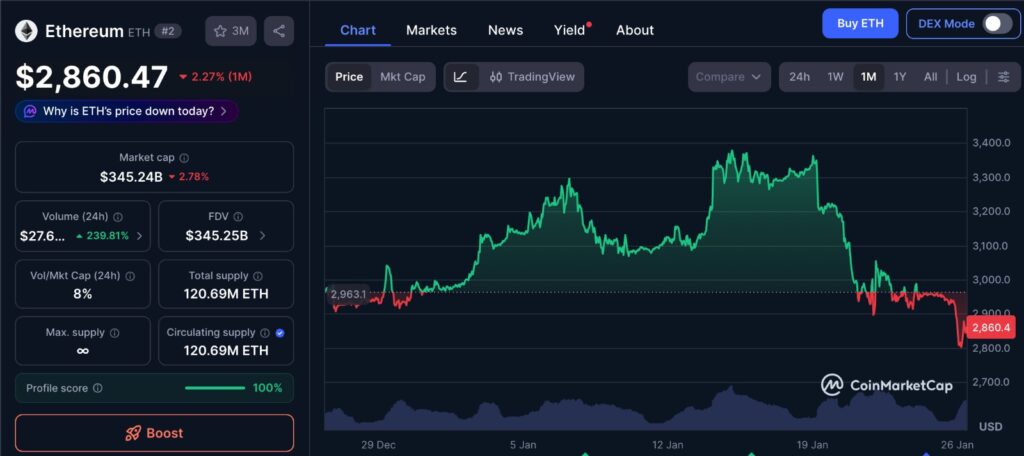
The one-month price chart highlights how Ethereum’s recent move has been defined more by compression than by direction. Price swings remain contained within a relatively narrow range, suggesting that volatility is being absorbed rather than expanded. This kind of behavior often reflects a market in transition, where buyers and sellers are still negotiating fair value rather than reacting impulsively. The absence of sharp follow-through in either direction reinforces the idea that the current phase is more about positioning than momentum.
Why Ethereum Whales Accumulate During Market Pullbacks
Ethereum whales accumulate tokens most aggressively during periods of uncertainty. As prices retraced, wallets holding large amounts of ETH steadily increased their balances. This behavior indicates confidence in Ethereum’s long-term fundamentals despite short-term technical weakness.
Whales typically operate with longer time horizons and deeper capital reserves. Instead of chasing rallies, they prefer accumulating during corrections when market sentiment turns cautious. This strategy allows them to lower their average entry price while positioning ahead of future price expansions.
Whale Behavior Versus Retail Sentiment
Retail traders often respond emotionally to price drops, leading to increased selling pressure near support levels. In contrast, whales tend to absorb this supply. This creates a transfer of ETH from weaker hands to stronger holders, which historically reduces selling pressure over time.
The recent decline followed this familiar pattern. As retail traders exited positions, whales stepped in, suggesting the dip was viewed as an opportunity rather than a threat.
Technical Structure Behind Ethereum Whales Accumulate Trend
From a technical perspective, Ethereum’s price action has formed a consolidation structure on higher timeframes. The asset remains within a broader range, where lower highs and higher lows suggest compression rather than collapse.
Ethereum whales accumulate within these structures because they often precede significant directional moves. Consolidation phases allow markets to reset, shake out speculative positions, and build the foundation for stronger trends.
Momentum Signals Remain Mixed
Despite accumulation, momentum indicators remain cautious. Some signals show slowing bullish momentum, indicating that a breakout is not guaranteed in the immediate term. This highlights an important point: whale accumulation does not always result in instant price appreciation.
Instead, it often marks the early stages of accumulation cycles that require time, confirmation, and external catalysts before translating into upward movement.
Network Strength Supports Ethereum Whales Accumulate Narrative
One of the strongest arguments supporting accumulation is Ethereum’s underlying network health. The total value locked across Ethereum-based decentralized applications remains elevated, reflecting sustained demand for the network’s infrastructure.
High network usage suggests that Ethereum’s ecosystem continues to generate real economic activity. When price declines while network fundamentals remain stable, long-term investors often view the disconnect as a value opportunity.
Fundamentals Versus Price Action
Markets frequently overshoot in both directions. Short-term price movements can disconnect from underlying fundamentals, creating inefficiencies. Ethereum whales accumulate during these periods, betting that price will eventually realign with network value.
This behavior reinforces the idea that accumulation is driven not by speculation alone, but by confidence in Ethereum’s role within decentralized finance, smart contracts, and broader blockchain adoption.
Market Context and Risk Appetite
The broader crypto market has experienced increased volatility, influenced by macroeconomic uncertainty and shifting investor sentiment. In such environments, capital tends to rotate toward assets perceived as fundamentally strong.
Ethereum often benefits from this rotation. Large investors reallocating capital seek assets with deep liquidity, established ecosystems, and long-term relevance. This explains why Ethereum whales accumulate even as overall market sentiment remains cautious.
Accumulation Does Not Mean Immediate Breakout
It is important to note that accumulation phases can last longer than expected. Price may continue to consolidate or even dip further while whales build positions. This can test patience but often strengthens the eventual breakout when momentum returns.
Conditions Required for a Breakout
For Ethereum to transition from accumulation to a sustained uptrend, several conditions must align.
First, key support levels must hold. Continued buying near current ranges would confirm that demand outweighs selling pressure.
Second, momentum indicators need to shift. A clear change in trend strength would signal that accumulation is translating into broader market participation.
Third, network activity should remain stable or grow. Increased usage across decentralized applications would reinforce confidence and attract additional capital.
When these factors converge, the accumulation phase can evolve into a breakout phase, validating the strategy employed by large holders.
Editors View: Why Accumulation Looks Quiet on Purpose
One detail that charts often miss is how deliberately quiet accumulation phases tend to be. Large holders rarely act when sentiment is euphoric or narratives are loud, because liquidity is expensive and positioning becomes visible too quickly. Instead, accumulation often happens during uncomfortable stretches when price action feels directionless and attention fades. This does not imply confidence in an immediate upside, but rather patience and an acceptance that time, not momentum, is doing most of the work during these phases.
Final Thoughts on Ethereum Whales Accumulate Trend
Ethereum whales accumulate behavior during the recent 16 percent drop highlights a critical distinction between short-term price noise and long-term conviction. While volatility has unsettled traders, large holders appear unfazed, continuing to build exposure at lower prices.
This accumulation does not guarantee immediate gains, but it establishes a foundation for potential upside if market conditions improve. By tracking whale behavior alongside technical structure and network fundamentals, investors gain a clearer perspective on Ethereum’s position within the broader market cycle.
As history has shown, periods of quiet accumulation often precede the most significant moves. Whether Ethereum’s next breakout happens soon or after further consolidation, the actions of large holders suggest that confidence in the asset remains firmly intact.
Disclaimer: This content is for informational purposes only and does not constitute financial advice.
Keep yourself updated with the latest crypto news with FYI Gazette
Read more about Memecoins with FYI Gazette
Keep yourself updated with the latest Altcoin News with FYI Gazette
 Bitcoin
  Ethereum
  Tether
  BNB
BNB  XRP
XRP  Solana
  TRON
TRON  Dogecoin
  Litecoin
  Pepe
Pepe