
ADA Futures Impact on Cardano Price Drop
ADA Futures Impact became the center of attention when the Chicago Mercantile Exchange launched regulated futures contracts for Cardano’s ADA token. Many traders expected the news to push prices higher. Instead, ADA fell by around 3 percent shortly after the launch. This unexpected reaction raised important questions about how futures markets affect crypto prices and whether institutional products always lead to bullish momentum.
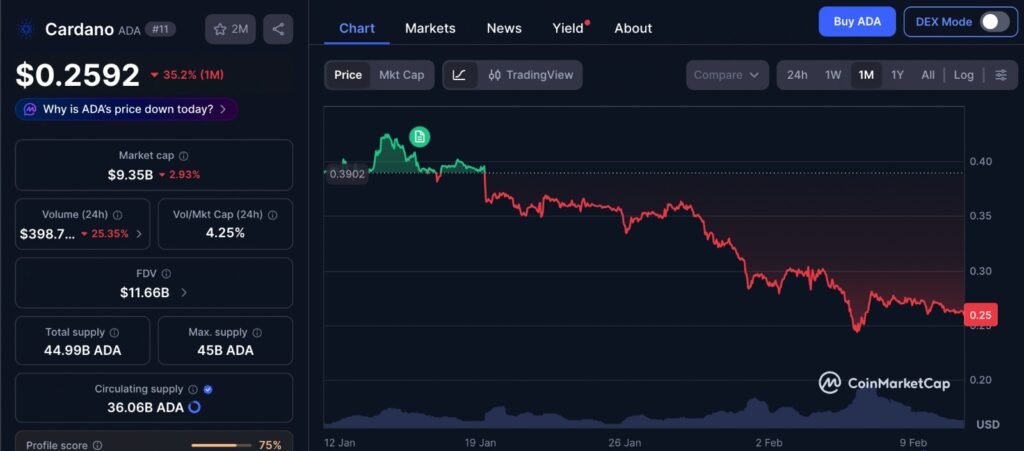
The one month price chart from CoinMarketCap adds further context to the ADA Futures Impact. Over the past several weeks, ADA has remained within a broader consolidation range rather than establishing a strong upward trend. The reaction to the CME futures launch appears as part of this wider pattern of cautious trading activity, rather than a sharp structural breakdown. This reinforces the view that the recent move reflects prevailing market conditions and sentiment, not a dramatic shift in Cardano’s long term positioning.
ADA Futures Impact and the CME Launch
The launch of ADA futures on CME was seen as a major milestone. Regulated futures contracts often signal growing institutional interest in an asset. In both traditional and crypto markets, new derivatives products can increase visibility and attract fresh capital. Because of this, many investors believed ADA would rally once the contracts went live.
However, the market reacted differently. At the time of the launch, ADA was trading near 0.27 dollars. Instead of climbing, the price slipped to around 0.26 dollars. The drop of roughly 3 percent surprised traders who were positioned for a breakout. This shows that positive headlines alone are not enough to move prices higher, especially when overall market conditions are weak.
How ADA Futures Impact Affected Derivatives Trading
One of the clearest effects of the ADA Futures Impact was the surge in derivatives trading activity. On platforms such as BitMEX, ADA futures trading volume jumped dramatically, increasing by more than 48,000 percent. This sharp rise reflected intense short term speculation. Traders rushed to open leveraged positions, hoping to profit from volatility around the CME launch.
Leverage Versus Real Demand
A spike in derivatives volume does not always mean real buying demand in the spot market. In ADA’s case, leverage increased faster than genuine accumulation. When traders use high leverage, price swings can become more aggressive. If there is not enough strong buying pressure underneath, prices can quickly move downward instead of upward.
This imbalance between leverage and spot demand played a key role in the price reaction. Instead of fueling a rally, the new futures contracts gave traders another way to take short positions or reduce risk.
Open Interest and ADA Futures Impact
Open Interest data provided more clarity about market behavior. Open Interest measures the total value of outstanding futures contracts. Around the time of the launch, Open Interest fell from about 490 million dollars to roughly 425 million dollars.
A decrease in Open Interest during a price drop often suggests that traders are closing positions rather than building new long bets. This indicated that bulls were not stepping in with strong conviction. At the same time, the spot price continued to struggle.
The combination of falling price and declining Open Interest suggested that bearish pressure was dominating. In many bullish scenarios, futures launches are accompanied by rising Open Interest and stronger spot demand. That pattern did not appear in this case.
Whale Accumulation Despite ADA Futures Impact
While short term traders seemed cautious or bearish, large holders known as whales showed a different behavior. On chain data revealed that whales had been accumulating ADA from late 2025 into early 2026. Even as prices declined, these large investors continued adding to their holdings.
This suggests a longer term outlook that differs from short term speculative trading. Whale accumulation often signals confidence in future recovery. Large investors typically buy during weakness when they believe prices are undervalued. Their actions do not guarantee an immediate rebound, but they can indicate that downside risk may be limited over time.
The contrast between whale buying and retail hesitation highlights the layered nature of the ADA Futures Impact. While derivatives traders focused on short term moves, long term holders appeared to be positioning for potential recovery.
Technical Signals After the ADA Futures Impact
From a technical analysis perspective, ADA was trading within a support range between 0.22 and 0.27 dollars. Despite the drop following the futures launch, the price did not collapse below this zone.
The Relative Strength Index was near oversold levels around 32, which sometimes suggests that selling pressure is becoming exhausted. Meanwhile, the Moving Average Convergence Divergence indicator was approaching a potential bullish crossover, hinting that momentum might be stabilizing.
These signals painted a mixed picture. On one hand, the ADA Futures Impact created short term volatility and price weakness. On the other hand, technical indicators and whale activity suggested that the asset was not completely breaking down.
Editor’s View: ADA Futures Impact and Market Psychology
There is also a behavioral element behind the ADA Futures Impact that price charts alone cannot capture. When a major exchange launches futures, many traders position themselves ahead of the event, expecting a rally. If that rally does not materialize immediately, disappointment can quickly turn into short term selling pressure. In weaker market conditions, participants often prioritize capital preservation over optimism, which can explain why positive structural developments sometimes coincide with price declines rather than gains.
What ADA Futures Impact Means for Investors
The broader crypto market was also experiencing weakness at the time. When sentiment is already fragile, even positive developments can fail to trigger rallies. In such conditions, traders may use major events as opportunities to take profits or reduce risk instead of adding exposure.
The key lesson from the ADA Futures Impact is that derivatives products alone do not guarantee upward price movement. Futures contracts allow traders to bet both on rising and falling prices. This means they can increase liquidity, but they can also increase short selling and volatility.
In this case, the launch of CME ADA futures provided new tools for traders, but it did not change the underlying market structure. Weak spot buying, declining Open Interest, and heavy leverage combined to push prices lower in the short term. Meanwhile, whales quietly accumulated in the background.
Ultimately, ADA’s future direction will depend more on sustained spot demand and broader market recovery than on derivatives listings alone. Institutional access is important, but it must be supported by real buying interest. The ADA Futures Impact demonstrates that market reactions are complex and that expectations do not always match reality.
Disclaimer: This content is for informational purposes only and does not constitute financial advice.
Keep yourself updated with the latest crypto news with FYI Gazette
Read more about Memecoins with FYI Gazette
Keep yourself updated with the latest Altcoin News with FYI Gazette
 Bitcoin
  Ethereum
  Tether
  BNB
BNB  XRP
XRP  Solana
  TRON
TRON  Dogecoin
  Litecoin
  Pepe
Pepe