ETH Institutional Demand Signals Market Shift
ETH Institutional Demand is becoming a central narrative for Ethereum as traders attempt to understand what could drive a sustained recovery in price. Ether ETH 1969 has struggled to reclaim the 2500 level since Jan. 31, creating uncertainty about whether bullish momentum has weakened or is simply delayed. While short term price action appears indecisive, several structural developments indicate that institutional behavior may be gradually shifting in Ethereum’s favor.
Since the recent bear cycle bottomed at 1744 on Feb. 6, Ether’s recovery has been modest, leaving many market participants cautious. Traders often look for strong confirmation signals before adjusting exposure, and the absence of rapid upside has contributed to hesitation. However, beneath the surface of daily volatility, multiple indicators suggest that ETH Institutional Demand may be strengthening, potentially laying the groundwork for future price expansion.
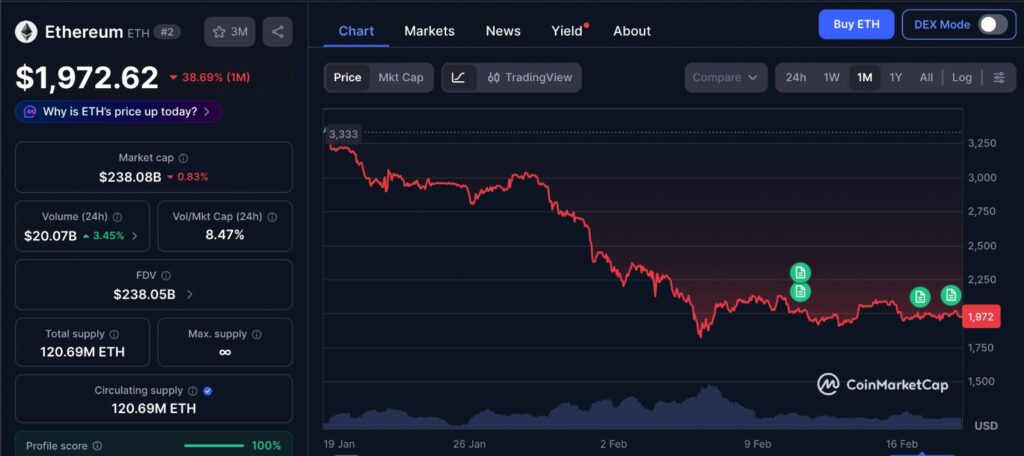
The one month price structure provides useful context for understanding recent sentiment, particularly when viewed alongside institutional developments rather than in isolation. Short term fluctuations often reflect positioning adjustments, liquidity dynamics, and reactionary trading behavior more than fundamental shifts. Periods of compression or uneven recovery are common during transitional phases, where markets reassess risk without establishing a clear directional bias. In this environment, price movement can appear inconclusive, even as underlying adoption narratives continue to evolve beneath the surface.
ETF Flows and the Perception of Institutional Confidence
One of the most widely discussed concerns involves spot Ether exchange traded fund flows. February recorded 327 million dollars in net outflows from US listed Ether ETFs, a figure that may initially appear negative. Outflows during periods of price weakness are frequently interpreted as declining institutional confidence, particularly when ETH remains well below historical highs.
Yet context significantly alters this interpretation. The total February outflows represent less than 3 percent of the combined assets under management for Ether ETFs. Institutional portfolios are routinely rebalanced to manage risk, liquidity requirements, and allocation strategies. As a result, moderate outflows do not necessarily indicate reduced belief in Ethereum’s long term prospects.
Overemphasis on daily ETF movements can therefore be misleading. While short term traders often treat flows as immediate directional signals, institutional investors typically operate with broader time horizons. Strategic positioning decisions are influenced by regulatory developments, infrastructure maturity, and technological considerations rather than short lived fund activity.
BlackRock’s Expanding Influence on ETH Institutional Demand
BlackRock’s growing presence in Ethereum based investment products represents one of the most important drivers of ETH Institutional Demand. Regulatory filings revealed that the Harvard endowment fund added an 87 million dollar position in BlackRock’s iShares Ethereum Trust during the final quarter of 2025. This allocation is particularly notable given simultaneous adjustments to Bitcoin related holdings.
During the same period, Harvard reduced its exposure to the iShares Bitcoin Trust, cutting holdings to 266 million dollars from 443 million dollars recorded earlier. Such a rotation suggests a deliberate reallocation of capital rather than generalized risk reduction. For market observers, this shift signals evolving institutional preferences within digital asset portfolios.
BlackRock’s amendments to its Staked Ethereum ETF proposal further reinforce this narrative. The revised structure incorporates retention of 18 percent of staking rewards as service related fees. Although some market participants criticized the fee design, the structure reflects operational realities associated with validator services and staking infrastructure.
Importantly, the ETF maintains a competitive 0.25 percent expense ratio. For institutions, regulated exposure combined with staking yield opportunities represents a meaningful advancement. ETF based staking access simplifies participation, enabling investors to capture Ethereum related returns through familiar financial vehicles.
Real World Asset Growth Reinforces Ethereum’s Position
Beyond ETFs, the rapid expansion of real world asset tokenization provides compelling evidence of growing ETH Institutional Demand. The RWA sector has surpassed 20 billion dollars in total onchain value, with Ethereum emerging as the dominant platform supporting tokenized financial instruments.
Major institutions including BlackRock, JPMorgan Chase, Fidelity, and Franklin Templeton have chosen Ethereum as their preferred blockchain infrastructure. This concentration of issuers highlights a consistent priority among institutional participants. Security, reliability, and ecosystem maturity appear to outweigh concerns regarding transaction costs or competing network architectures.
Nearly half of Ethereum’s RWA deposits consist of tokenized gold, while allocations tied to US Treasurys, bonds, and money market products continue to expand. In comparison, competing blockchains collectively host a significantly smaller share of tokenized assets. This disparity suggests that institutional blockchain adoption is driven primarily by trust and stability.
For large capital allocators, minimizing operational risk typically overrides fee optimization. Ethereum’s established infrastructure and security model provide a level of assurance that institutions find difficult to replicate elsewhere. As tokenized asset markets expand, Ethereum’s dominance strengthens its role within digital finance.
Venture Capital Signals and Market Maturation
Shifts in venture capital investment patterns further support the ETH Institutional Demand thesis. Dragonfly Capital’s recent funding activities indicate rising interest in tokenized equities and private credit markets. Capital flows are increasingly directed toward infrastructure, custody solutions, and trading systems rather than consumer oriented decentralized applications.
This transition reflects broader market maturation. Institutional adoption requires robust financial infrastructure, regulatory alignment, and secure custody mechanisms. As investors prioritize these components, Ethereum’s strategic value within the ecosystem becomes more pronounced.
Although many tokenized asset systems currently operate within closed environments or specialized networks, future connectivity with Ethereum’s broader ecosystem remains likely. Over time, interoperability solutions may expand liquidity and utility, potentially amplifying demand for ETH.
Editor’s View: Market Behavior Behind ETH Institutional Demand
Institutional positioning rarely reacts to price alone, despite how markets are often framed. Large allocators tend to move when structural access, regulatory comfort, and portfolio fit improve, not when charts signal obvious momentum. In that context, reallocations toward Ethereum related products may reflect operational confidence rather than directional conviction. This distinction matters because it highlights a slower decision cycle, where infrastructure maturity can outweigh short term volatility. Price action may capture attention, but institutional behavior is frequently shaped by constraints invisible on charts.
Can ETH Institutional Demand Support a Price Recovery
While predicting precise price timelines remains difficult, the convergence of institutional reallocations, staking ETF innovation, and RWA dominance reshapes Ethereum’s outlook. Structural developments often influence markets gradually before triggering visible price reactions.
Should institutional sentiment continue to evolve, a recovery toward the 2500 level becomes increasingly plausible. Markets frequently discount positive fundamentals during bearish phases, only to reprice rapidly when confidence strengthens.
In this environment, Ethereum’s trajectory appears less dependent on speculative momentum and more influenced by institutional integration. As ETH Institutional Demand grows, Ethereum may be positioned for a more durable market cycle supported by structural adoption and expanding capital market participation.
Disclaimer: This content is for informational purposes only and does not constitute financial advice.
Keep yourself updated with the latest crypto news with FYI Gazette
Read more about Memecoins with FYI Gazette
Keep yourself updated with the latest Altcoin News with FYI Gazette
 Bitcoin
  Ethereum
  Tether
  BNB
BNB  XRP
XRP  Solana
  TRON
TRON  Dogecoin
  Litecoin
  Pepe
Pepe