
Crypto Hack Losses Hit 2025 Low in February
Crypto Hack Losses fell sharply in February, reaching their lowest monthly level since March 2025 as total stolen funds across hacks and scams came in at $26.5 million, according to blockchain security firm PeckShield. The decline signals a notable slowdown in exploit activity compared to January and reflects a cooling phase across the broader digital asset ecosystem.
PeckShield recorded 15 hacking incidents during February. However, most of the financial damage came from just two attacks. The largest exploit occurred on Feb. 21 and involved a $10 million theft from YieldBlox’s DAO managed lending pool. The breach was executed through a price manipulation strategy that targeted the protocol’s structure.
On the same day, the decentralized identity protocol IoTeX suffered the second largest incident of the month. Approximately $8.9 million was lost due to a private key exploit. Together, these two attacks accounted for the majority of February’s crypto hack losses, while the remaining 13 incidents were comparatively minor in scale.
Crypto Hack Losses Show a 69.2 Percent Monthly Drop
February’s $26.5 million total represents a 69.2 percent decrease compared to January, when more than $86 million was stolen through hacks and scams. The sharp month over month contraction highlights how quickly exploit activity can fluctuate within the crypto sector.
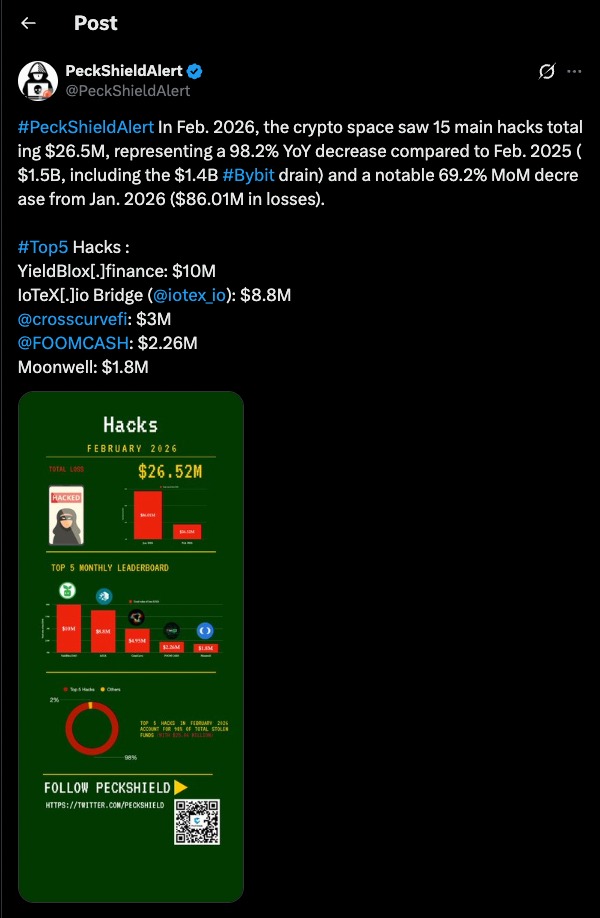
PeckShield’s breakdown highlights how concentrated February’s losses were, with just a handful of incidents accounting for most of the damage. The data also underscores how dramatically the landscape has shifted year over year, especially when compared to February 2025, which was heavily skewed by a single billion dollar breach. By presenting both the monthly and annual comparisons, the snapshot provides useful context that raw dollar figures alone do not immediately convey.
The comparison becomes even more striking when viewed against February 2025. That month recorded approximately $1.5 billion in losses, largely driven by the massive Bybit hack. The absence of similar mega hacks in February 2026 prevented the overall figures from being inflated by a single catastrophic event.
According to a PeckShield spokesperson, the lack of billion dollar scale breaches was one of the primary reasons February’s numbers remained relatively contained. Without an outsized exploit distorting the data, the month reflected a more normalized level of attack activity across the industry.
Market Volatility May Have Reduced Crypto Hack Losses
Market conditions also played a meaningful role in shaping February’s results. Early in the month, the crypto market experienced a sharp correction, with Bitcoin dipping below $70,000. During periods of heightened volatility, industry participants often shift their focus toward managing liquidity, adjusting leverage and responding to rapid price swings.
The PeckShield spokesperson explained that during high volatility environments, tactical focus frequently moves away from exploiting protocols and toward navigating market stress. Institutional deleveraging and systematic sell offs dominated market behavior, potentially reducing the immediate window of opportunity for large scale contract based attacks.
In unstable markets, risk management becomes the central priority. Liquidity pressures and portfolio adjustments can overshadow exploit planning, which may partially explain the slowdown in major hacks observed during February.
Security Improvements May Be Contributing
Beyond market dynamics, improvements in security standards may also be influencing the decline in crypto hack losses. Dominick John, an analyst at Kronos Research, suggested that tighter risk controls, stronger counterparty requirements and enhanced real time monitoring across major venues could be limiting vulnerabilities.
Capital is becoming more selective. Investors increasingly favor protocols that demonstrate mature security frameworks, consistent audit histories and active monitoring systems. Projects that lack strong safeguards may face greater scrutiny and reduced funding opportunities.
John indicated that losses could continue to decline if audits, institutional risk frameworks and monitoring systems continue to mature. As verification processes improve and oversight becomes more rigorous, the likelihood of large scale exploits may decrease, provided security standards keep pace with innovation.
Artificial Intelligence and Automated Defense
Artificial intelligence is emerging as a tool that could further strengthen crypto security. Automated code reviews, anomaly detection systems and pre deployment attack simulations can identify vulnerabilities earlier in a project’s lifecycle. AI driven scans allow development teams to detect weaknesses before they are exploited in live environments.
At the same time, the crypto ecosystem remains fast moving and competitive. While automated defenses enhance resilience, attackers continuously adapt their strategies. This creates an environment where security upgrades must remain ongoing rather than treated as one time improvements.
Phishing Remains a Persistent Threat
Despite the sharp decline in overall crypto hack losses, phishing continues to pose a serious risk. Losses tied to wallet drainer attacks dropped significantly in 2025, falling from $494 million to $83.85 million. However, phishing remains one of the most persistent and widespread threats facing crypto users.
Phishing attacks typically involve scammers impersonating trusted individuals or organizations in order to steal sensitive information. Instead of targeting smart contract vulnerabilities directly, many attackers now focus on manipulating users through deception.
The PeckShield spokesperson emphasized that hacking the human is increasingly more common than hacking the contract itself. This shift underscores the importance of individual security practices alongside protocol level protections.
Institutions and large holders are encouraged to adopt multi signature cold storage solutions and strictly safeguard wallets and private keys. Even as auditing standards improve, user level discipline remains critical to preventing losses.
Editor’s View: Why Quieter Months Matter More Than Big Hacks
When large scale breaches are absent, the numbers often look reassuring, but quieter months can reveal more about structural discipline than dramatic headlines ever do. In periods without a mega hack distorting the data, what stands out is whether routine controls are holding up under everyday pressure. February’s decline suggests not just fewer attacks, but a market environment where participants were more focused on risk containment than aggressive expansion. That behavioral shift, especially during volatility, often reduces opportunistic exploits in ways that raw statistics alone do not fully capture.
What the Decline in Crypto Hack Losses Signals
February’s low total appears to be the result of several overlapping factors. The absence of mega hacks significantly reduced overall damage. Market volatility redirected attention toward liquidity management and deleveraging. At the same time, stronger security frameworks and improved monitoring may be reinforcing defensive measures across the industry.
However, one month of lower losses does not eliminate long term risk. The crypto sector continues to innovate rapidly, and new technologies can introduce vulnerabilities as quickly as old ones are addressed.
For now, February 2026 stands as the lowest month for crypto hack losses since March 2025. Whether this cooling trend continues will depend on how effectively security standards, institutional oversight and technological safeguards evolve alongside ongoing innovation in the digital asset space.
Disclaimer: This content is for informational purposes only and does not constitute financial advice.
Keep yourself updated with the latest crypto news with FYI Gazette
Read more about Memecoins with FYI Gazette
Keep yourself updated with the latest Altcoin News with FYI Gazette
 Bitcoin
  Ethereum
  Tether
  BNB
BNB  XRP
XRP  Solana
  TRON
TRON  Dogecoin
  Litecoin
  Pepe
Pepe