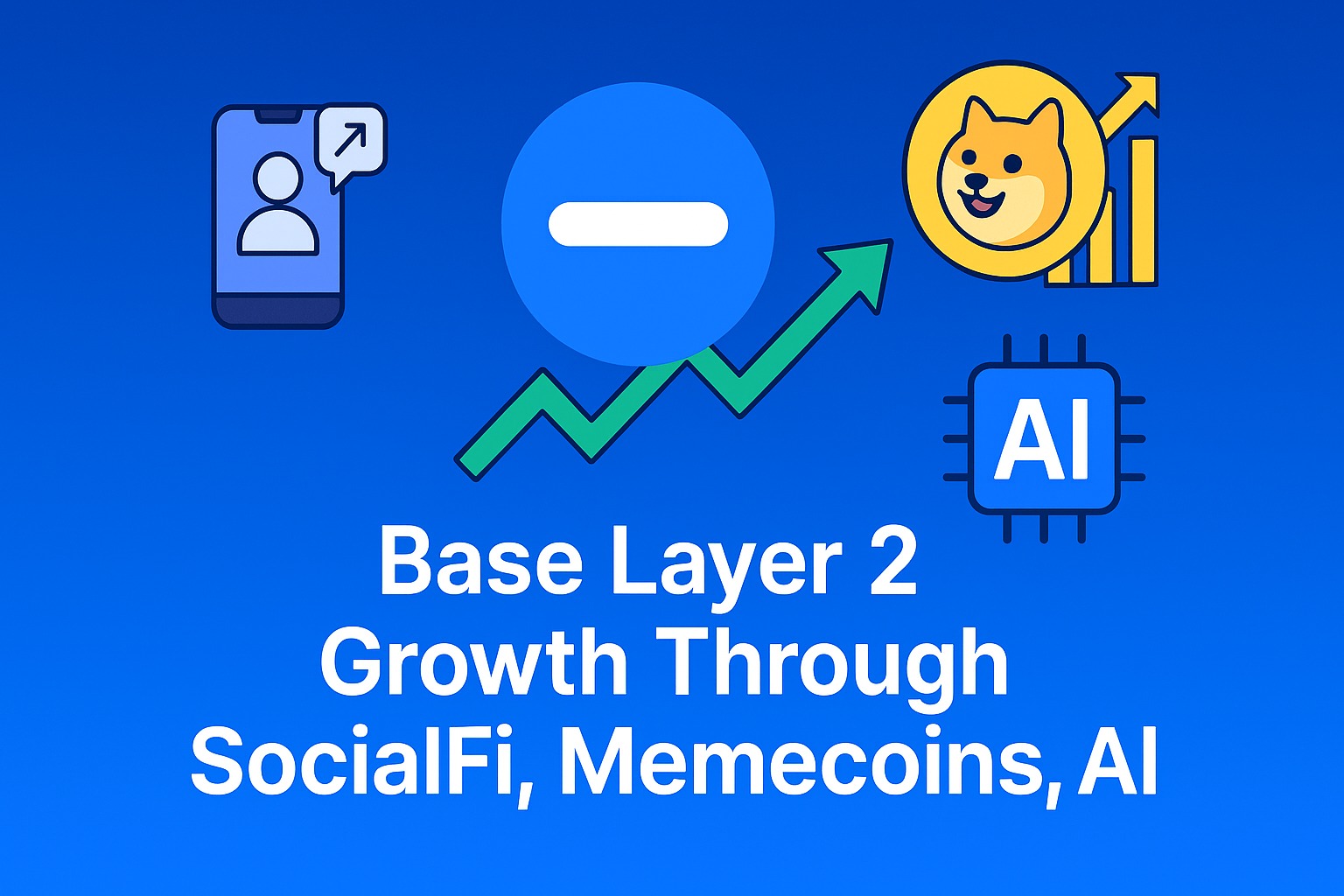
Base Layer 2 Growth Through SocialFi, Memecoins, AI
Base Layer 2 has entered its most important transition since launch, moving toward a unified software stack maintained internally. Originally introduced as a rollup built on Optimism’s OP Stack, the network is now consolidating its infrastructure into an in house distribution. This shift represents a structural change rather than a cosmetic upgrade. By controlling its own stack, Base can potentially accelerate upgrades, refine performance, and reduce external dependencies that may slow development cycles.
Three years after its testnet debut, Base’s growth story reflects the changing nature of crypto adoption. The network did not expand through a single breakthrough moment. Instead, it experienced several distinct waves of activity, each driven by different market narratives. SocialFi speculation, memecoin issuance, and AI agent experimentation all played roles at various stages. These cycles influenced user behavior, liquidity patterns, and transaction volumes, gradually shaping Base’s position within the Ethereum ecosystem.
Base’s launch was closely tied to Coinbase’s broader strategy. The network was framed as a gateway capable of introducing mainstream users to onchain applications. Unlike many layer 2 projects that relied purely on developer communities, Base benefited from the distribution reach of a major exchange. That advantage became visible almost immediately.
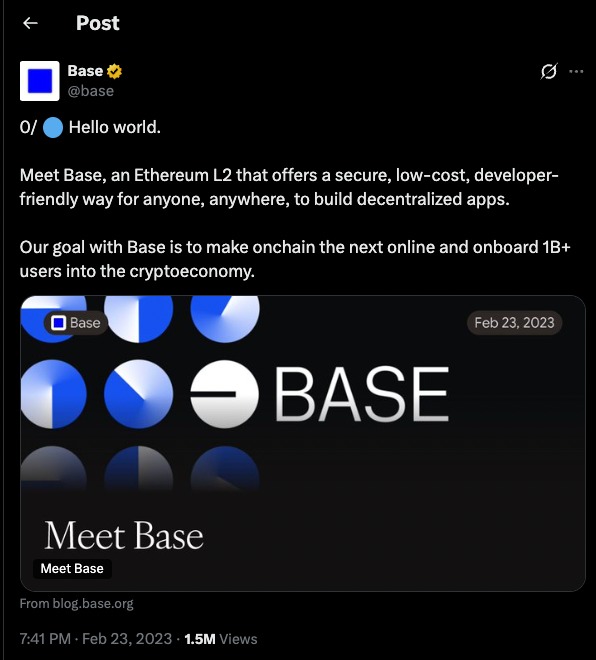
This post captured Base’s initial framing as an accessible and developer friendly Ethereum layer 2 rather than a purely speculative environment. The language emphasized security, low costs, and ease of building, reflecting Coinbase’s broader strategy of lowering entry barriers to onchain participation. In hindsight, the message also highlights how Base’s early narrative centered on infrastructure and user onboarding rather than the trend driven activity that later defined its growth cycles.
Base Layer 2 and the Onchain Summer Phase
Base’s mainnet opened to builders in mid 2023, followed shortly by public user access. Coinbase promoted the period as Onchain Summer, positioning the chain as a playground for new applications. Early traction was significant. Hundreds of thousands of users joined within the first week, accompanied by substantial capital inflows.
A large portion of that attention centered on Friend.tech. The application allowed users to trade access to social connections, combining elements of speculation and online identity. Activity surged rapidly as influential accounts experimented with the platform. Fee generation climbed at an exceptional pace, briefly rivaling the largest networks.
However, the growth proved fragile. Transaction volumes and fees fell sharply within weeks. Interest cooled as quickly as it had formed, highlighting how novelty driven engagement can be difficult to sustain. Friend.tech’s later decision to abandon administrative control marked the end of that early SocialFi chapter.
Base Layer 2 and the Memecoin Driven Expansion
Following the SocialFi slowdown, Base’s next surge aligned with the broader memecoin boom. Across crypto markets, speculative token launches became a dominant force. Low transaction costs and fast settlement times encouraged rapid issuance and trading.
While Solana initially captured much of this momentum, Base soon experienced a similar pattern. Token deployments increased dramatically within short timeframes. The scale of issuance reflected renewed developer and user interest, driven largely by speculative experimentation rather than long term utility.
This phase had measurable network effects. Rising token creation translated into higher transaction counts and increased DeFi participation. Liquidity flows strengthened Base’s decentralized finance activity, pushing engagement metrics upward. At various points, Base surpassed Ethereum in daily active addresses, demonstrating how layer 2 networks can capture attention when transaction efficiency aligns with market trends.
Base Layer 2 and the Emergence of AI Agent Activity
Another significant shift occurred in the latter half of 2024, when AI themed experimentation gained visibility across crypto communities. Developers began exploring autonomous systems capable of executing transactions, managing balances, and interacting with smart contracts.
Base became a natural environment for this experimentation. Coinbase leadership argued that blockchain networks provide accessible financial rails for AI systems, particularly because software agents cannot use traditional banking infrastructure. This reasoning aligned with Base’s low cost and programmable design.
Toolkits enabling AI agent deployment introduced new forms of activity. Agents capable of holding wallets and performing transactions illustrated how automated behavior might integrate with decentralized networks. Early experiments attracted attention, though the broader AI agent token narrative eventually cooled, mirroring previous hype cycles.
Base Layer 2 and the Return of Social Infrastructure
Social driven activity returned to Base under different conditions in 2025. Rather than being led by a single application, the resurgence was linked to deeper integration with Coinbase’s wallet ecosystem. Base became the default execution layer, embedding the chain more directly into consumer facing interfaces.
Farcaster emerged as a central platform during this period. By linking social identities to crypto addresses, it enabled interactions that blended communication with onchain actions. Creator focused protocols also contributed to transaction spikes as tokenized content and social promotion intersected.
This cycle proved more durable than earlier bursts, yet activity gradually normalized. Incentive programs and social features were eventually scaled back, reflecting the challenge of sustaining engagement once initial curiosity fades.
Editor’s View: Cycles of Attention and Convenience
What stands out across Base’s history is how user behavior appears driven less by long term loyalty and more by immediate opportunity. Participants tend to migrate toward environments where friction is lowest and narratives are strongest, rather than committing to a single chain identity. Base’s integration with Coinbase likely reduced psychological barriers, making experimentation feel safer or more convenient during speculative waves. This pattern reflects a broader market tendency where accessibility and distribution can temporarily outweigh deeper ecosystem attachment.
Base Layer 2’s Broader Position
Across its first three years, Base’s trajectory illustrates how layer 2 networks often evolve through successive narratives rather than steady linear growth. SocialFi, memecoins, and AI agents each produced temporary accelerations. Although these trends were cyclical, they expanded the network’s visibility and user base.
Base now leads several Ethereum layer 2 metrics, including transactions and user activity. Its transition toward a unified internal stack marks the next phase of development. Whether this architectural shift strengthens its long term dominance or simply concludes its initial growth era will depend on how future usage patterns evolve as Ethereum’s scaling priorities continue to change.
Disclaimer: This content is for informational purposes only and does not constitute financial advice.
Keep yourself updated with the latest crypto news with FYI Gazette
Read more about Memecoins with FYI Gazette
Keep yourself updated with the latest Altcoin News with FYI Gazette
 Bitcoin
  Ethereum
  Tether
  XRP
XRP  BNB
BNB  Solana
  TRON
TRON  Dogecoin
  Litecoin
  Pepe
Pepe