

Bitcoin Bulls Face Obstacles Near 92K Resistance
Bitcoin Bulls opened the week attempting to regain control of the market, yet persistent resistance near 92,000 continues to slow their progress. After Bitcoin failed to move above 92,250, the price dropped sharply, signaling hesitation among traders and the influence of broader economic pressures. As uncertainty surrounds the upcoming Federal Reserve decision and the strength of the US job market, the path to 100,000 appears increasingly dependent on risk appetite and clearer economic data.
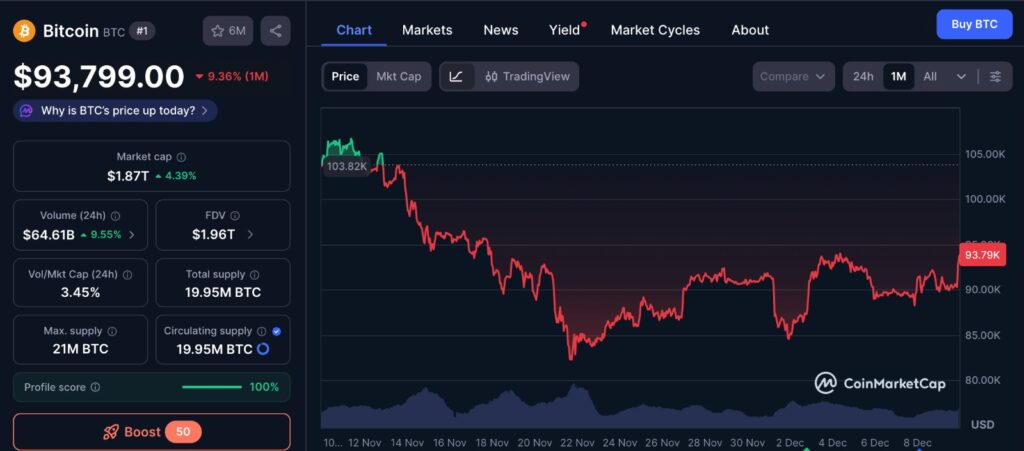
The attached chart from the past month highlights Bitcoin’s shifting momentum as it repeatedly tests resistance levels while holding key areas of support. The price action reflects a broader period of consolidation, marked by sharp reactions to macroeconomic news and shifts in trader sentiment. Short-term rallies stalled near the upper range, while pullbacks found stability as buyers stepped in at critical support levels. This one-month view reinforces the current market narrative: Bitcoin remains highly sensitive to economic indicators, liquidity conditions, and risk appetite, with neither bulls nor bears yet establishing decisive control.
Why Bitcoin Bulls are Struggling to Break 92K
Bitcoin Bulls initially showed momentum as price action approached the 92,250 level, but that progress was quickly erased when Bitcoin saw a pullback of about 2,650 dollars. This reversal coincided with losses in the US stock market, which reacted to ongoing concerns about labor conditions and rising doubts about extended valuations in sectors such as artificial intelligence. The combination of macro stress and shifting market sentiment made it difficult for Bitcoin to sustain its climb.
At the center of the challenge is weakening demand for leveraged bullish exposure. The Bitcoin monthly futures premium, or basis rate, has stayed below the neutral 5 percent level for more than two weeks. Under healthy conditions this premium signals confidence among traders willing to pay for longer term bullish positioning. Its continued weakness instead reflects caution and aligns with Bitcoin’s notable 28 percent decline since the highs reached in October.
Economic Pressures Weigh on Bitcoin Bulls
A major complication for Bitcoin Bulls is the lack of reliable economic data in the United States. A 43 day government funding shutdown delayed key employment and inflation reports, reducing clarity around the health of the broader economy. Without this information traders find it difficult to assess monetary policy expectations or anticipate market direction.
Even though a 0.25 percent interest rate cut in December remains part of the consensus outlook, this expectation has not sparked the optimism Bitcoin Bulls hoped for. A private employment report showing more than 71,000 layoffs in November added to concerns that economic momentum may be slowing. Risk assets tend to struggle when visibility is low, and Bitcoin has been no exception.
The US real estate market has also introduced new headwinds. Data showed that 15 percent of home purchase agreements were canceled in October, reflecting high housing costs and a nervous consumer environment. Additional reports noted a sharp 38 percent rise in delistings from October 2024, alongside a slight decline in median home listing prices in November. These developments indicate growing stress within a major segment of the economy, reinforcing caution among investors.
Bitcoin Bulls Lag Behind Equity Markets
Though Bitcoin Bulls attempted to maintain strength, Bitcoin underperformed compared to the stock market. A drop to 90,000 was intensified by the liquidation of around 92 million dollars in leveraged long futures. These liquidations often create cascading sell pressure and disrupt bullish momentum.
What stands out is the contrast between Bitcoin and the S&P 500 index, which sits only slightly below its record high near 6,920. This divergence underscores a shift in risk appetite, with equities maintaining resilience while Bitcoin faces more skepticism. Risk averse environments usually make it harder for Bitcoin Bulls to generate sustained rallies.
Defensive Positioning Shows Pro Traders are Skeptical
Even though the rejection at 92,000 did not dramatically alter futures positioning, options markets signal that traders remain defensive. Whales and market makers are demanding a 13 percent premium to sell Bitcoin put options on Deribit, a notable sign that downside protection is expensive and in high demand. Elevated skew of this kind is consistent with bearish or uncertain market conditions.
However, despite the cost of protection, the 90,000 support level has held firm. This indicates that traders are preparing for downside risk without fully expecting a deeper collapse below 85,000. The market shows caution, but not panic.
International Signals Challenge Bitcoin Bulls
In China, traders have been retreating from cryptocurrency markets as stablecoins have begun trading below parity against local currency benchmarks. Under normal circumstances a slight premium should exist to compensate for cross border friction. A discount instead signals strong demand to exit crypto markets. Such behavior often appears in bearish phases and reduces global liquidity available to Bitcoin Bulls.
The lack of inflows into US spot Bitcoin ETFs over recent weeks has further weakened bullish momentum. Without fresh capital entering through these investment vehicles, it becomes difficult for Bitcoin Bulls to establish a convincing push beyond current resistance levels.
What Bitcoin Bulls Need for a Breakout
For Bitcoin Bulls to overcome the 92,000 barrier, several conditions must improve. Clearer economic visibility in the United States is essential. Traders need reliable employment and inflation data to understand whether monetary policy will remain supportive.
In addition, stronger participation from futures traders and renewed ETF inflows would help restore bullish leverage. A shift in global sentiment away from risk aversion would also lift the overall market environment.
Outlook for Bitcoin Bulls
At present Bitcoin Bulls face a mix of macro uncertainty, defensive professional trading behavior, and weakened demand across multiple regions. While the 90,000 support has held, upside attempts remain limited. Whether Bitcoin can approach 100,000 soon will depend on improved labor data, real estate stability, and confidence returning to risk markets.
Until those factors align, Bitcoin is likely to remain range bound, with Bulls watching carefully for any shift in sentiment that could finally unlock the next major rally.
Keep yourself updated with the latest crypto news with FYI Gazette
Read more about Memecoins with FYI Gazette
Keep yourself updated with the latest Altcoin News with FYI Gazette
 Bitcoin
  Ethereum
  Tether
  XRP
XRP  BNB
BNB  Solana
  TRON
TRON  Dogecoin
  Litecoin
  Pepe
Pepe