

Bitcoin ETF Purification Reshaping Bitcoin Cycles
Bitcoin ETF Purification is becoming a central theme in market discussions as Bitcoin’s recent price behavior triggers debate about institutional flows and exchange traded funds. Rather than framing Bitcoin’s weakness as a failure of the asset itself, EMJ Capital founder Eric Jackson argues that Bitcoin’s growing connection to ETFs has fundamentally changed how it trades and how investors interpret its movements.
According to Jackson, Bitcoin’s current struggles are not rooted in declining relevance or broken fundamentals. Instead, they reflect structural shifts introduced by institutional access vehicles. The emergence of US spot Bitcoin ETFs, while expanding adoption, has also tied Bitcoin more closely to traditional portfolio mechanics, altering its short term price behavior.
Bitcoin ETF Purification and Ownership Shifts
A core element of the Bitcoin ETF Purification narrative is the idea that ETFs have reshaped who owns Bitcoin. In previous cycles, retail traders and crypto native investors dominated activity. Today, ETF allocators and institutional participants exert significant influence over flows and volatility.
This transition matters because different investor classes behave differently. Retail participants often respond to momentum and narratives, while institutional allocators operate within risk frameworks, rebalancing schedules, and broader portfolio constraints. As a result, Bitcoin’s price action may increasingly mirror patterns seen in traditional financial markets.
Jackson suggests that Bitcoin has effectively become a high beta asset within institutional portfolios. This classification implies greater sensitivity to risk sentiment, especially during equity market corrections. Instead of functioning purely as an independent store of value, Bitcoin can move alongside other growth oriented exposures.
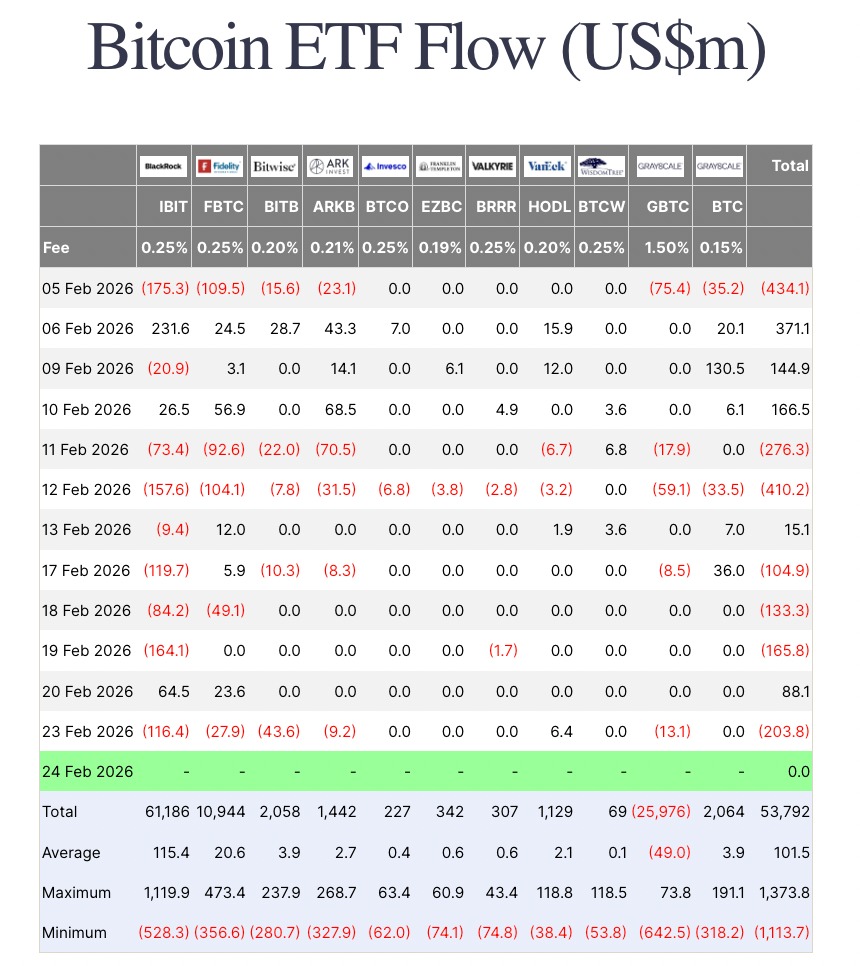
The recent ETF flow data highlights how persistent withdrawals have become a defining feature of the current market environment. Rather than isolated events, the outflows appear distributed across multiple sessions, suggesting a broader pattern of allocation adjustments rather than single-day reactions. This type of behavior is typically associated with portfolio rebalancing dynamics, where capital shifts are driven by risk management frameworks instead of directional conviction. In this context, the flows offer insight into positioning mechanics that price charts alone cannot fully capture.
Bitcoin ETF Purification and Market Correlation
One of the most debated observations involves Bitcoin’s apparent correlation with technology focused assets. Jackson highlights Bitcoin’s tendency to move in tandem with the iShares Expanded Tech Software Sector ETF, known by its ticker IGV. When technology stocks experience sell pressure, Bitcoin has often followed similar directional moves.
For critics, this correlation challenges Bitcoin’s reputation as a diversification tool or digital gold equivalent. Gold recently achieved new highs while Bitcoin struggled, reinforcing skepticism about BTC’s defensive qualities. The divergence raises questions about whether Bitcoin behaves more like a speculative growth asset than a safe haven.
Jackson interprets correlation differently. In his view, Bitcoin’s alignment with technology sectors is not evidence of weakness but a reflection of changing ownership dynamics. As institutions treat Bitcoin as part of broader portfolio strategies, its price becomes more exposed to macro driven adjustments rather than isolated crypto factors.
Bitcoin ETF Purification and ETF Outflows
ETF flows remain a visible driver of sentiment. Recent sessions have recorded consistent net outflows from US spot Bitcoin ETFs, signaling reduced near term demand from certain institutional channels. Daily withdrawal figures have occasionally reached hundreds of millions of dollars, coinciding with Bitcoin’s declining price levels.
Such outflows naturally trigger bearish interpretations. Reduced ETF demand can amplify downside pressure, particularly when combined with broader risk aversion. However, Jackson frames this selling phase within a longer cycle perspective rather than as a definitive rejection of Bitcoin.
He compares current ETF related selling with prior cycles in which other investor groups exited at perceived peaks. Retail participants sold near earlier highs, followed by hedge funds and other speculative capital. In the present environment, ETF allocators represent the marginal sellers.
Bitcoin ETF Purification and Capital Rotation
The Bitcoin ETF Purification concept emphasizes rotation rather than collapse. Market cycles often involve transitions between investor classes. Periods of weakness filter out shorter horizon participants, creating space for capital with different objectives and holding periods.
Jackson anticipates that future demand could increasingly come from longer duration institutions such as sovereign wealth funds, corporate treasuries, and pension capital. These entities typically deploy capital with multi year or multi decade horizons, potentially reducing sensitivity to quarterly volatility.
While this outlook does not guarantee immediate recovery, it introduces a different lens through which to interpret current price weakness. Market adjustments may represent reallocation processes rather than structural deterioration.
Bitcoin ETF Purification and Stablecoin Liquidity
Beyond ETF flows, liquidity conditions remain crucial. Stablecoin supply trends often serve as a proxy for available capital within crypto markets. Expanding stablecoin balances generally coincide with increased trading activity and risk appetite, while contractions can reflect caution or deleveraging.
Jackson highlights the importance of stablecoin supply recovery for shifting broader sentiment. Liquidity expansion has historically supported digital asset strength by enabling greater participation across exchanges. Without sufficient liquidity growth, sustained bullish momentum becomes harder to establish.
This focus aligns with broader market observations that liquidity frequently drives price dynamics more than isolated narratives. Bitcoin’s performance cannot be viewed solely through ETF flows without considering underlying capital availability.
Bitcoin ETF Purification and Price Context
Bitcoin’s recent decline toward lower trading ranges has intensified speculation about potential support zones. Market participants have discussed macro bottom targets near the 50000 region, reflecting uncertainty about the depth and duration of the current corrective phase.
Short term volatility has reinforced a cautious environment. Price dips and failed recoveries contribute to fragile sentiment, particularly among traders seeking directional confirmation. Yet Bitcoin’s historical cycles demonstrate that prolonged consolidation and sharp corrections are not unusual.
Within the Bitcoin ETF Purification framework, price weakness is interpreted as part of a transitional period shaped by evolving ownership structures, ETF mechanics, and liquidity conditions rather than a breakdown of Bitcoin’s broader thesis.
Editor’s View: Bitcoin ETF Purification
Market cycles often look mechanical on charts, yet investor behavior rarely is. When assets become embedded in institutional products, selling pressure can emerge not from changing conviction but from portfolio rules, risk limits, and correlation shocks. Bitcoin’s recent weakness may partly reflect this structural behavior, where allocation frameworks override long term narratives. Such phases tend to feel dramatic in price terms, even though they may simply represent capital rotation rather than a reassessment of the asset itself.
Bitcoin ETF Purification and Narrative Evolution
Bitcoin’s identity continues to evolve alongside market structure changes. The asset has transitioned from niche technology to globally recognized financial instrument. ETF integration marks another stage in this evolution, bringing both benefits and complexities.
Greater accessibility expands participation but also introduces new feedback loops. Portfolio rebalancing, macro driven adjustments, and cross asset correlations now influence Bitcoin more directly. These forces reshape how investors evaluate volatility, risk, and opportunity.
Whether Bitcoin ultimately stabilizes under this new structure remains determined by market behavior. However, the Bitcoin ETF Purification narrative captures a recurring pattern. Periods of stress often coincide with shifts in investor composition and changing interpretations of Bitcoin’s role within financial markets.
Disclaimer: This content is for informational purposes only and does not constitute financial advice.
Keep yourself updated with the latest crypto news with FYI Gazette
Read more about Memecoins with FYI Gazette
Keep yourself updated with the latest Altcoin News with FYI Gazette
 Bitcoin
  Ethereum
  Tether
  XRP
XRP  BNB
BNB  Solana
  TRON
TRON  Dogecoin
  Litecoin
  Pepe
Pepe