
Bitcoin ETFs Signal A New Market Shift
Bitcoin ETFs are becoming the defining force of the 2025 crypto landscape as retail traders reduce their presence, creating a market unlike previous cycles. Bitcoin ETFs now shape flows, sentiment, and direction, while everyday investors who once fueled rallies are stepping back. This shift has created a familiar yet noticeably different environment, one where Bitcoin remains firmly in control and altcoins struggle to keep up.
AMBCrypto recently highlighted how Bitcoin’s current landscape is being shaped by a “dual strategy,” where investors balance the convenience of ETFs with the security of self-custody. This dual approach reflects a maturing market in which institutions and long-term holders coexist, but it is the ETFs that increasingly set the tone. With months of four to six billion dollars in ETF inflows, the scale of institutional participation has become impossible to overlook. Meanwhile, long-time Bitcoin users continue advocating for the benefits of holding their own keys, reinforcing Bitcoin’s ideological core even as the market becomes more structured and regulated.
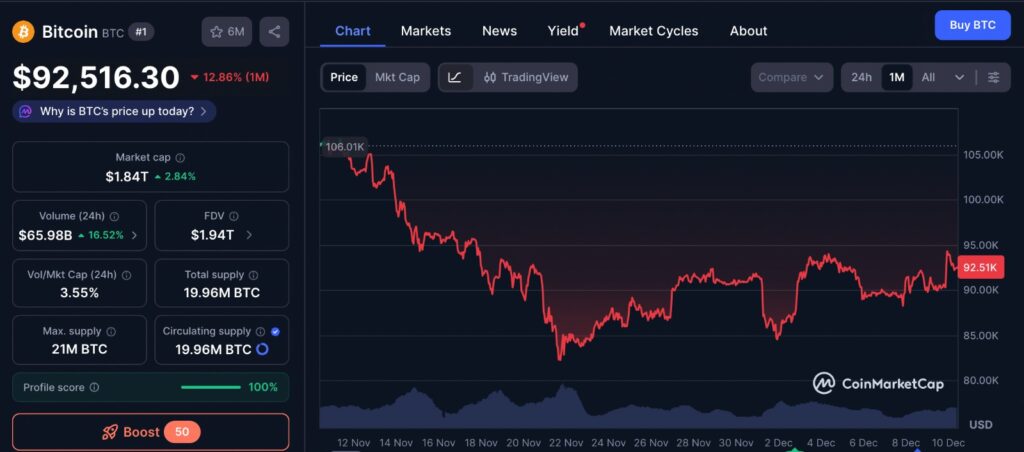
The latest one-month Bitcoin chart from CMC shows a period of steady but cautious movement, reflecting the broader market’s hesitation. While BTC has held its higher price range without breaking down, it has also struggled to build clear upward momentum, mirroring the technical weakness highlighted across major EMAs. The chart captures this balanced yet uncertain trend, with brief spikes in buying pressure followed by quick cooldowns. Overall, the recent price behavior reinforces the current narrative: Bitcoin remains strong at the top, but the market is still waiting for a decisive catalyst before committing to the next major direction.
Bitcoin ETFs And Market Leadership
Bitcoin ETFs have not only brought new capital into the market but have also strengthened Bitcoin’s dominance. Data continues to show that Bitcoin sets the pace across the entire crypto ecosystem. The Altcoin Season Index recently revealed that only four out of fifty-five tracked altcoins have outperformed Bitcoin over the last sixty days. This is far below the seventy-five percent threshold required to signal the start of a true altcoin season. At present, the index remains stuck between five and ten percent, indicating a firmly established “Bitcoin season.”
This trend extends beyond performance alone. A correlation analysis shows most major altcoins clustering around a correlation range of 0.7 to 0.9 with Bitcoin. Such strong alignment means Bitcoin continues to dictate the market’s broader direction. Altcoins are not leading narratives or cycles. Instead, they are reacting to Bitcoin’s movements, waiting for shifts in sentiment, dominance, or capital flows. This is consistent with earlier stages of institutional involvement, where capital generally flows first into Bitcoin before expanding outward. However, the current environment suggests that Bitcoin’s leadership is especially strong, with little room for altcoins to break away.
Retail Pulls Back As Bitcoin ETFs Take Over
While Bitcoin ETFs gain momentum, retail participation has softened significantly. This marks a major departure from previous cycles where retail enthusiasm often ignited fast and volatile rallies.
Analyst observations show that small holders, often called “Shrimps” because they hold less than one Bitcoin, have sharply reduced their activity. Data indicates these small holders sent only four hundred eleven Bitcoin to Binance, compared to two thousand six hundred seventy-five Bitcoin during the panic following the collapse of FTX in 2022. Even within the ETF era itself, retail inflows have dropped by more than sixty percent, declining from one thousand fifty-six Bitcoin shortly after spot ETFs launched to the lows recorded on the ninth of December.
The shift is striking because it comes during a period when Bitcoin’s price has been rising. Historically, rising prices attracted retail traders eager to chase momentum, yet this time the opposite is unfolding. Many everyday investors now seem to prefer the perceived safety and convenience offered by ETFs, which eliminate the need for managing private keys, navigating exchanges, or handling complex custody setups. This transition may contribute to a steadier market overall, with fewer sharp emotional swings typically associated with retail-driven trading.
Bitcoin ETFs In A Market Waiting For Direction
Despite rising ETF inflows and Bitcoin’s dominance, the price action itself shows hesitation. At the time of reporting, Bitcoin traded at ninety thousand one hundred ninety-six dollars, positioned below all major exponential moving averages. The 20-day EMA rested at ninety-one thousand three hundred fifteen dollars, the 50-day at ninety-six thousand nine hundred two dollars, and the 100-day at one hundred two thousand three hundred twenty-three dollars. Remaining below these levels suggests that bullish conviction is subdued for now. Market participants often view reclaiming the 20-day EMA as an early sign of renewed strength, so staying beneath it signals caution.
Additional indicators echo this restrained sentiment. The Relative Strength Index reflects muted demand rather than strong accumulation, while the Chaikin Money Flow at 0.07 suggests only mild capital inflows. These readings imply that although institutional money continues entering through ETFs, traders and investors are waiting for a clearer catalyst. The broader market seems to be in a holding pattern, watching for signals that could push Bitcoin decisively upward or trigger renewed volatility.
For now, Bitcoin is maintaining its ground without exhibiting strong breakout momentum. This balanced but cautious stance reflects a market adjusting to new forms of participation and new dominant forces.
Bitcoin ETFs And The Road Ahead
The rise of Bitcoin ETFs highlights a turning point. Institutional investors are increasingly shaping market behavior, while retail’s once-vibrant presence is fading into the background. As long as Bitcoin continues to trade beneath key moving averages, it is unlikely the broader market will shift away from Bitcoin-led dynamics. Altcoins may remain constrained until sentiment improves or new narratives emerge.
What is clear is that Bitcoin’s dominance is unchallenged in the current cycle. ETF demand remains a powerful force and appears to be redefining how capital enters the crypto market. This creates a landscape where Bitcoin continues to lead, retail plays a smaller role, and institutions steer the narrative with steady inflows rather than speculative bursts.
In this new era, Bitcoin ETFs do not simply complement the market; they actively frame it. Until technical strength returns and price reclaims key averages, the crypto market is likely to stay firmly under Bitcoin’s control.
Keep yourself updated with the latest crypto news with FYI Gazette
Read more about Memecoins with FYI Gazette
Keep yourself updated with the latest Altcoin News with FYI Gazette
 Bitcoin
  Ethereum
  Tether
  XRP
XRP  BNB
BNB  Solana
  TRON
TRON  Dogecoin
  Litecoin
  Pepe
Pepe