
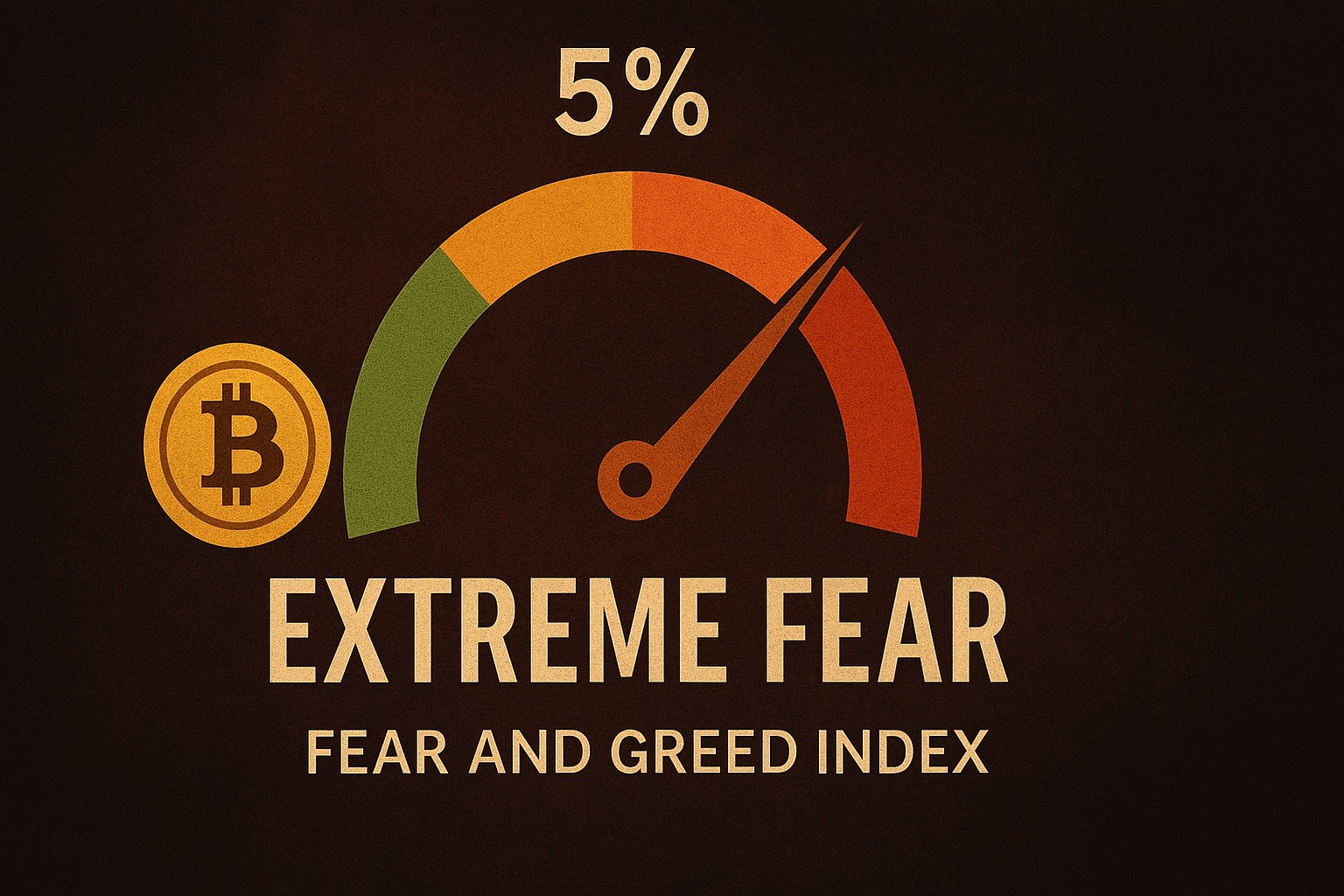
Bitcoin Fear Levels Hit Extreme Fear Again
Bitcoin Fear Levels deteriorated sharply on Monday as Bitcoin dropped more than 4 percent to 64300, fully erasing the gains it had recorded since Friday. The move followed a brief weekend recovery that pushed prices higher, but the optimism proved short lived as selling pressure quickly returned. The sudden reversal reinforced a cautious tone across the broader cryptocurrency market.
Bitcoin Fear Levels Reflect Market Psychology
Bitcoin Fear Levels are widely monitored because they capture the emotional state of the market rather than just price movements. Sentiment indicators help explain how traders and investors are reacting to volatility, uncertainty, and risk. When fear readings sink to extreme levels, market behavior often becomes defensive and price swings can intensify.
A sharp increase in fear typically coincides with higher volatility, reduced confidence, and short term instability. These phases are often driven by rapid price changes that disrupt positioning and expectations.
Fear and Greed Index Signals Extreme Fear
The Crypto Fear and Greed Index fell back to 5 out of 100, placing sentiment firmly in the extreme fear category. Such a low reading is rare and has only occurred a few times since the index was introduced. Historically, these levels have been associated with periods of heightened uncertainty and strong market stress.
Extreme fear readings indicate that traders remain cautious and risk appetite is subdued. Rather than signaling immediate direction, the index primarily reflects prevailing emotional conditions.
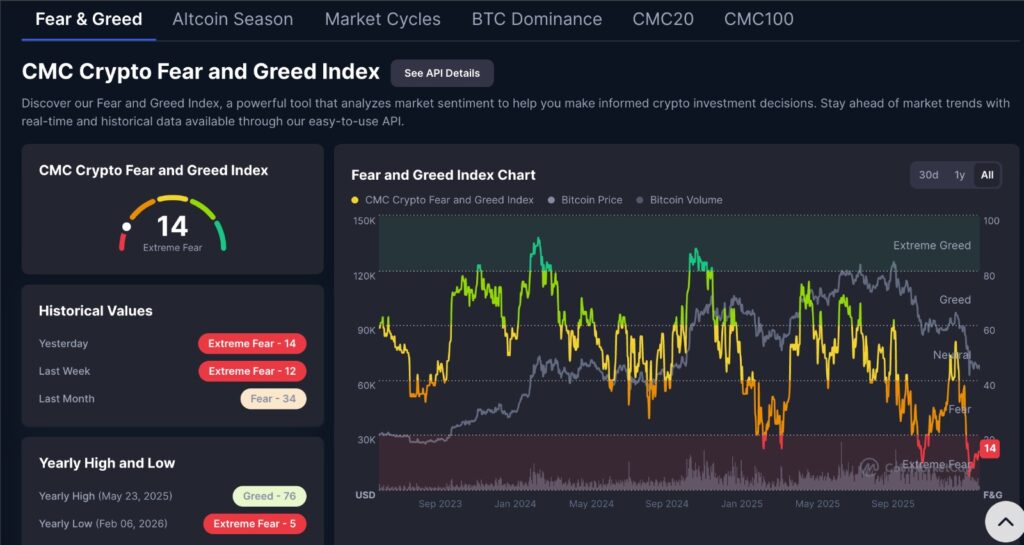
The sentiment gauge illustrates how quickly market psychology can shift during volatile phases. Even without a dramatic structural change in Bitcoin’s broader trend, fear readings can compress as traders react to short term price instability. Such sharp sentiment swings often reflect positioning stress and risk reduction rather than a fundamental reassessment of the asset. In this context, the index functions less as a directional signal and more as a snapshot of prevailing trader behavior.
Weekend Strength Quickly Faded
Bitcoin showed relative strength over the weekend, climbing to 68600 on Saturday. However, the rally failed to sustain momentum. By Monday, the market had not only reversed those gains but also returned to a key support region near the lower boundary of a range bound channel.
Range bound structures often develop when markets lack a clear directional bias. The swift rejection of higher prices highlighted the fragile nature of recent upward moves.
Rapid Price Decline Intensifies Volatility
During the sell off, Bitcoin lost more than 3000 in less than two hours. Moves of this magnitude illustrate how quickly volatility can expand in the crypto market. Rapid declines frequently trigger forced position closures, particularly among leveraged participants.
Such price action tends to amplify instability, as sudden movements disrupt both bullish and bearish strategies.
Liquidations Accelerate the Downturn
Market turbulence was further reflected in derivatives activity. More than 136000 traders were liquidated within a 24 hour period, with total liquidations reaching 458 million. The overwhelming majority of these liquidations came from leveraged long positions, revealing that many traders had anticipated continued upside.
Large liquidation events can intensify downward pressure. When leveraged positions are forcibly closed, automated selling increases, which can accelerate price declines.
Leverage Adds Structural Fragility
High leverage environments often magnify market reactions. Even moderate price changes can trigger cascading liquidations, reinforcing volatility. This dynamic frequently transforms routine corrections into sharper and faster market moves.
On Chain Data Shows Continued Stress
On chain analytics data indicated that recent investors continue to realize significant losses. The seven day moving average for net realized losses remained close to 500 million per day. This suggests that many participants are selling assets at a loss, a pattern commonly observed during periods of capitulation.
Although the scale of losses has cooled compared to earlier spikes, the broader market structure still reflects persistent pressure.
Capitulation Remains a Dominant Theme
Capitulation describes conditions where investors exit positions despite unfavorable pricing, often driven by fear or risk reduction. Sustained realized losses imply that many traders are prioritizing caution and liquidity.
Bitcoin Fear Levels Versus Historical Highs
Bitcoin’s current valuation also provides important context. The asset is trading approximately 48 percent below its October all time high of 126000 and remains several percentage points below its prior cycle peak near 69000. These comparisons illustrate the extent of recent volatility and shifting market conditions.
Periods of extreme fear frequently emerge when prices deviate significantly from previous highs. Traders often reassess expectations and adjust risk exposure accordingly.
Bitcoin Sharpe Ratio at Unusual Lows
Additional insight comes from the Bitcoin Sharpe Ratio, which measures risk adjusted returns. Recent readings placed the metric near historically low territory. Low Sharpe Ratio values indicate that returns have been weak relative to volatility over the measured period.
While some market observers interpret such conditions as potentially attractive for long term positioning, risk metrics alone do not determine market direction.
Risk Metrics Require Broader Context
Risk indicators are most useful when evaluated alongside price structure, volume dynamics, and sentiment trends. Depressed readings highlight market conditions but do not guarantee immediate reversals.
Broader Market Implications
Bitcoin Fear Levels often influence sentiment across the wider cryptocurrency ecosystem. When Bitcoin experiences elevated fear and volatility, other digital assets frequently exhibit correlated weakness. This interconnected behavior reflects Bitcoin’s dominant role in shaping market perception.
Heightened fear conditions can also impact strategy. Traders may reduce exposure, tighten risk management, or remain sidelined until volatility stabilizes.
Editor’s View: Market Behavior Behind Bitcoin Fear Levels
Extreme fear readings often reveal more about participant positioning than about Bitcoin itself. Rapid sentiment collapses tend to occur when traders are heavily skewed in one direction, leaving the market vulnerable to sharp unwinds. The clustering of long liquidations suggests many participants were reacting to recent momentum rather than reassessing risk. In such phases, price moves are frequently amplified by positioning imbalances, not just fresh information.
Conclusion
Bitcoin Fear Levels returning to extreme fear territory underscore the fragile balance within the current market environment. The combination of price declines, liquidations, and realized losses reflects continued uncertainty. While volatility remains a defining characteristic of crypto markets, sentiment indicators continue to offer valuable perspective on investor behavior and market dynamics.
Disclaimer: This content is for informational purposes only and does not constitute financial advice.
Keep yourself updated with the latest crypto news with FYI Gazette
Read more about Memecoins with FYI Gazette
Keep yourself updated with the latest Altcoin News with FYI Gazette
 Bitcoin
  Ethereum
  Tether
  XRP
XRP  BNB
BNB  Solana
  TRON
TRON  Dogecoin
  Litecoin
  Pepe
Pepe