

Bitcoin Funding Plan Behind $44B BTC Strategy
Bitcoin Funding Plan is shifting the focus from when to buy Bitcoin to how exposure is built over time. Instead of relying on available cash or reacting to price levels, this approach constructs a system where capital can be continuously accessed and deployed into Bitcoin in a controlled manner. That shift matters because it reduces dependence on timing and replaces it with a repeatable process tied to capital availability. In effect, Bitcoin accumulation becomes less about conviction in a moment and more about maintaining positioning across cycles. This is a structural change in behavior rather than just another accumulation announcement.
Bitcoin Funding Plan Explained
The Bitcoin Funding Plan centers on raising up to $44 billion through structured financial programs designed specifically to fund Bitcoin purchases. Rather than allocating a fixed treasury amount, the strategy uses capital markets to build exposure incrementally.
This approach reflects a key distinction. Instead of treating Bitcoin as an asset purchased with surplus funds, it is being integrated into a broader capital strategy. The scale of the plan signals that Bitcoin is no longer viewed as a side allocation but as a core balance sheet component.
By structuring the plan over time, the company avoids deploying capital all at once. This allows for flexibility in execution while maintaining a consistent accumulation framework.
How the Bitcoin Funding Plan Works
The mechanics behind the Bitcoin Funding Plan rely on a combination of at-the-market equity programs and preferred stock offerings. These instruments allow the company to raise capital gradually by selling shares directly into the market rather than through large, one-time issuances.
At-the-market programs are particularly important because they enable continuous funding. Shares can be sold in small increments depending on market conditions, which avoids sudden dilution events and creates a steady inflow of capital.
Preferred stock offerings add another layer. These instruments provide investors with structured returns while giving the company access to additional funds that can be directed toward Bitcoin purchases. Unlike traditional debt, this structure can be more flexible, though it still carries financial obligations.
This combination creates a system where capital raising and Bitcoin buying are linked but not forced to occur simultaneously, allowing for more controlled execution.
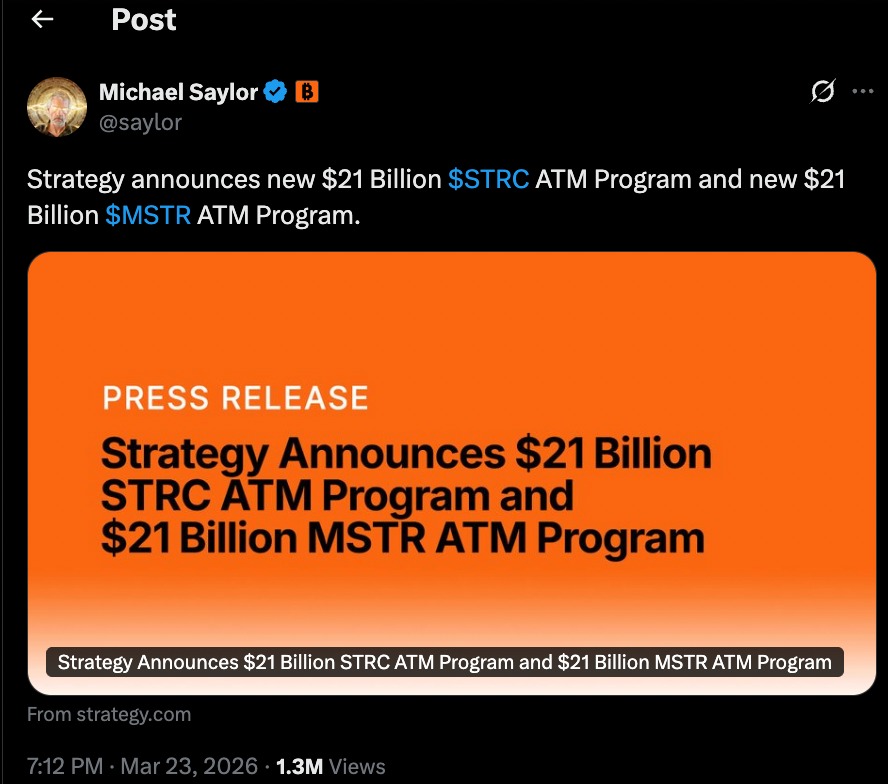
The announcement shared by Michael Saylor highlights the scale and structure behind the funding approach, with separate at-the-market programs tied to both STRC and MSTR. This dual structure suggests a deliberate effort to diversify how capital is raised while maintaining flexibility in execution. Rather than relying on a single funding source, the strategy distributes capital inflows across multiple instruments, allowing for more controlled and continuous deployment into Bitcoin. It also reinforces that the plan is not a one-time raise, but part of a broader system designed for ongoing accumulation.
Bitcoin Funding Plan and Existing Bitcoin Position
The Bitcoin Funding Plan builds on an already substantial Bitcoin position. The company currently holds hundreds of thousands of BTC, representing tens of billions of dollars in value.
Recent purchases show that accumulation is ongoing, with smaller additions complementing larger acquisitions made earlier. This indicates a consistent strategy rather than isolated buying events.
The funding plan is designed to extend this behavior. Instead of slowing down after reaching a large position, the company is effectively creating a pipeline that supports continued accumulation at scale.
This reinforces the idea that Bitcoin is being treated as a long-term strategic asset rather than a trade.
Market Impact of the Bitcoin Funding Plan
A Bitcoin Funding Plan of this scale introduces a different kind of market influence. Instead of large, one-off purchases, the impact is likely to be distributed over time.
The signaling effect is significant. A structured plan backed by capital markets suggests long-term commitment and may influence how other institutions approach Bitcoin exposure.
However, because execution is phased, the actual buying pressure may not be immediately visible. Instead, it may contribute to sustained demand that builds gradually rather than triggering sharp price reactions.
If similar funding models are adopted more broadly, the market could shift toward more predictable and structured accumulation patterns.
Risks Within the Bitcoin Funding Plan
Despite its structure, the Bitcoin Funding Plan introduces several risks. Equity-based funding can lead to dilution, which may affect existing shareholders.
There is also exposure to Bitcoin’s price volatility. If prices decline during periods of capital deployment, the effectiveness of the strategy can be impacted.
Additionally, the separation between capital raising and asset acquisition introduces timing risk. Funds may be raised under favorable conditions but deployed in less favorable ones.
These factors highlight that while the strategy is structured, it is not insulated from market dynamics.
Bitcoin Funding Plan as a Long-Term System
The Bitcoin Funding Plan represents more than a funding strategy. It is an attempt to create a system that supports continuous participation in the Bitcoin market.
By focusing on access to capital rather than timing, the company reduces reliance on short-term decision-making. This allows accumulation to continue across different market conditions without needing to adjust the core approach.
The scale and structure of the plan suggest that Bitcoin is being integrated into an ongoing financial framework rather than treated as a static holding.
Editor’s View: Why This Structure Matters More Than Size
What stands out in this Bitcoin Funding Plan is not the $44 billion figure, but the shift in how exposure is being engineered. When accumulation is tied to a funding system rather than discretionary decisions, the role of market sentiment begins to diminish. This creates a dynamic where participation becomes consistent, even in periods of uncertainty. It also reflects a growing preference for controlling access to capital instead of trying to control entry points. In that sense, the structure itself becomes the strategy, not just the asset being acquired.
Disclaimer: This content is for informational purposes only and does not constitute financial advice.
Keep yourself updated with the latest crypto news with FYI Gazette
Read more about Memecoins with FYI Gazette
Keep yourself updated with the latest Altcoin News with FYI Gazette
 Bitcoin
  Ethereum
  Tether
  XRP
XRP  BNB
BNB  Solana
  TRON
TRON  Dogecoin
  Litecoin
  Pepe
Pepe