
Bitcoin Going Zero Searches Surge Amid Fear
Bitcoin Going Zero fears have once again captured public attention as online search activity for the phrase “Bitcoin going to zero” rises sharply. Recent Google Trends data shows that interest in this term has climbed to its highest level since the market turmoil that followed the FTX collapse in November 2022. The sudden increase in searches highlights a renewed wave of anxiety among market participants as Bitcoin experiences another significant price correction.
The surge in search interest closely aligns with Bitcoin’s latest drawdown. After reaching an all time high near 126,000 dollars on Oct. 6, 2025, Bitcoin has since fallen to around 66,500 dollars. This decline leaves the asset nearly 50 percent below its peak, a magnitude of retracement that naturally attracts attention and concern. Large price movements often trigger emotional responses, and search behavior frequently reflects this shift in investor psychology.
At the same time, sentiment indicators reinforce the cautious mood. The Bitcoin Fear and Greed Index has dropped into extreme fear territory, registering readings near 9. Historically, such low levels have been associated with periods of intense uncertainty and stress. Similar readings were observed during major disruptions in previous cycles, including the Terra ecosystem collapse and the fallout from the FTX crisis. These parallels contribute to a broader sense of unease, even though each market cycle is shaped by different underlying factors.
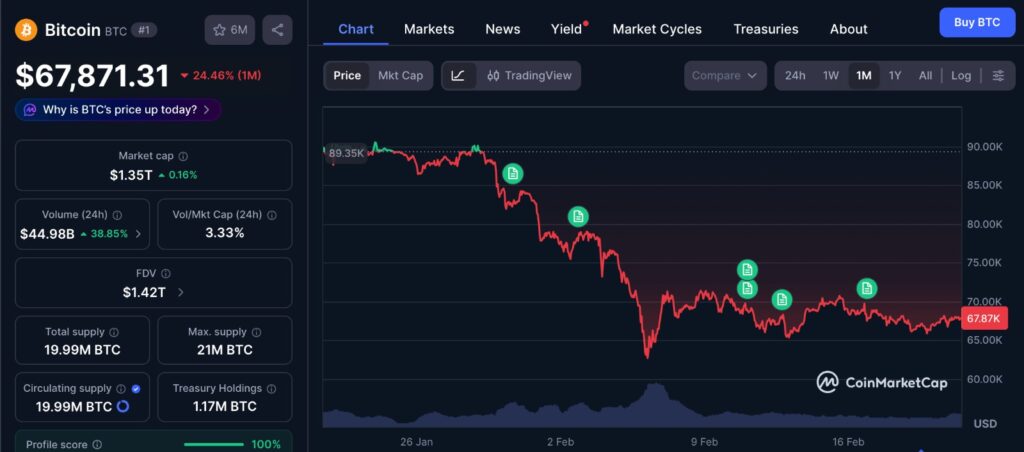
Over the past month, Bitcoin’s price behavior has reflected a market caught between hesitation and reactive positioning. Rather than a smooth directional move, the chart shows alternating phases of recovery attempts and renewed selling pressure, a pattern commonly observed during high uncertainty environments. Short term rallies appear to encounter resistance quickly, suggesting that participants remain sensitive to overhead price levels and recent volatility. This type of structure typically signals a market still searching for conviction, where sentiment shifts can outweigh broader narratives in the near term.
Bitcoin Going Zero Searches and Market Psychology
Spikes in fear related searches are not new in the cryptocurrency market. During periods of rapid price declines, investors often turn to search engines to make sense of what is happening. Queries such as “Bitcoin going to zero” tend to surge when confidence weakens and uncertainty rises. This pattern illustrates the psychological dimension of financial markets, where perception and narrative can influence behavior alongside technical and fundamental developments.
Search trends are widely viewed as a real time proxy for retail sentiment. When prices are stable or rising, fear driven searches typically remain subdued. However, when volatility increases and losses accumulate, worst case scenarios gain traction. The renewed prominence of Bitcoin Going Zero searches suggests that a segment of the market is reacting strongly to recent price action.
Importantly, heightened search interest does not automatically imply that Bitcoin’s network fundamentals have deteriorated. Instead, it often signals shifts in mood and attention. Markets are influenced not only by data but also by collective emotions, and fear can spread quickly during uncertain conditions.
How Today’s Bitcoin Going Zero Fears Differ From 2022
Although search activity now mirrors levels seen in late 2022, the broader context differs in meaningful ways. The fear cycle of 2022 was largely driven by internal crypto industry failures. The collapse of major centralized lenders and exchanges raised systemic concerns about counterparty risk, liquidity, and trust in market infrastructure. Those events created structural shocks that directly impacted user funds and market stability.
In contrast, current fears appear more connected to macroeconomic uncertainty and narrative dynamics. While price declines remain a central trigger, broader economic concerns play a larger role in shaping sentiment. Global markets have been navigating elevated uncertainty, and risk sensitive assets often react strongly to such conditions. Bitcoin, despite its unique characteristics, is not isolated from these wider forces.
The Influence of Bearish Commentary
Narratives also play a critical role in shaping market perception. Analysts observing media coverage note that strong bearish viewpoints have received significant visibility. Repeated warnings of downside risks and comparisons to historical financial crises tend to resonate more during market downturns. When prices weaken, negative interpretations often gain greater attention.
This dynamic can create feedback loops. As bearish narratives circulate, more participants search for confirming information, which in turn reinforces the visibility of fear driven themes. The rise in Bitcoin Going Zero searches reflects not only price movements but also how market conversations evolve during periods of stress.
Retail Sentiment and Timing Effects
Another notable feature of the current environment is the timing difference between retail sentiment and broader media tone. Market observers frequently point out that retail reactions can lag shifts in professional narratives. By the time search interest peaks, institutional investors and professional analysts may already be adjusting their outlook or positioning.
This lag is a common phenomenon across financial markets. Retail participants often respond after price movements become pronounced or widely discussed. As a result, extreme fear readings and search spikes may coincide with later stages of a downturn rather than its beginning.
Institutional Behavior Versus Bitcoin Going Zero Anxiety
Despite rising fear reflected in search data, institutional activity does not necessarily show the same level of pessimism. Large investors, including certain funds and corporate entities, continue to maintain or expand Bitcoin exposure. This divergence highlights how different market segments interpret identical conditions through distinct lenses.
Institutional strategies typically focus on longer time horizons and portfolio allocation frameworks. Short term volatility and fear cycles, while relevant, may not drive the same reactions seen among retail participants. The coexistence of elevated Bitcoin Going Zero searches and ongoing institutional accumulation illustrates the complexity of market behavior.
Macro Uncertainty and Broader Concerns
The current surge in fear related searches is also unfolding against a backdrop of heightened global uncertainty. Measures that track economic and policy uncertainty remain elevated compared to historical norms. Such conditions can dampen risk appetite and contribute to defensive positioning across asset classes.
In addition, technological concerns such as quantum computing occasionally resurface in market discussions. While these themes attract attention, they often intensify during price declines rather than acting as independent drivers. When markets are already under pressure, existing worries can become more prominent.
Editor’s View: Why Bitcoin Going Zero Fears Intensify During Drawdowns
Sharp increases in collapse related searches often reveal more about investor psychology than about the asset itself. When markets undergo deep corrections, uncertainty is frequently reframed in binary terms, where participants shift from discussing valuation to questioning viability. This transition tends to coincide with periods of emotional fatigue, when recent price action dominates perception and amplifies worst case thinking. In this sense, the visibility of extreme narratives can function as a sentiment signal, reflecting collective stress rather than a structural change in market foundations.
Interpreting Bitcoin Going Zero Trends
The renewed spike in Bitcoin Going Zero searches ultimately reflects the intersection of price action, sentiment, and narrative. Sharp drawdowns naturally revive fears, while broader economic uncertainty amplifies cautious attitudes. At the same time, differing behavior among retail and institutional participants underscores the varied perspectives within the market.
Fear cycles are a recurring feature of Bitcoin’s history. Periods of extreme pessimism have appeared multiple times, often during significant corrections. While search trends provide insight into sentiment, they represent only one piece of a larger puzzle. Understanding how psychology, macro factors, and market structure interact remains essential for interpreting such signals.
Disclaimer: This content is for informational purposes only and does not constitute financial advice.
Keep yourself updated with the latest crypto news with FYI Gazette
Read more about Memecoins with FYI Gazette
Keep yourself updated with the latest Altcoin News with FYI Gazette
 Bitcoin
  Ethereum
  Tether
  XRP
XRP  BNB
BNB  Solana
  TRON
TRON  Dogecoin
  Litecoin
  Pepe
Pepe