
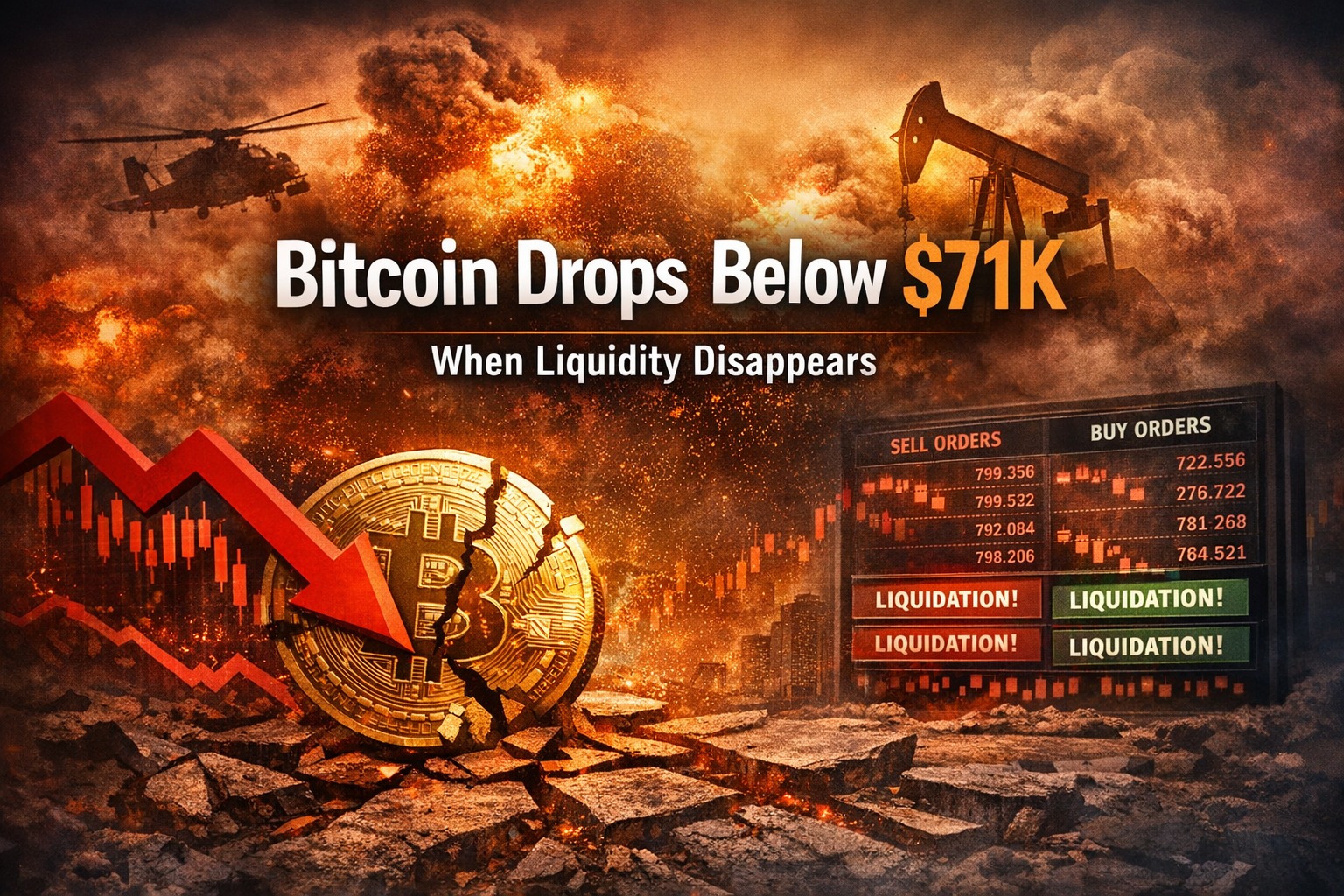
Bitcoin Price Drop Below $71K Reveals How Markets React When Liquidity Disappears
Bitcoin price drop below $71K is often explained as a reaction to geopolitical headlines, but the move itself says more about how markets behave when participants lose flexibility. When tensions escalate, in this case around US–Iran developments, the immediate impact is not a sudden shift in long-term belief. Instead, it compresses decision-making time. Markets do not struggle with supply appearing, they struggle when supply can no longer wait. That distinction is what turns controlled selling into forced movement.
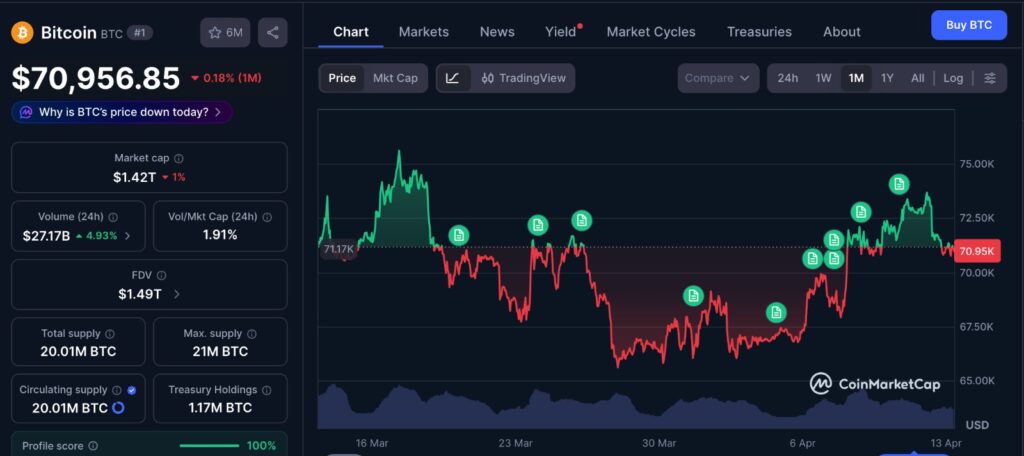
The 1-month chart reflects how price reacts during periods of compressed decision-making rather than sustained directional conviction. Recent sessions show that downward moves have been sharper than upward recoveries, suggesting that selling pressure is being executed faster than it can be absorbed. This type of structure often appears when liquidity remains present but less responsive, allowing price to move more aggressively through levels that would otherwise slow it down.
Price doesn’t fall because of news, it falls when liquidity becomes selective
Recent sessions have shown that Bitcoin did not gradually trend lower, it moved quickly once conditions shifted. This type of movement typically reflects a change in how liquidity is behaving, not just why participants are selling.
In stable conditions, selling is absorbed:
- Orders are distributed over time
- Liquidity providers remain active
- Price adjusts without disruption
But when external risk increases, participation becomes cautious. Liquidity providers widen spreads or reduce exposure, which changes the structure of the order book.
This is where the shift becomes structural:
- Sellers are still present
- Buyers are still present
- But the willingness to absorb flow becomes conditional
Instead of passively taking the other side, liquidity starts reacting to price rather than stabilizing it. That small shift is enough to make execution more aggressive.
Price doesn’t drop because there are more sellers, it drops because there is less capacity to absorb them.
Markets don’t move because supply appears, they move because absorption disappears.
Geopolitical tension accelerates timing, not direction
The escalation around US–Iran tensions acts as a trigger, but not in the way headlines suggest. Markets do not “decide” to sell because of conflict, they adjust timing.
Recent market behavior reflects this clearly:
- Risk events compress execution windows
- Participants reduce exposure faster than usual
- Orders that would normally be spread out are executed sooner
This creates a clustering effect. Selling that would have been absorbed gradually instead hits the market in a shorter time frame, overwhelming available liquidity.
The result is not a change in direction, it is a change in how quickly price is forced to move through existing structure. When time gets compressed, even balanced markets behave like they are under pressure.
Liquidations are not the cause, they are the amplifier
Sharp moves below key levels often coincide with liquidation activity, but it is important to understand the sequence correctly.
Liquidations do not initiate the move. They accelerate it.
When price begins to drop:
- Leveraged long positions start to unwind
- Forced selling enters the market
- Liquidity is further consumed
This creates a feedback loop where:
- Initial selling reduces price
- Liquidations add additional selling pressure
- Reduced liquidity struggles to absorb both
What makes this dynamic more impactful is that liquidation flow is not strategic, it is automatic. It does not wait for better prices or favorable conditions, which adds pressure at the worst possible time.
The key insight is structural:
Markets don’t break because leverage exists, they break when liquidity cannot support that leverage anymore.
Why Bitcoin reacts faster than traditional markets
One of the most overlooked aspects of moves like this is timing relative to other assets.
Bitcoin often reacts before traditional markets for a simple reason:
- It trades continuously
- It has globally distributed participation
- It reflects sentiment shifts immediately
When geopolitical risk emerges, traditional markets may still be closed or constrained by session boundaries. Bitcoin, however, becomes the first venue where risk is expressed.
This doesn’t mean Bitcoin is more sensitive, it means it is more accessible as a reaction layer.
As a result:
- Price moves can appear sudden
- Volatility clusters around news events
- Market structure adjusts in real time
In many cases, Bitcoin acts less like a leading asset and more like an open channel. It is simply where pressure shows up first.
Editor’s View: When markets lose patience, price loses stability
What stands out in moves like this is not fear, it is urgency. Most participants do not change their outlook overnight, but they do change how long they are willing to wait. That shift is subtle, but it has structural consequences. When patience disappears, even balanced markets become unstable because execution becomes compressed. Price doesn’t need panic to move, it only needs participants to stop delaying decisions.
What this move actually signals about market conditions
The drop below $71K is not just a reaction to external events, it reveals something deeper about current conditions:
- Liquidity is present, but not deeply committed
- Market structure is responsive, not resilient
- Price stability depends heavily on timing alignment
Over the past week, similar conditions have shown that markets can remain stable as long as execution remains distributed. Once that distribution breaks, movement accelerates quickly because liquidity is no longer positioned to absorb flow efficiently.
This reinforces a key structural principle:
Price doesn’t move because of demand, it moves because there is nothing left to slow it down.
Conclusion: The real trigger was not the news, it was the loss of flexibility
Geopolitical developments act as catalysts, but they do not determine market direction on their own. What they change is the behavior of participants.
In this case:
- Selling was already possible
- Liquidity was already finite
- But the ability to delay execution disappeared
That is what transformed a controlled environment into a reactive one.
Bitcoin’s move below $71K is less about the event itself and more about what happens when markets lose their ability to absorb pressure gradually. When flexibility disappears, price does not negotiate, it adjusts.
Disclaimer: This content is for informational purposes only and does not constitute financial advice.
Keep yourself updated with the latest crypto news with FYI Gazette
Read more about Memecoins with FYI Gazette
Keep yourself updated with the latest Altcoin News with FYI Gazette
 Bitcoin
  Ethereum
  Tether
  XRP
XRP  BNB
BNB  Solana
  TRON
TRON  Dogecoin
  Litecoin
  Pepe
Pepe