

Bitcoin Price Floor Near $70K Faces Pressure
Bitcoin Price Floor is less about where buyers step in and more about why they are choosing not to step away. The persistence of bids around $70,000 suggests that participants are not necessarily convinced of upside, but are equally reluctant to reprice risk lower in an uncertain macro environment. This kind of balance often emerges when capital is undecided, not absent, where holding becomes a default rather than a directional bet. What looks like support may actually be hesitation expressed through positioning.
Recent price behavior reflects this tension. Bitcoin has revisited the same support zone multiple times without building momentum away from it. Each bounce is weaker in follow-through, indicating that while sellers are not dominant, buyers are also not pressing the market higher with urgency.
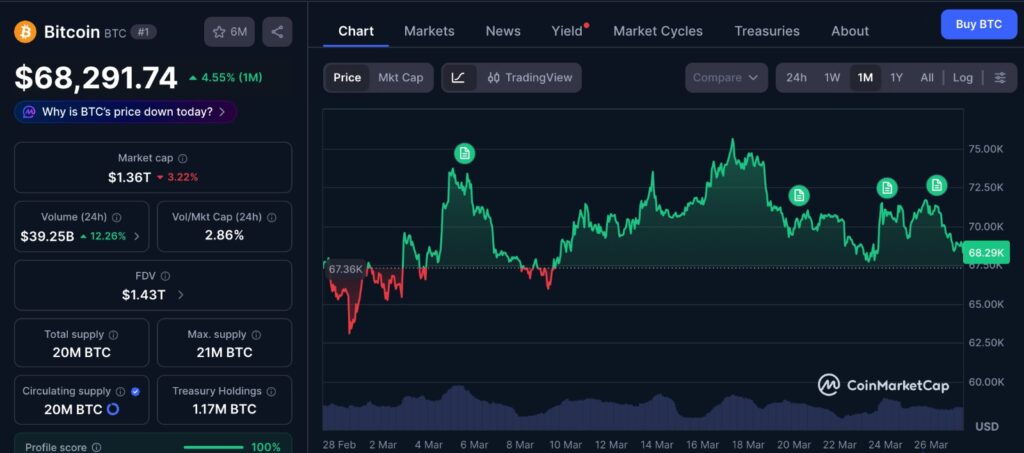
The 1-month Bitcoin chart reflects a market that is holding structure rather than building momentum. Price movements within this range show repeated attempts to stabilize near key levels, but without strong continuation, indicating that participation is measured rather than aggressive. The consistency of this range suggests that both buyers and sellers are active, yet neither side is establishing clear control. This kind of behavior often signals a market waiting for external confirmation rather than driving its own direction.
Bitcoin Price Floor Under Pressure From TradFi Returns
The pressure on the Bitcoin Price Floor is increasingly tied to the re-emergence of yield in traditional finance. Government bonds and similar instruments are now offering returns that compete with the expected upside of risk assets. This changes how capital is allocated, particularly for institutional participants.
For large investors, allocation decisions are not driven by narrative alone but by relative return and risk-adjusted positioning. When yields were near zero, Bitcoin’s volatility was acceptable in exchange for potential upside. In the current environment, a portion of that capital can achieve stable returns without exposure to drawdowns, reducing the need to overweight Bitcoin.
This does not result in immediate selling pressure, but it slows down inflows. Without consistent new demand, support levels rely more on existing holders rather than fresh capital entering the market.
Inflation Concerns and the Bitcoin Price Floor
Inflation continues to shape the context around the Bitcoin Price Floor, but its effect is indirect. Bitcoin is often described as a hedge, yet in practice, inflation impacts Bitcoin through the policy response it triggers. When inflation remains elevated, central banks maintain tighter conditions, which removes liquidity from the system.
This dynamic creates a contradiction. The long-term thesis for Bitcoin strengthens as fiat purchasing power erodes, but the short-term environment becomes less supportive for price expansion. Investors are forced to weigh these opposing forces.
In the current setting, inflation is not acting as a direct catalyst for Bitcoin. Instead, it is influencing interest rates and liquidity, which in turn affect how much capital is willing to take on risk.
Market Structure Around the Bitcoin Price Floor
Structurally, the Bitcoin Price Floor near $70,000 is being reinforced through repeated interaction rather than strong directional movement. Each test of this level builds familiarity among market participants, making it a reference point for positioning.
However, repeated testing without expansion also signals that the level is not being defended aggressively enough to trigger a trend. This often leads to range-bound conditions, where price oscillates between support and resistance without establishing dominance on either side.
Analysts have pointed to patterns forming within this range, suggesting compression rather than expansion. In such environments, liquidity builds on both sides of the range, and price tends to move toward areas where orders are concentrated rather than where conviction is strongest.
Liquidity Conditions and Bitcoin Price Floor Stability
The stability of the Bitcoin Price Floor is closely tied to liquidity conditions, which are currently more constrained than in previous bullish phases. Liquidity determines how easily capital can move into the market without significantly impacting price.
In periods of high liquidity, demand can absorb supply efficiently, allowing price to trend upward. In the current environment, limited liquidity means that upward moves require more sustained buying, which has not been consistently present.
At the same time, reduced liquidity increases sensitivity to downside pressure. When fewer buyers are actively stepping in, even moderate selling can push price lower. This makes support levels more fragile than they appear, as their strength depends on continuous participation rather than one-time defense.
Bitcoin Price Floor in a Changing Macro Environment
The macro environment surrounding the Bitcoin Price Floor is no longer defined by a single dominant factor. Instead, it is shaped by the interaction between inflation, interest rates, and traditional market returns.
Bitcoin’s behavior is increasingly correlated with broader financial conditions. When yields rise and liquidity tightens, risk assets tend to face resistance. This places Bitcoin within a larger framework where its performance is influenced by external variables rather than internal crypto-specific drivers alone.
This shift changes how the market interprets price stability. Holding a level like $70,000 is no longer just a technical signal, but a reflection of how Bitcoin fits into a wider portfolio context.
Investor Behavior Around the Bitcoin Price Floor
Investor behavior around the Bitcoin Price Floor shows a transition from aggressive positioning to measured participation. Market participants are no longer acting ahead of expected moves but are responding to confirmed conditions.
This results in slower market reactions and prolonged consolidation. Instead of sharp trends, price moves become more deliberate, with each move requiring confirmation before follow-through occurs.
The absence of urgency on both sides of the market indicates that participants are waiting for clarity. This often happens when external variables, such as macroeconomic signals, carry more weight than internal market momentum.
Editor’s View: Why Stability Can Be Misleading
There is a subtle shift in how market participants interpret stability at this level. Holding $70,000 would normally signal strength, but the absence of urgency suggests that participants are more defensive than confident. Many are not positioning for upside, but simply avoiding downside exposure while waiting for clearer macro direction. This creates a market that looks stable on the surface, yet lacks the internal pressure typically required to sustain upward movement.
Conclusion: Bitcoin Price Floor Faces Ongoing Test
The Bitcoin Price Floor near $70,000 represents a balance between structural support and shifting capital preferences. While it continues to hold, the conditions supporting it are evolving.
Rising yields in traditional finance, persistent inflation concerns, and tighter liquidity are all influencing how investors approach Bitcoin. These factors do not immediately break support, but they reduce the strength behind it.
As a result, the current price level is less a sign of strength and more a reflection of equilibrium. Whether this balance holds depends on how capital continues to position itself across both crypto and traditional markets.
Disclaimer: This content is for informational purposes only and does not constitute financial advice.
Keep yourself updated with the latest crypto news with FYI Gazette
Read more about Memecoins with FYI Gazette
Keep yourself updated with the latest Altcoin News with FYI Gazette
 Bitcoin
  Ethereum
  Tether
  BNB
BNB  XRP
XRP  Solana
  TRON
TRON  Dogecoin
  Litecoin
  Pepe
Pepe