

Bitcoin Price Levels Signal a Shift in Market Structure
Bitcoin price levels are beginning to reflect a meaningful shift in how the market is functioning beneath the surface. The end of a five-month stretch of persistent weakness is not just a change in direction, but a change in how price is being allowed to move. Markets do not reverse because sentiment improves; they reverse when the conditions that previously suppressed price begin to break down. What matters here is not the recovery itself, but the absence of immediate rejection at levels that historically capped upside.
Recent sessions have shown Bitcoin reclaiming zones that repeatedly triggered selling pressure, with price holding rather than quickly retracing. That behavior suggests that the supply which once absorbed buying pressure in these regions is no longer as dominant. When resistance stops behaving like resistance, it is often because the underlying positioning has already shifted.
Bitcoin Price Levels and the Breakdown of Seller Control
The previous downtrend was defined by a consistent pattern of rallies failing into supply. Each attempt higher was met with sufficient sell-side liquidity to push price back down, reinforcing a structure of lower highs. This was not just technical weakness but a reflection of how liquidity was positioned above price.
That structure now appears to be weakening. Instead of sharp rejections, price is stabilizing above previously contested zones. This does not confirm a new trend, but it does indicate that the mechanism driving the downtrend is losing effectiveness. Over the past week, current market conditions suggest that sellers are no longer able to enforce the same level of control without significantly more effort.
Price does not rise because buyers become aggressive; it rises when sellers can no longer suppress it.
Key Bitcoin Price Levels to Watch in April
Support Zones Holding the Structure
Support is no longer just a level on the chart; it represents areas where selling pressure is being actively absorbed. The region around 68,000 is critical because it aligns with long-term trend indicators that institutions monitor closely. Below that, the zone near 59,000 reflects a deeper structural base where price has historically stabilized during periods of uncertainty. The level near 54,000 represents realized price dynamics, where long-term participants have accumulated exposure.
The importance of these levels lies in their ability to absorb supply without allowing price to break down. If sellers attempt to push price lower and fail repeatedly, it signals that liquidity on the bid side is stronger than anticipated. Over the past week, price behavior around these zones has shown controlled reactions rather than impulsive breakdowns, suggesting that buyers are not chasing, but positioning.
Resistance Levels and Liquidity Friction
The zone between 70,000 and 72,000 remains a critical area because it represents a concentration of prior supply. This is not just a technical barrier but a behavioral one. Participants who previously experienced rejection in this region often re-engage when price returns, creating friction that slows upward movement.
Above that, levels near 76,000, 80,000, and 83,000 represent areas where liquidity may become more uneven. These zones are not targets in a directional sense, but areas where price is likely to encounter shifts in order flow. When price approaches such levels, the reaction reveals whether liquidity is being added or removed.
Market Behavior Behind Bitcoin Price Levels
The recent shift in price behavior is closely tied to how liquidity is distributed across the order book. During the downtrend, sell-side liquidity was consistently replenished above price, creating a ceiling that prevented sustained upside. Now, that ceiling appears less stable.
Recent sessions have shown price moving through previously dense liquidity zones with less resistance than before. This suggests that a portion of the supply that once existed in these regions has either been absorbed or withdrawn. When liquidity thins out, price does not need strong demand to move higher; it simply requires the absence of sufficient opposition.
This is where market makers play a critical role. Their objective is not to predict direction but to manage inventory and facilitate flow. When they detect that sell-side liquidity is no longer sufficient to contain price, they adjust spreads and positioning, allowing price to move more freely. This creates the appearance of momentum, even if underlying demand has not significantly increased.
Why Bitcoin Price Levels Are Reacting Differently Now
Market behavior is often shaped by participant conditioning. After months of failed rallies, many traders become biased toward expecting reversals. This leads to early selling into strength, which normally reinforces resistance.
However, when price continues to hold despite that behavior, it creates a structural imbalance. Sellers who expect a pullback are forced to reconsider their positioning as price fails to move in their favor. Over time, this can lead to a gradual reduction in sell pressure, not because sentiment changes, but because positioning becomes less aggressive.
Over the past week, current market conditions suggest that this process is already underway. Price is not accelerating sharply, but it is also not giving back gains easily. That combination reflects a market where resistance is weakening incrementally rather than breaking all at once.
Bitcoin Price Levels and Execution Dynamics
Large participants do not engage with the market in the same way as retail traders. They must consider execution risk, which means entering or exiting positions without significantly impacting price. This often requires distributing orders across multiple levels rather than acting at a single point.
When price approaches key levels, institutions are not simply reacting to the level itself, but to the liquidity available around it. If liquidity is sufficient, they can execute without disruption. If it is not, their activity can push price further in the direction of their trades.
This dynamic explains why certain levels hold cleanly while others break unexpectedly. It is not the level itself that matters, but the interaction between order size and available liquidity. When large participants cannot find enough opposing orders, price moves to the next area where liquidity exists.
What April Suggests About Bitcoin Price Levels
Seasonal patterns suggest that April has historically provided favorable conditions for Bitcoin, but the relevance of this lies in how it interacts with current structure. Historical tendencies do not move price; they influence expectations.
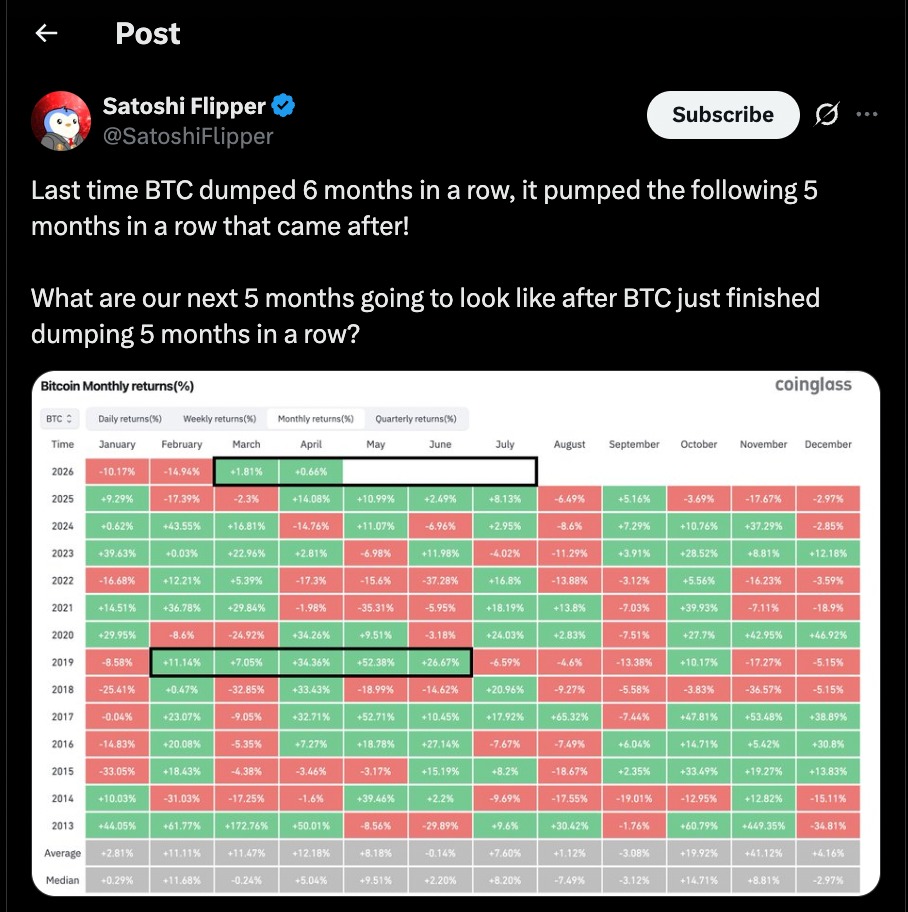
The historical context highlighted above reinforces how Bitcoin’s behavior often unfolds in sequences rather than isolated moves. While past performance does not dictate future outcomes, it does reveal how extended periods of weakness can reset positioning across the market. When a prolonged decline exhausts sell-side pressure, even modest shifts in demand can lead to sustained upward movement. What matters here is not the expectation of repetition, but the recognition that market structure tends to evolve after prolonged imbalance, creating conditions where price is no longer constrained in the same way.
Recent sessions have shown that price is stabilizing rather than rejecting at key levels, which is often the first step in a structural transition. However, the continuation of this behavior depends on whether liquidity conditions remain supportive.
If support levels continue to absorb selling pressure and resistance zones fail to trigger strong rejection, the structure will continue to evolve. If not, the market may revert to its prior state of constrained movement.
Editor’s View: How Market Memory Quietly Alters Price Behavior
What often gets missed in moments like this is how participants carry memory from prior losses into current positioning. After months of failed rallies, traders tend to reduce conviction, which means even when price stabilizes, it does so in an environment where fewer participants are willing to aggressively oppose it. This creates a quieter form of strength where the market does not surge, but also does not give back ground easily. In that sense, the shift is less about renewed demand and more about the gradual absence of resistance that once defined the trend.
Bitcoin Price Levels Reflect a Transitional Market
The market is currently in a phase where the previous downtrend has weakened, but a new directional structure has not yet fully formed. This is where most misinterpretation occurs, as participants attempt to define direction before the structure has stabilized.
Bitcoin price levels are not static markers; they are zones where competing interests interact. Understanding how price behaves around these zones provides insight into whether the market is compressing, expanding, or redistributing.
At this stage, the key development is not that price has moved higher, but that it is no longer behaving in line with its previous pattern of rejection. That shift in behavior, subtle as it may appear, is what defines the current environment.
Disclaimer: This content is for informational purposes only and does not constitute financial advice.
Keep yourself updated with the latest crypto news with FYI Gazette
Read more about Memecoins with FYI Gazette
Keep yourself updated with the latest Altcoin News with FYI Gazette
 Bitcoin
  Ethereum
  Tether
  XRP
XRP  BNB
BNB  Solana
  TRON
TRON  Dogecoin
  Litecoin
  Pepe
Pepe