
Bitcoin Price Outlook as BTC Faces Heavy Selling
Bitcoin Price Outlook remains under pressure as Bitcoin approaches the end of February with fresh local lows, persistent selling activity, and deeply negative market sentiment shaping expectations.
After several weeks of unstable price behavior, Bitcoin continues to struggle for direction. Short term recoveries have repeatedly failed to establish sustained momentum, leaving traders cautious about the near term trend.
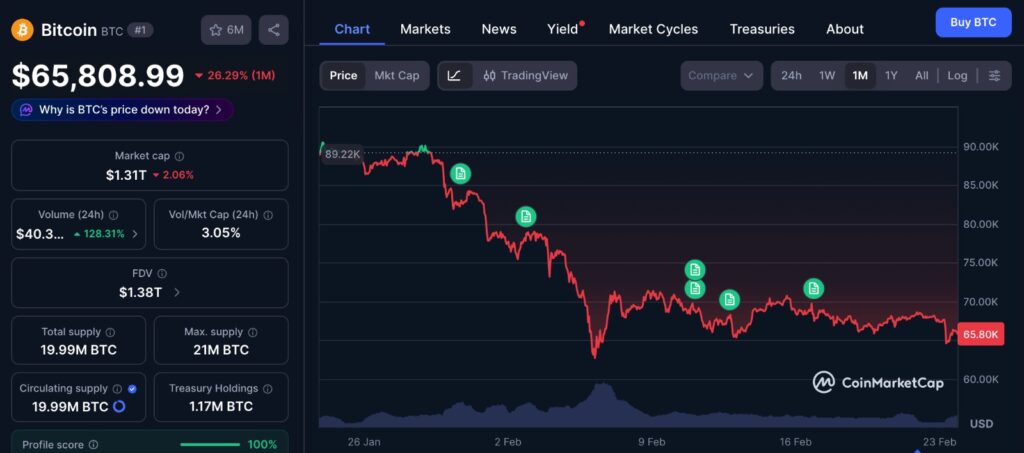
Over the past month, Bitcoin’s price structure has reflected persistent instability, with rebounds repeatedly encountering selling pressure before establishing sustained momentum. The chart illustrates how short term recoveries have struggled to shift broader positioning, reinforcing the cautious tone visible across the market. Rather than indicating a clear directional regime, recent movements highlight sensitivity to both liquidity shifts and sentiment driven reactions. This type of price behavior often accompanies periods where participants remain highly responsive to perceived risk rather than conviction.
Bitcoin drops below 65000 at weekly close
Bitcoin saw renewed selling pressure during the latest weekly close, briefly pushing price below 65000 before a limited recovery followed. The move extended recent weakness and reinforced the broader defensive tone visible across the crypto market.
Trading activity showed Bitcoin reaching a local low near 64258. Although price managed to rebound slightly, the overall structure remained fragile, with BTC still showing losses on shorter timeframes.
Some traders focused on technical explanations for the decline rather than viewing it purely as panic selling. One key observation was Bitcoin revisiting a naked point of control level, an area previously associated with heavy trading volume that had not yet been retested.
Such zones often attract attention because price reactions around them can signal whether buyers are willing to step in. In this case, while a bounce occurred, it was not strong enough to shift broader sentiment.
Bearish views remain dominant
Despite intermittent optimism, bearish interpretations continue to dominate market discussions. A recurring concern among traders is the combination of rising volume alongside falling prices.
In many market frameworks, increasing volume during declines is interpreted as confirmation of selling conviction. Rather than indicating exhaustion, it can suggest that sellers remain active and aggressive.
This perspective has fueled expectations that Bitcoin could revisit lower support regions. Downside targets around the 50000 to 52000 range are frequently cited, not as precise forecasts, but as areas where historical liquidity dynamics might come into play.
Liquidation activity across crypto derivatives markets adds another layer of complexity. Elevated liquidation volumes indicate that leveraged positions continue to be rapidly unwound, amplifying price movements.
Macro uncertainty weighs on markets
Bitcoin’s struggles are unfolding alongside broader macroeconomic uncertainty. Global markets continue to react to geopolitical developments, inflation concerns, and policy related headlines.
Trade tensions remain a key theme following renewed attention on tariff policies. Uncertainty surrounding legal challenges and potential policy adjustments has contributed to cautious sentiment across traditional financial markets.
Equity futures opened the week under pressure, reflecting growing sensitivity to macro risks. Analysts described markets as increasingly reactive to geopolitical narratives and economic data releases.
Crypto markets have not been immune to these influences. Bitcoin, often viewed as a risk sensitive asset in the current environment, has mirrored broader defensive behavior.
Whale inflows raise caution signals
Onchain indicators have highlighted notable trends in exchange inflow activity, particularly involving large holders. Data suggests that whale related transfers continue to represent a significant portion of Bitcoin moving onto trading platforms.
The Exchange Whale Ratio, a metric commonly monitored for signs of large holder behavior, has reached elevated levels. Historically, such readings have often preceded increased selling or profit taking phases.
Analysts also observed older coins returning to exchanges in larger quantities. This behavior may indicate repositioning by long term holders rather than purely speculative activity from newer participants.
When combined with ongoing losses among short term holders, the resulting supply landscape appears mixed. Rising available supply without clear evidence of strong demand can contribute to downward pressure.
Bear market comparisons reappear
Comparisons to earlier market cycles, particularly the 2022 downturn, have resurfaced as Bitcoin’s price structure remains uncertain. Some analysts point to similarities in onchain metrics and broader market conditions.
One frequently discussed reference involves Bitcoin’s relationship with anchored volume weighted average price levels. Trading below such metrics is sometimes interpreted as a sign of weakening market structure.
Historical comparisons are never exact, yet traders often use them as contextual tools. The renewed focus on bear market analogies reflects growing risk awareness rather than definitive conclusions.
Editor’s View: Sentiment Versus Positioning
Periods of extreme fear often reflect positioning stress rather than a simple shift in long term conviction. When price declines persist, many participants become more focused on avoiding further losses than reassessing underlying value, which can exaggerate short term reactions. This dynamic frequently creates an environment where even neutral market developments are interpreted defensively. In such conditions, volatility is driven as much by trader psychology and risk management behavior as by technical levels or indicators.
Sentiment sinks into extreme fear
Perhaps the most striking development is visible in market sentiment indicators. The Crypto Fear and Greed Index recently recorded extremely low readings, highlighting widespread pessimism among participants.
Values deep within the extreme fear zone suggest that confidence has deteriorated significantly. Such psychological conditions often accompany periods of heightened volatility and uncertainty.
It is important to note that sentiment measures emotion rather than direction. Extreme fear does not automatically imply imminent recovery, nor does it guarantee further declines.
As February draws to a close, Bitcoin Price Outlook continues to be shaped by the interaction of technical weakness, macro uncertainty, exchange flow behavior, and market psychology.
Disclaimer: This content is for informational purposes only and does not constitute financial advice.
Keep yourself updated with the latest crypto news with FYI Gazette
Read more about Memecoins with FYI Gazette
Keep yourself updated with the latest Altcoin News with FYI Gazette
 Bitcoin
  Ethereum
  Tether
  XRP
XRP  BNB
BNB  Solana
  TRON
TRON  Dogecoin
  Litecoin
  Pepe
Pepe