
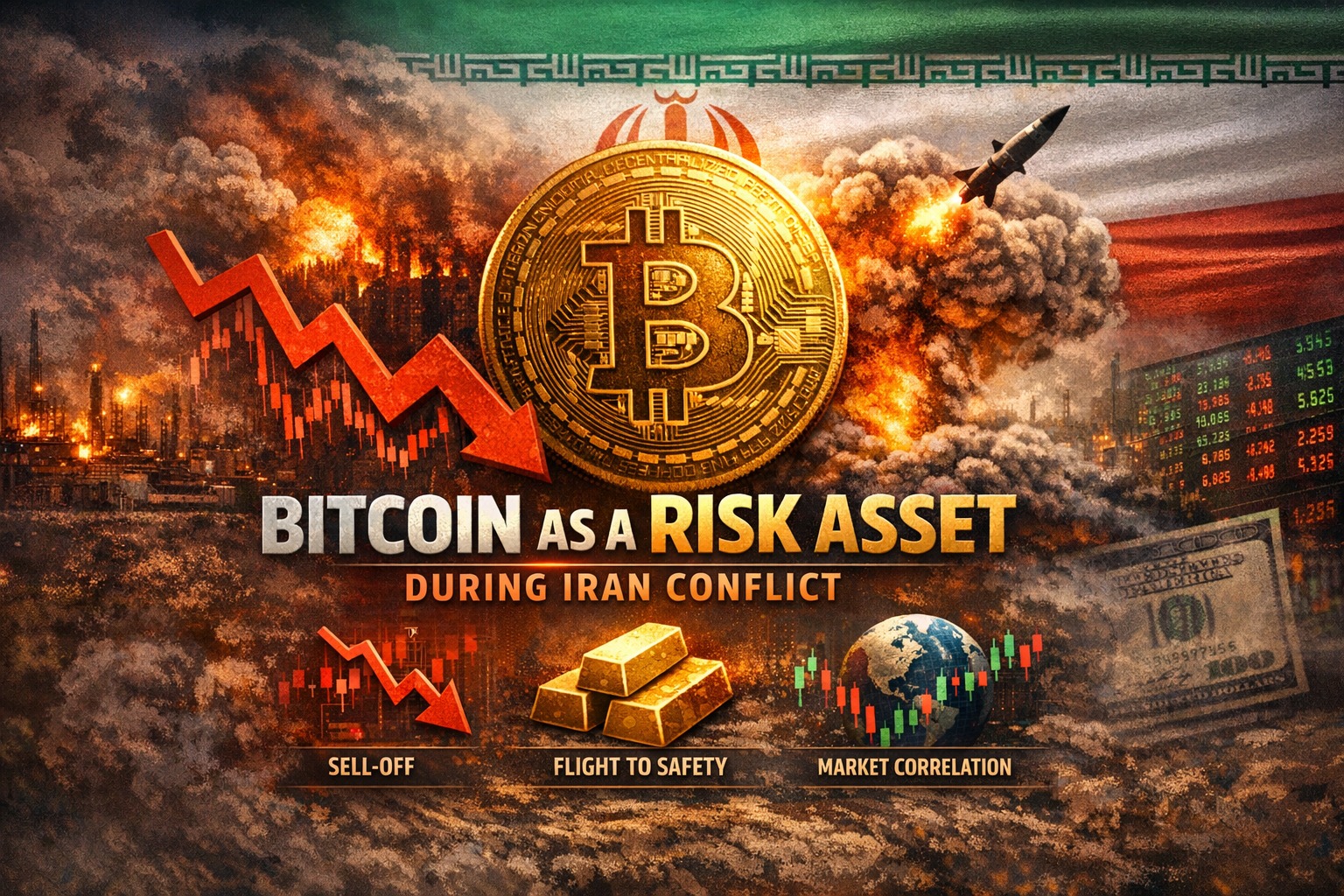
Bitcoin Risk Asset Behavior During Iran Conflict
Bitcoin Risk Asset behavior becomes most visible not during rallies, but during stress, when capital is forced to choose between liquidity and conviction. The recent Iran-linked tensions exposed how Bitcoin is actually positioned inside portfolios: not as protection, but as exposure. When uncertainty rises, investors are not asking what Bitcoin is designed to be, they are deciding what they can afford to hold. That distinction is what drives its price.
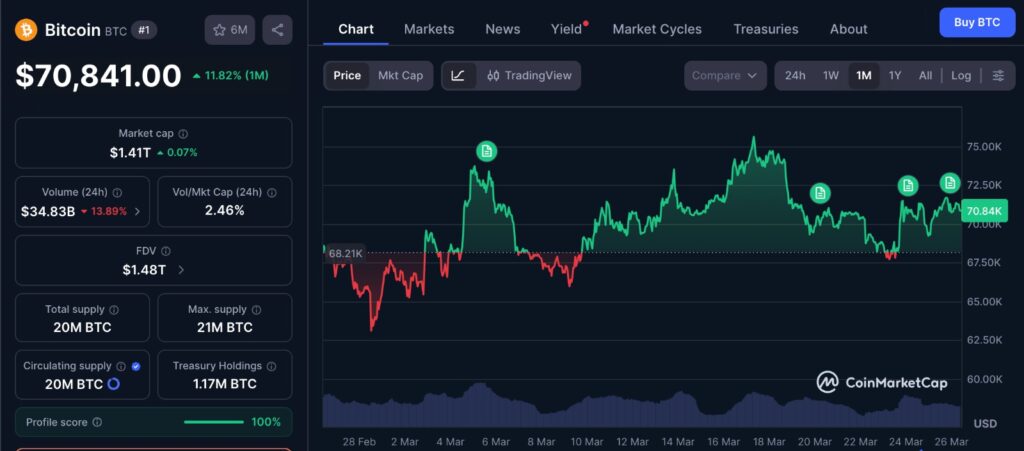
The chart above reflects how Bitcoin’s price has responded over the past month within a broader environment shaped by shifting risk sentiment. Rather than showing isolated crypto-driven movement, the structure of the chart highlights how Bitcoin reacts to periods of uncertainty with the same directional bias as other risk assets. Short-term declines and recoveries tend to align with changes in global sentiment rather than internal network developments. This reinforces the idea that Bitcoin’s price behavior is currently influenced more by macro positioning than by its independent narrative.
Bitcoin Risk Asset Reaction to Geopolitical Stress
During the escalation tied to Iran, Bitcoin did not attract defensive flows. Instead, it declined alongside equities at key moments of tension. This is not incidental behavior. It reflects how Bitcoin is grouped within portfolios when risk needs to be reduced quickly.
In stressed conditions, investors prioritize assets that can preserve value with minimal volatility. Bitcoin, despite its long-term narrative, is still treated as an asset that carries drawdown risk. As a result, it is often sold alongside equities rather than accumulated as protection.
Why Bitcoin Risk Asset Behavior Is Changing
Institutional participation has altered how Bitcoin trades under pressure. Large investors do not evaluate Bitcoin in isolation. It sits within a broader allocation that includes equities and other high-beta assets. When volatility rises, risk models trigger reductions across the entire bucket, not selectively.
This creates mechanical selling. It is not necessarily a view on Bitcoin itself, but a response to portfolio constraints. If an institution needs to lower exposure, Bitcoin is liquid enough to be sold quickly, which reinforces its behavior as a risk asset.
Bitcoin Risk Asset Correlation With Traditional Markets
Bitcoin’s correlation with equities becomes most apparent during rapid shifts in sentiment. During the Iran-related developments, its price moved in step with stock indices, reflecting a shared response to risk.
This correlation is driven by positioning rather than coincidence. When the same participants hold both equities and Bitcoin, their decisions affect both markets simultaneously. If exposure is reduced, both assets decline together. This creates a synchronized reaction that challenges the idea of Bitcoin operating independently.
Bitcoin Risk Asset Versus Safe Haven Narrative
The safe haven argument assumes that Bitcoin benefits from instability. In practice, that requires consistent inflows during periods of stress. Recent behavior suggests the opposite. Capital is not rotating into Bitcoin when uncertainty rises, it is moving out of it.
Gold benefits from decades of established trust as a store of value. Bitcoin does not yet have that institutional reflex behind it. Its price is influenced by how participants manage risk in real time, not by its theoretical properties. Until behavior aligns with narrative, the safe haven label remains conditional.
Bitcoin Risk Asset and Liquidity Cycles
Liquidity determines how much risk the market is willing to carry. When liquidity is abundant, investors extend into higher-volatility assets, including Bitcoin. When liquidity tightens or uncertainty increases, that extension reverses.
The Iran situation highlighted how quickly this adjustment can happen. As risk increased, capital moved toward assets perceived as stable, reducing exposure to Bitcoin. This is not a rejection of Bitcoin’s long-term role, but a reflection of how liquidity preference changes under pressure.
Bitcoin Risk Asset Position in Investor Portfolios
Bitcoin is increasingly placed within the high-risk segment of portfolios. It is treated similarly to growth equities or other volatile instruments that offer upside but carry drawdown risk. This classification dictates how it behaves during market stress.
When investors need to reduce exposure, they start with assets that contribute most to volatility. Bitcoin fits that category. Its liquidity makes it easier to exit compared to less liquid positions, which accelerates its downside during risk-off phases.
Bitcoin Risk Asset Signals From Market Behavior
Price action during geopolitical stress reveals how Bitcoin is actually used, not how it is described. Instead of acting as a hedge, it reflects broader positioning decisions across markets.
Short-term movements are shaped by flows rather than fundamentals. When capital exits risk, Bitcoin follows. This does not invalidate its long-term thesis, but it shows that its current role is still tied to how investors manage exposure rather than how the asset is defined.
Editor’s View: Where the Safe Haven Narrative Breaks in Real Time
What becomes clear in moments like this is that Bitcoin is not judged by its design, but by how easily it can be exited. In theory, it offers independence from traditional systems, but in practice, investors treat it as something they can quickly reduce when conditions tighten. This gap between belief and behavior is where most narratives fail under pressure. It shows that market identity is not defined during calm periods, but during moments when participants are forced to act.
Global Market Impact of Bitcoin Risk Asset Behavior
Bitcoin’s reaction to geopolitical events influences the broader crypto market. As the primary asset in the space, its direction sets the tone for altcoins, which often exhibit higher volatility.
When Bitcoin declines during risk-off periods, the rest of the market typically amplifies that move. This interconnected structure reflects Bitcoin’s role as the anchor for crypto pricing and sentiment.
At the same time, its alignment with traditional markets increases its integration into global finance. It reacts to the same forces that move equities, including liquidity shifts and risk sentiment. This reduces its independence but strengthens its relevance as a macro-sensitive asset.
In summary, the Iran-related tensions reinforced a consistent pattern. Bitcoin is behaving as a risk asset because that is how it is positioned, traded, and managed within portfolios. Until investor behavior changes, its response to geopolitical stress is likely to remain tied to broader market dynamics rather than acting as a standalone hedge.
Disclaimer: This content is for informational purposes only and does not constitute financial advice.
Keep yourself updated with the latest crypto news with FYI Gazette
Read more about Memecoins with FYI Gazette
Keep yourself updated with the latest Altcoin News with FYI Gazette
 Bitcoin
  Ethereum
  Tether
  BNB
BNB  XRP
XRP  Solana
  TRON
TRON  Dogecoin
  Litecoin
  Pepe
Pepe