

Bitcoin sell-off mirrors dot-com crash patterns, says analyst
Bitcoin sell-off patterns in the crypto market today are drawing strong comparisons to the aftermath of the early 2000s dot-com crash, according to analyst Jordi Visser. He argues that heavy selling pressure from crypto whales and long-term holders is keeping prices suppressed, echoing how technology stocks stagnated for years following their bubble burst.
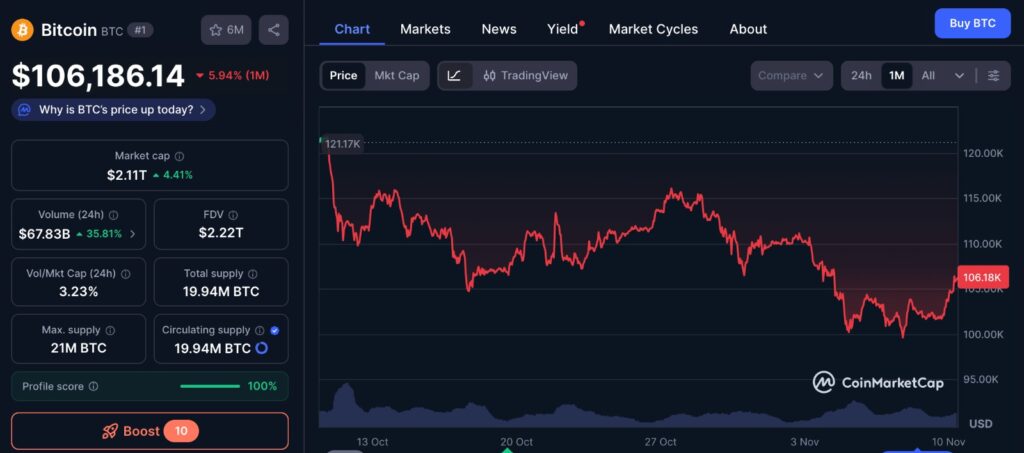
The latest one-month chart from CoinMarketCap illustrates how the Bitcoin sell-off has played out in real time. BTC’s price has shown heightened volatility, with multiple short-lived rallies followed by sharp corrections, reflecting ongoing investor uncertainty. Despite the fluctuations, the data indicates a gradual stabilization pattern forming around the $100,000 mark, a potential sign of market consolidation. This charted performance visually reinforces analysts’ observations that while selling pressure persists, the pace of decline is moderating, suggesting that Bitcoin may be entering a pivotal recovery phase.
The parallels between Bitcoin sell-off and the dot-com crash
Visser, an experienced market observer, highlighted that the current crypto market behavior closely mirrors the period after the 2000 dot-com stock market collapse. When that bubble burst, technology stocks plummeted by as much as 80% and took over 16 years to reclaim their previous highs. During that long consolidation phase, venture capitalists (VCs) and insiders, facing liquidity constraints, were forced to hold onto their investments for extended periods due to lock-up requirements.
When their lock-ups expired, many investors liquidated positions as soon as they could, creating continuous waves of selling pressure that delayed recovery. According to Visser, the same cycle is playing out now in the crypto market.
He explained, “Many stocks were trading below their IPO prices back then. We have a similar situation today. Venture capital and insider investors, desperate for liquidity or redemptions, are selling into every rally. That’s what has happened to me for Solana, Ethereum, for every altcoin, and for Bitcoin.”
Bitcoin sell-off and market consolidation dynamics
In Visser’s analysis, crypto markets are not expected to endure a 16-year recovery period as equities did. However, he stressed that the Bitcoin sell-off reflects comparable dynamics of investor behavior, particularly the persistent sell-side pressure. He believes the crypto market is nearing the end of its consolidation phase, predicting a possible turnaround within a year.
“The dot-com comparison isn’t about the timeframe,” Visser clarified. “It’s about the psychology and the capital structure. We are in the late stages of forced selling and consolidation. The worst of it may be nearly over.”
This sentiment has arisen amid concerns that the latest Bitcoin bear market began in October, prompting analysts and investment firms to revise previously bullish price forecasts. While optimism remains for long-term recovery, the short-term tone among analysts has shifted to caution.
Has Bitcoin bottomed out?
The pressing question for traders and investors is whether Bitcoin has already found its bottom. Current data suggests the BTC price could be stabilizing around the $100,000 level, though some market participants fear another drop toward $92,000 if selling pressure continues to intensify.
CryptoQuant analyst Julio Moreno noted that large holders, or whales, typically sell during market peaks, a pattern that is not inherently negative. “Whale selling happens at every cycle’s high,” he said. “It becomes a problem only when new demand fails to absorb the coins being sold.”
Bitcoin sell-off and whale activity
According to Moreno’s research, long-term Bitcoin holders have been distributing their holdings more rapidly since October. “Long-term holder selling has increased; that’s not unusual,” he explained. “What’s changed is that demand is contracting. It’s unable to absorb the supply at these elevated prices.”
Charts from CryptoQuant show long-term holders offloading BTC faster than the market can digest. When demand from new entrants weakens, this creates excess supply, putting downward pressure on prices. This phenomenon parallels the dot-com aftermath when institutional investors and insiders repeatedly sold shares into modest rallies, stalling market recovery for years.
The psychology behind the Bitcoin sell-off
The psychology of markets plays a central role in both the dot-com and current crypto cycles. After long periods of speculation and inflated valuations, investor confidence takes time to rebuild. During such phases, early adopters or insiders, motivated by the need for liquidity, often sell into rebounds.
Visser emphasized that this “forced selling” dynamic defines the current phase of the crypto market. Many venture investors who entered during the 2020–2021 bull run are now seeking to exit positions due to redemptions or cash flow pressures. Each time Bitcoin rallies, these investors use the opportunity to sell, limiting sustained upward movement.
However, Visser also believes this behavior may be nearing exhaustion. As fewer coins remain in the hands of overleveraged or impatient holders, selling pressure is likely to diminish. “The structure of supply is improving,” he noted. “When the last of the forced sellers are done, that’s when the next bull phase begins.”
Lessons from the dot-com recovery
Drawing from history, Visser suggested that just as technology stocks eventually rebounded to become dominant in the global economy, Bitcoin and major cryptocurrencies may follow a similar trajectory once the market clears weak hands. The dot-com survivors, companies like Amazon and Google, thrived after years of painful consolidation, when overvalued competitors had already collapsed.
“Crypto will follow the same path,” Visser predicted. “The long-term winners, Bitcoin, Ethereum, and a few key platforms, will emerge stronger after this reset. But first, we need to finish the cleansing process of excess speculation.”
A new phase for Bitcoin and crypto markets
Despite the Bitcoin sell-off narrative dominating headlines, not all analysts are pessimistic. Many agree that fundamental interest in blockchain technology and institutional involvement remain robust. The recent price declines, they argue, are more a reflection of cyclical rebalancing than a collapse in confidence.
As liquidity conditions stabilize and demand from institutional players returns, the market could experience renewed upward momentum. Visser’s perspective underscores that structural market healing often precedes long-term growth. “We’re near the end of forced selling,” he reiterated. “Once equilibrium is restored, the next rally will be healthier and more sustainable.”
Outlook for the next 12 months
If Visser’s timeline holds true, the crypto market could transition into recovery mode within the next year. Historical patterns support this: following both the 2018 and 2022 bear markets, Bitcoin entered accumulation phases before breaking out to new highs.
Market watchers are now focused on demand metrics, such as exchange inflows, whale activity, and on-chain wallet growth. Sustained demand from institutional investors, combined with reduced selling pressure from long-term holders, could mark the turning point for Bitcoin’s next bull cycle.
Final thoughts
The Bitcoin sell-off has undoubtedly rattled investors, but parallels to the dot-com crash offer both caution and hope. While forced selling continues to suppress prices, analysts like Visser believe the end of this phase is in sight. If the lessons of history hold, the market’s next chapter may resemble the early 2010s tech revival, slow at first, then explosive once confidence and liquidity return.
Keep yourself updated with the latest crypto news with FYI Gazette
 Bitcoin
  Ethereum
  Tether
  XRP
XRP  BNB
BNB  Solana
  TRON
TRON  Dogecoin
  Litecoin
  Pepe
Pepe