
Chainlink Whale Impact and Its Effect on LINK Price
Chainlink Whale Impact is becoming a key topic in the LINK market following a significant movement of tokens by large holders. Recently, whales withdrew around 789,810 LINK, valued at approximately $10.9 million, from major centralized exchanges. This activity suggests strategic accumulation and has important implications for supply, liquidity, and price behavior.
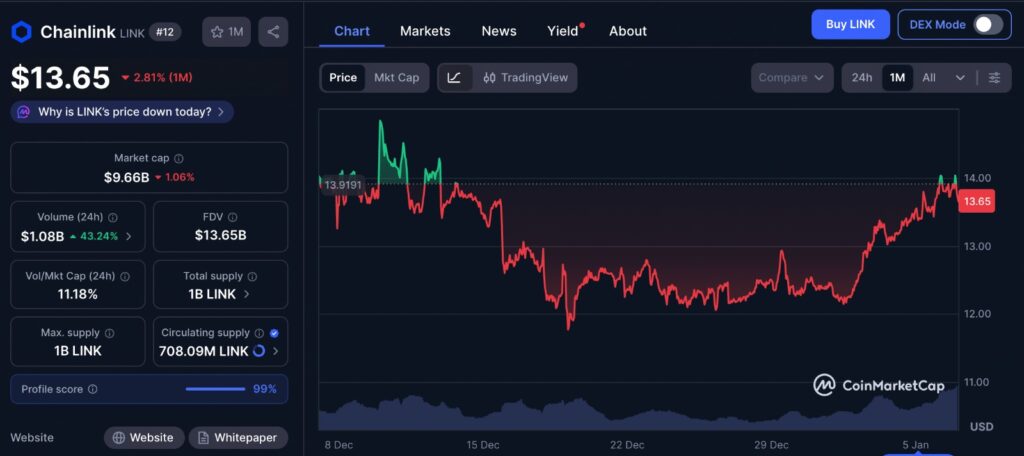
Viewed alongside the past month’s price action, the chart reflects a market that has been moving with restraint rather than urgency. Price swings remain contained, suggesting participants are responding thoughtfully instead of reacting emotionally to short-term moves. This kind of structure often appears when buyers and sellers are both active but unwilling to force direction, allowing positioning to develop quietly in the background. In that sense, the chart supports the idea that recent on-chain activity is unfolding within a controlled environment rather than a speculative rush.
Chainlink Whale Impact and Whale Accumulation Behavior
Large holders, often called whales, usually move funds with a clear purpose. In this case, the withdrawals were spread across multiple transactions rather than a single transfer. One whale removed more than 540,000 LINK from Coinbase over several weeks, while another address withdrew over 170,000 LINK from Binance in a short time frame. These movements indicate accumulation rather than preparation to sell.
When tokens are moved off exchanges, they are no longer immediately available for trading. This behavior typically reflects confidence in future price performance and a long-term holding strategy. The Chainlink Whale Impact therefore reflects reduced sell pressure rather than short-term speculation.
Chainlink Whale Impact on Exchange Supply
One of the most important outcomes of the Chainlink Whale Impact is the reduction of exchange supply. As LINK tokens leave centralized platforms, the amount of liquid supply available for traders declines. This makes the market more sensitive to changes in demand.
Recent spot market data shows consistent net outflows, including a single-day withdrawal exceeding $3 million. Earlier sessions also recorded much larger outflows, nearing $40 million. These movements occurred without major price breakdowns, reinforcing the idea that holders were not selling but instead moving assets to private wallets.
Lower exchange balances generally create conditions where price can move faster once demand increases. With fewer tokens available for purchase, even moderate buying activity can have a stronger impact on price direction.
Price Structure Shift Linked to Chainlink Whale Impact
The Chainlink Whale Impact coincides with a notable change in LINK’s technical structure. The asset recently broke above a long-standing descending channel that had previously limited upside movement. This breakout followed the formation of a base pattern, suggesting that selling pressure had weakened.
LINK was trading around the mid-$13 range while holding above the former resistance zone. Immediate resistance is located near the $14.7 level. If buyers manage to push above this area, the next major resistance zone lies near $16.6. Beyond that, the $20 level represents a historically important psychological zone.
How Chainlink Whale Impact Supports the Breakout
Whale accumulation strengthens this price structure by limiting downside risk. As large holders remove supply from the market, selling pressure decreases. This allows prices to stabilize above key levels and makes pullbacks shallower.
The Chainlink Whale Impact also supports higher lows, which is an important sign of bullish structure. While price movement remains gradual, the underlying setup appears constructive rather than fragile.
Derivatives Market and Chainlink Whale Impact
Derivatives data adds another layer to the Chainlink Whale Impact narrative. On major exchanges, a large majority of top traders are holding long positions. More than 70 percent of accounts are positioned for upward movement, pushing the long-to-short ratio above 2.5.
This imbalance shows confidence among leveraged traders. While heavy long positioning can sometimes increase volatility, current funding rates remain stable. This suggests that leverage is not excessive and that market participants are positioning carefully rather than aggressively chasing price.
The alignment between spot accumulation and derivatives positioning strengthens the overall market structure.
Liquidity Zones and Chainlink Whale Impact
Liquidity analysis shows a concentration of short liquidation levels above the current price, while downside liquidity appears thinner. This imbalance can attract price upward, as markets often move toward areas with higher liquidity.
In this environment, the Chainlink Whale Impact works together with liquidity dynamics to favor upward exploration. Reduced downside leverage lowers the probability of sharp sell-offs, while upside liquidations could fuel momentum if resistance breaks.
However, sustained upward movement still depends on continued buying interest rather than liquidation events alone.
Market Outlook Under the Chainlink Whale Impact
At present, LINK is trading within a controlled structure shaped by whale accumulation, declining exchange supply, strong long positioning, and favorable liquidity distribution. The market does not show signs of panic or overheating, which supports a stable continuation scenario.
If buyers successfully clear overhead resistance, the reduced supply could amplify upward price movement. On the other hand, if momentum slows, LINK may continue consolidating without major downside, allowing the structure to strengthen further.
Either way, the Chainlink Whale Impact remains a central factor influencing how the market evolves.
Editor’s View: Reading Between the Whale Transactions
Large withdrawals like these are often interpreted mechanically as bullish or bearish, but the human element matters just as much as the numbers. Whales tend to act slowly and deliberately, especially when prices are not trending aggressively in either direction. Moving funds off exchanges during a relatively stable phase can reflect patience rather than urgency, suggesting a preference for control over liquidity instead of immediate market impact. This kind of behavior usually aligns with longer decision cycles, where positioning matters more than short-term price fluctuations.
Conclusion
The Chainlink Whale Impact reflects deliberate accumulation by large holders, resulting in reduced exchange supply and tighter liquidity. Combined with improving price structure and supportive derivatives data, this setup suggests a market leaning toward stability and potential continuation rather than weakness.
As long as whales continue to hold and supply remains constrained, LINK’s price behavior is likely to stay sensitive to demand increases. The coming sessions will determine whether this structure develops into a stronger upward move or extended consolidation, but whale activity has already reshaped the market landscape.
Disclaimer: This content is for informational purposes only and does not constitute financial advice.
Keep yourself updated with the latest crypto news with FYI Gazette
Read more about Memecoins with FYI Gazette
Keep yourself updated with the latest Altcoin News with FYI Gazette
 Bitcoin
  Ethereum
  Tether
  XRP
XRP  BNB
BNB  Solana
  TRON
TRON  Dogecoin
  Litecoin
  Pepe
Pepe