
Crypto Slump drives Bitcoin under 94K amid market fears
Crypto Slump is the phrase many industry leaders are using to describe Bitcoin’s sharp fall below 94,000 dollars and the broader market pullback that stunned traders over the weekend. As Bitcoin briefly touched a year-to-date low near 93,000 dollars, crypto executives, analysts and fund managers weighed in on what is driving the downturn and whether the correction signals deeper trouble or a temporary shakeout in an otherwise maturing market.
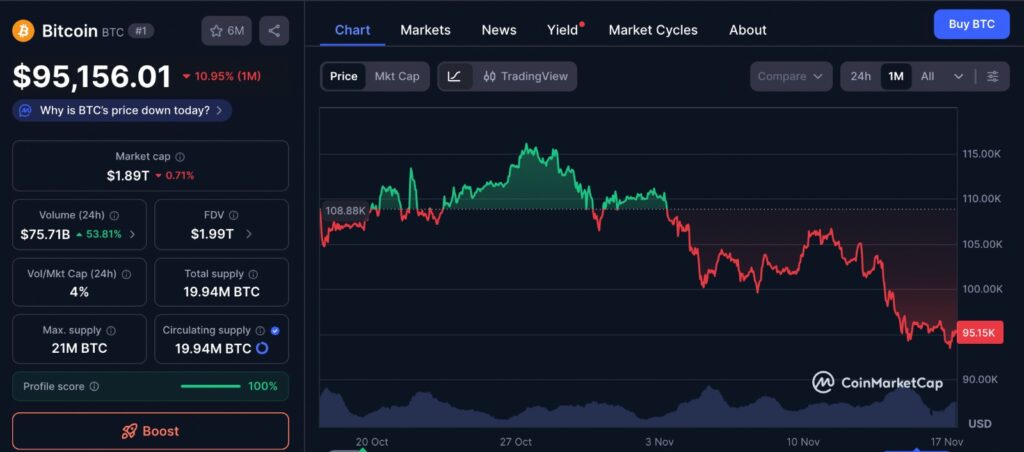
The one-month Bitcoin chart from CoinMarketCap further illustrates how quickly momentum has shifted. After spending several weeks trading in a relatively stable range, Bitcoin’s price began trending downward as selling pressure accelerated and market sentiment weakened. The chart highlights the steady erosion of support levels leading into the recent dip below 94,000 dollars, reinforcing how a combination of ETF outflows, long-term holder distribution and broader macro uncertainty have shaped the current market trajectory.
Executives point to multiple forces behind the crypto slump
Bitcoin’s decline to 93,029 dollars on Sunday coincided with a steep reduction in global crypto market capitalization. According to market data, the total cap slid from 3.7 trillion dollars on November 11 to 3.2 trillion dollars on Monday. For many analysts, this contraction reflects a confluence of internal and external pressures rather than a single catalytic event.
Ryan McMillin, chief investment officer at Merkle Tree Capital, said the downturn is the result of overlapping shocks rather than one major blow. He noted onchain data showing long-term holders finally beginning to cash out after a powerful multi-month rally. These veteran holders, often called whales or OGs, typically wait out volatility instead of selling into weakness. Their decision to distribute coins now suggests confidence has softened compared with earlier in the cycle.
McMillin added that during the earlier stages of the bull run, spot Bitcoin ETFs and related investment vehicles were providing strong bid support. More recently, however, that dynamic has reversed. ETF flows have turned negative just as global markets have cooled, risk sentiment has deteriorated and expectations for rate cuts have been delayed. That combination, McMillin argued, created a perfect environment for a pullback as old coins met a weaker bid.
Macro pressures extend the crypto slump
Executives across the industry echoed the belief that the crypto slump is not purely driven by crypto-native behavior but is closely tied to the global economic and geopolitical backdrop.
Matt Poblocki, general manager of Binance Australia and New Zealand, emphasized that cryptocurrency remains a maturing asset class and is still significantly shaped by macroeconomic forces. With monetary policy uncertainty and geopolitical tensions intensifying, investors have rotated out of risk assets, leading to broader market weakness that naturally bleeds into digital assets.
Holger Arians, CEO of Banxa, went further, arguing that markets have been running unusually hot despite unresolved geopolitical conflicts and rising global tensions. He noted that global tech valuations continued to climb based on optimism about the future, creating a disconnect between risk appetite and real-world conditions. In such an environment, Arians said, a risk-off moment was almost unavoidable.
The crypto slump, he explained, is part of a larger pause in global risk sentiment. While crypto often moves independently of stocks and macro trends, this particular period has kept investors on the sidelines as they wait for clarity, direction and relief after a turbulent year.
Market leaders weigh in on behavioral dynamics fueling the crypto slump
Beyond macro and ETF-driven explanations, several crypto executives suggested that market psychology is also playing a role. Hunter Horsley, CEO of Bitwise Asset Management, believes the long-standing four-year cycle narrative may itself be contributing to the downturn. As traders anticipate a predictable post-halving correction, he argued, some end up selling preemptively, making the narrative self-fulfilling.
Tom Lee, chairman of BitMine, speculated that market makers facing balance-sheet issues may have become targets for aggressive players attempting to trigger liquidations and push Bitcoin lower. Although unproven, the idea reflects broader concerns about leverage, liquidity stress and opportunistic trading pressure during volatile periods.
Why sharp drops remain a normal part of the crypto slump
Despite the severity of the drop, many analysts argue that the underlying market remains structurally strong. Poblocki pointed out that sharp corrections happen in every cycle and should not be viewed as signs of a broken market. He noted that retail participation remains steady, with investors rotating into blue-chip assets like Bitcoin and Ethereum instead of fully exiting the space. This behavior suggests sustained long-term confidence even during the crypto slump.
Poblocki added that ETF flows, while softer, have not shown signs of panic-level redemptions. Institutional participation remains robust, and the disciplined approach of retail investors further signals market maturity.
Arians similarly argued that the underlying fundamentals are healthier than price action indicates. He pointed to increasing regulatory clarity, expanding real-world use cases and the steady integration of traditional finance into the crypto ecosystem. These developments, he said, continue to strengthen market infrastructure even as prices retrace.
He also highlighted rising stablecoin volumes, growing onchain activity and strong developer momentum as signs that foundational growth remains intact. Though the crypto slump weighs on sentiment, Arians believes the groundwork being laid today is preparing the market for the next expansion phase.
A maturing market beneath the crypto slump
McMillin’s perspective aligned with that of macro analyst Jordi Visser, who argued that while long-term holders are selling heavily, the market is handling this supply far better than in past cycles. In earlier phases of Bitcoin’s history, similar levels of long-term holder distribution often led to 70 to 80 percent drawdowns. Today, the corrections are significantly milder.
This difference, McMillin said, is the result of deeper institutional liquidity, ETF absorption and broader market participation. Coins are gradually moving from a concentrated group of early adopters to a wider base of new investors. That shift represents a sign of market maturation rather than structural weakness.
Outlook: Can the crypto slump reverse?
While uncertainty remains, many leaders believe the market is positioned to recover once macro fear subsides and ETF flows stabilize. The crypto slump may continue in the short term, but the combination of stronger infrastructure, diversified participation and rising institutional presence gives analysts confidence that the long-term picture remains intact.
In their view, the current correction is not the end of the cycle but another phase in the ongoing transition toward a more resilient and widely adopted global crypto market.
Keep yourself updated with the latest crypto news with FYI Gazette
 Bitcoin
  Ethereum
  Tether
  XRP
XRP  BNB
BNB  Solana
  TRON
TRON  Dogecoin
  Litecoin
  Pepe
Pepe