
Crypto Trust Charters Face Pressure From US Banks
Crypto Trust Charters are becoming a central topic in the evolving relationship between cryptocurrency firms and the United States banking system. The discussion has intensified after major banking industry representatives called on regulators to move more cautiously when approving national trust bank charters for digital asset companies. At the core of the debate is whether existing regulatory frameworks are sufficiently clear to support the rapid expansion of crypto focused financial institutions.
Crypto Trust Charters Under Regulatory Spotlight
The recent controversy surrounding Crypto Trust Charters stems from concerns raised by the American Bankers Association, a leading voice representing traditional banking institutions. The association has formally urged the Office of the Comptroller of the Currency to slow down approvals for crypto related national trust bank charters. According to the banking group, regulators should wait until critical rulemakings connected to stablecoin legislation are fully defined before granting additional charters.
Banking industry leaders argue that the regulatory landscape for digital assets is still developing. In their view, approving charters too quickly could create oversight challenges and introduce risks that might have been avoided with clearer guidance. The request for a more measured approach highlights the broader tension between financial innovation and regulatory stability.
Why Traditional Banks Are Concerned
One of the primary issues cited by bankers involves regulatory uncertainty. Digital asset companies seeking national trust bank status often operate under business models that differ significantly from conventional banks. These firms typically focus on custody, settlement, and crypto related services rather than deposit taking or lending.
The American Bankers Association has emphasized that many obligations facing crypto institutions remain unsettled. Questions persist regarding how various federal agencies will coordinate supervision and how different rules will apply to stablecoins and other digital assets. Bankers maintain that regulators should avoid approving charters until these responsibilities are clearly mapped out.
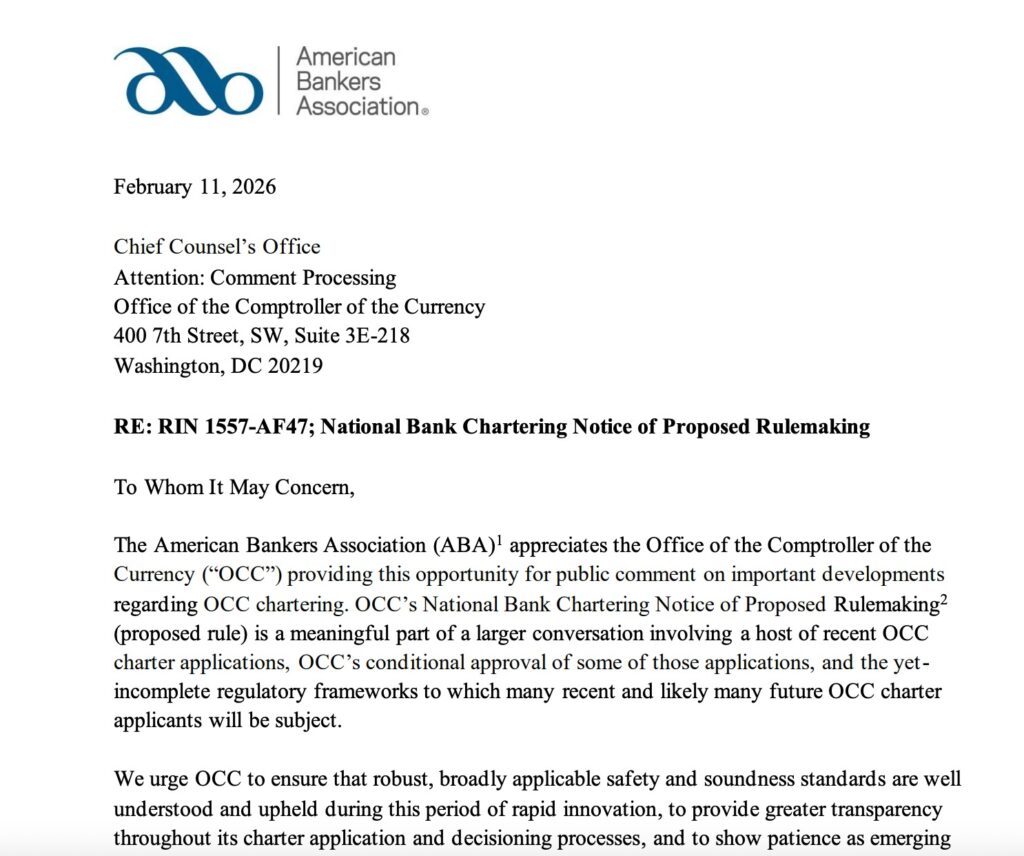
The document reflects the American Bankers Association’s formal response to the OCC’s proposed rulemaking on national bank charters. Beyond procedural language, the letter illustrates how established financial institutions frame regulatory risk, emphasizing safety, supervisory clarity, and consistency across agencies. The tone of the communication is measured and legalistic, which is typical of industry responses intended to influence regulatory interpretation rather than public opinion. Viewed in context, the filing highlights the structural differences in how incumbent banks and digital asset firms evaluate uncertainty.
Safety and Soundness Considerations
Safety and soundness standards are another major focus of the banking industry’s argument. National trust banks linked to crypto firms frequently operate without federal deposit insurance, reflecting their non traditional structure. While these institutions may not accept customer deposits in the usual sense, they often hold large volumes of digital assets on behalf of clients.
Traditional banking representatives caution that this model introduces unique operational and risk management challenges. They argue that regulators should ensure robust safeguards are in place, including clear rules governing asset protection, cybersecurity, and financial resilience. Without comprehensive standards, bankers worry that vulnerabilities could emerge during periods of market stress.
Crypto Trust Charters and Regulatory Clarity
The debate over Crypto Trust Charters is closely tied to ongoing legislative efforts aimed at defining stablecoin oversight. In particular, attention has focused on the Guiding and Establishing National Innovation for US Stablecoins Act, commonly referred to as the GENIUS Act. While the legislation represents progress toward regulatory clarity, key implementing rules are still under development.
The Role of Stablecoin Regulations
Stablecoins have become a significant component of the digital asset ecosystem, functioning as a bridge between traditional finance and blockchain based markets. Because of their potential impact on payments and financial stability, lawmakers and regulators are working to establish clear supervisory frameworks.
Banking groups argue that approving crypto trust charters before these regulations are finalized could complicate oversight. They suggest that regulators should align charter decisions with the completion of stablecoin rulemakings to ensure consistent standards across the financial system. This position reflects a desire to prevent regulatory gaps and conflicting interpretations.
Coordination Across Regulatory Agencies
Another recurring theme involves the interaction between banking regulators and market oversight authorities. Digital asset activities may fall under the jurisdiction of agencies such as the Securities and Exchange Commission or the Commodity Futures Trading Commission, depending on the nature of the products and services offered.
Traditional banks have expressed concern that certain chartered trust institutions could operate in areas traditionally supervised by these agencies. They warn that unclear boundaries might allow firms to benefit from a federal banking charter while avoiding aspects of securities or derivatives regulation. Clear coordination, bankers argue, is essential to maintaining regulatory consistency.
Naming, Transparency, and Consumer Protection
Crypto Trust Charters have also prompted discussion about consumer understanding and institutional transparency. The American Bankers Association has recommended that regulators carefully evaluate how newly chartered trust institutions present themselves to the public, particularly when using terminology associated with traditional banks.
Avoiding Misleading Terminology
The use of the word bank has become a focal point in these discussions. Banking representatives argue that customers often associate the term with federally insured deposit institutions. When digital asset trust companies adopt similar naming conventions without offering comparable protections, the potential for confusion increases.
Industry groups contend that clear naming guidelines could improve consumer awareness and reduce misperceptions about the nature of services provided. Accurate terminology is viewed as especially important in a sector where business models differ from familiar banking structures.
Calls for Greater Regulatory Transparency
Transparency in the charter approval process is another key issue. Banking advocates have encouraged regulators to provide detailed explanations of how they determine capital requirements, operational controls, and risk management standards for crypto related trust banks.
Greater visibility into these criteria, they argue, would benefit both applicants and market participants. Clear expectations could reduce uncertainty and help distinguish federally chartered trust institutions from other digital asset service providers.
Recent Approvals and Industry Implications
The concerns voiced by traditional banks follow conditional approvals granted by the Office of the Comptroller of the Currency to several digital asset firms seeking national trust bank status. These approvals represent a significant step in integrating crypto focused companies into the federal banking framework.
Significance for Digital Asset Firms
For cryptocurrency companies, national trust charters offer potential advantages. Operating under federal oversight can provide enhanced credibility, clearer compliance pathways, and improved access to financial infrastructure. Such charters may also support expansion into new services tied to custody and digital asset management.
Proponents argue that bringing crypto firms into established regulatory systems can strengthen consumer confidence and promote responsible innovation. From this perspective, trust charters represent progress rather than risk.
Ongoing Debate Within the Financial Sector
Despite these potential benefits, the broader debate remains unresolved. Traditional banks continue to stress the importance of regulatory clarity, consistent oversight, and risk management safeguards. Crypto firms, meanwhile, advocate for pathways that enable innovation and integration with the financial system.
Editor’s View: Why Institutions Prefer Friction
Financial institutions rarely resist change because they fail to understand new technology. More often, hesitation comes from institutional memory and asymmetric risk. When systems function predictably, even inefficiencies become a form of stability, while unfamiliar models introduce consequences that are difficult to quantify. In the case of crypto trust charters, the tension appears less about digital assets themselves and more about who ultimately absorbs responsibility when edge cases emerge. This dynamic helps explain why regulatory pacing often feels slow to innovators but rational to incumbents.
The Future of Crypto Trust Charters
As stablecoin regulations and digital asset policies continue to evolve, Crypto Trust Charters will likely remain under close examination. Policymakers face the challenge of balancing technological advancement with the need for financial stability and consumer protection.
The outcome of these discussions may shape how digital asset companies operate within the banking ecosystem. Whether regulators adopt a slower approval pace or continue granting charters, the debate underscores the growing importance of clear and coordinated regulatory frameworks in the digital finance era.
Disclaimer: This content is for informational purposes only and does not constitute financial advice.
Keep yourself updated with the latest crypto news with FYI Gazette
Read more about Memecoins with FYI Gazette
Keep yourself updated with the latest Altcoin News with FYI Gazette
 Bitcoin
  Ethereum
  Tether
  XRP
XRP  BNB
BNB  Solana
  TRON
TRON  Dogecoin
  Litecoin
  Pepe
Pepe