
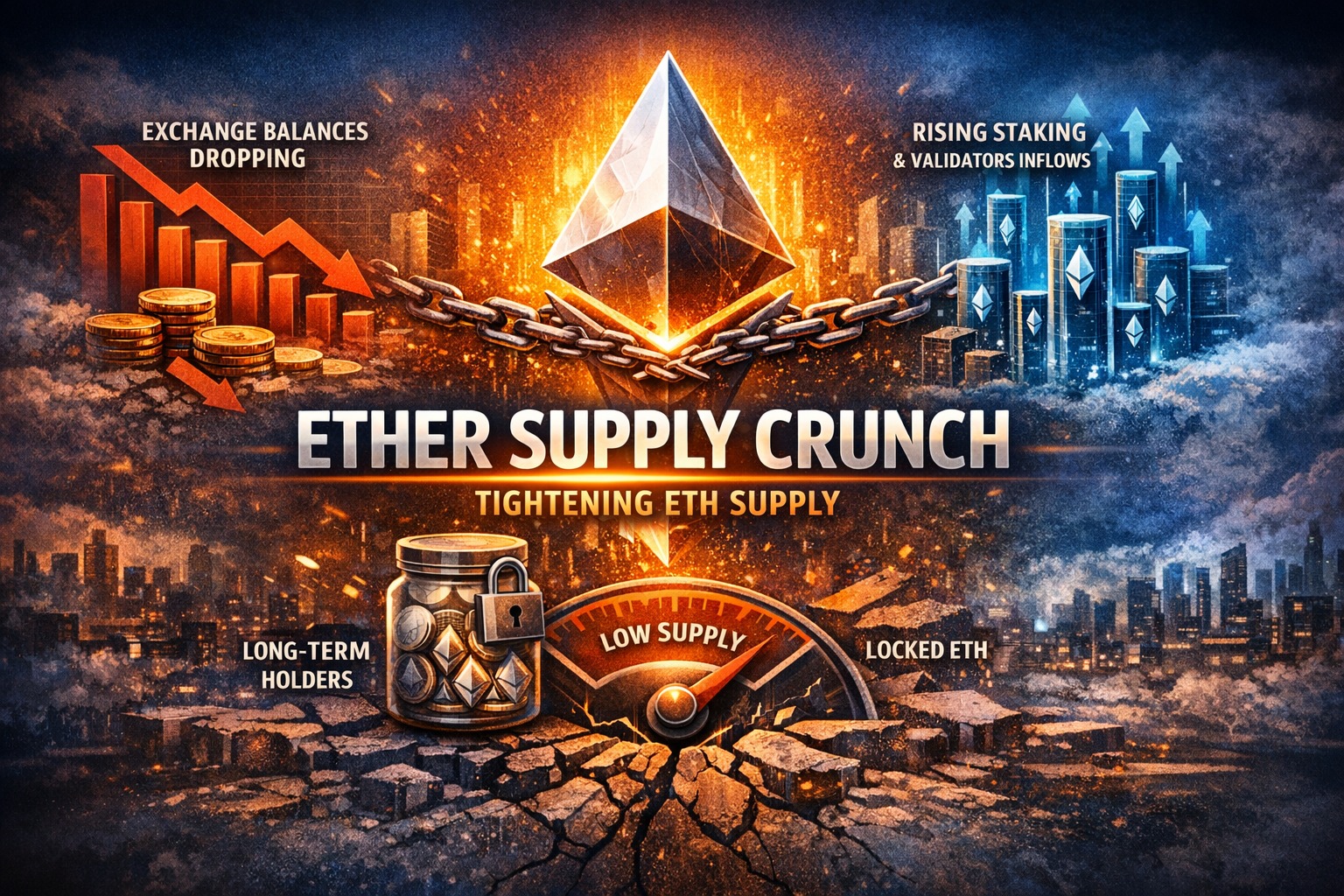
Ether Supply Crunch Signals Tightening ETH Supply
Ether Supply Crunch is less about scarcity in absolute terms and more about where ETH is choosing to reside within the system. Capital is gradually moving away from places designed for liquidity and into structures that prioritize yield, security, or long-term positioning. This shift reduces the visibility of supply rather than its existence, making the market appear stable even as tradable inventory tightens. The result is a quieter form of imbalance, where the absence of selling pressure is not obvious until liquidity is tested.
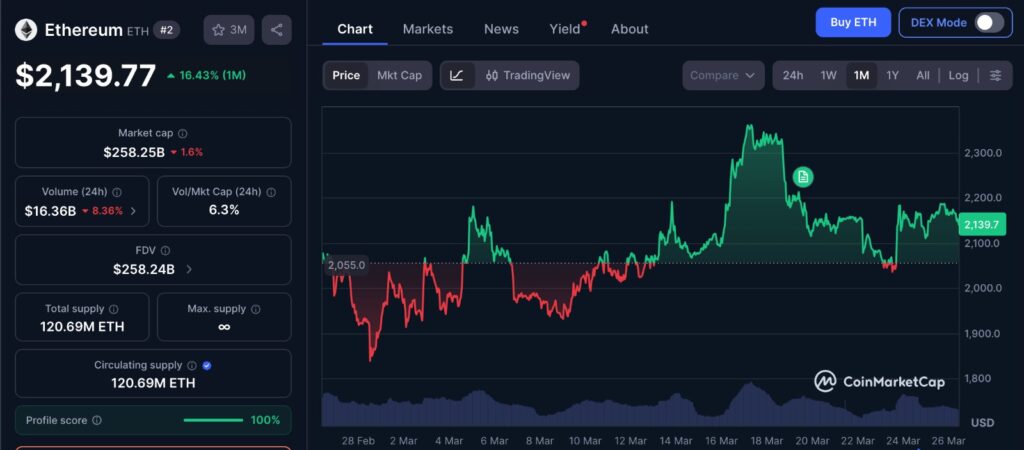
Over the past month, ETH price action has remained relatively range-bound despite underlying supply tightening, reflecting a market where structural shifts are not yet translating into directional conviction. The chart shows periods of upward movement followed by quick retracements, suggesting that liquidity remains responsive to short-term flows rather than long-term positioning. This behavior aligns with the broader supply narrative, where reduced sell-side availability has not yet been met with sustained demand. As a result, price continues to move within a contained range even as underlying conditions gradually evolve.
Ether Supply Crunch reflected in declining exchange balances
The most direct signal of the Ether Supply Crunch is the steady decline in ETH held on centralized exchanges. Exchange balances represent the portion of supply that can be sold with minimal friction, so when these balances fall, it reduces immediate sell-side liquidity.
Current data shows ETH reserves on exchanges at multi-year lows. This is not a short-term reaction to volatility but a consistent outflow trend, suggesting that holders are deliberately moving assets into self-custody or deploying them elsewhere.
From a market structure perspective, this reduces the amount of ETH available for active trading. With fewer coins sitting on exchanges, large sell orders require more effort to execute without impacting price, which gradually alters liquidity conditions.
Ether Supply Crunch supported by rising staking participation
Staking is a central driver behind the Ether Supply Crunch because it removes ETH from circulation in a predictable and persistent way. A significant portion of total supply is now locked in staking contracts, where it is used to validate transactions and secure the network.
Unlike assets sitting on exchanges, staked ETH cannot be instantly accessed or sold. It must go through a withdrawal process, which introduces both time and friction. This effectively converts liquid supply into semi-illiquid supply.
The key detail here is that staking is not speculative behavior. Participants are committing capital for yield and network participation, which indicates a longer-term holding horizon. As more ETH moves into staking, the freely tradable supply continues to compress.
Ether Supply Crunch driven by validator queue imbalance
The validator queue provides another layer of insight into the Ether Supply Crunch. Data shows that the number of validators waiting to enter the network significantly exceeds those exiting.
This imbalance means that more ETH is continuously being locked into staking than being released back into circulation. The effect is cumulative rather than immediate. Each new validator adds to the portion of supply that is temporarily inaccessible to the market.
From a structural standpoint, this creates a one-directional flow of supply out of liquid markets. Unless the exit queue expands meaningfully, the net result is a persistent tightening of available ETH.
Ether Supply Crunch and reduced sell-side pressure
Exchange outflows are not just a storage decision, they reflect intent. When large amounts of ETH leave exchanges, it suggests that holders are not positioning for immediate selling.
This directly impacts sell-side pressure. With fewer coins available on exchanges, the market becomes less sensitive to sudden selling activity. Liquidity thins out on the sell side, which changes how price responds to both buying and selling flows.
Importantly, this does not imply that price must rise. It simply means that the market requires less demand to absorb available supply compared to a high-liquidity environment.
Ether Supply Crunch versus current market demand
Despite these tightening conditions, ETH price has not shown a strong upward response. This highlights the separation between supply mechanics and demand presence.
A constrained supply environment only influences price when demand interacts with it. At the moment, demand has not expanded enough to fully engage with the reduced liquidity.
This creates a setup where structural conditions are shifting in the background while price remains relatively stable. It reflects a market that is repositioning rather than reacting.
Ether Supply Crunch and long-term holder behavior
Another layer of the Ether Supply Crunch comes from the behavior of long-term holders. A growing share of ETH is being held by addresses that show limited selling activity over extended periods.
This reduces the velocity of supply. Even if ETH is technically circulating, it is not actively participating in market transactions. Lower velocity effectively tightens supply because fewer coins are available to respond to price changes.
This pattern often signals a shift in how participants view the asset. Instead of treating ETH as a trading instrument, it is increasingly positioned as a long-term allocation within the broader crypto ecosystem.
Ether Supply Crunch signals a structural market shift
Taken together, these elements point to a structural change in how ETH supply is distributed. The market is gradually moving away from exchange-driven liquidity toward locked and utility-driven supply.
Staking, decentralized applications, and self-custody all contribute to this transition. Each removes a portion of ETH from immediate circulation, reshaping how liquidity is formed.
This type of shift does not trigger immediate price reactions, but it changes the sensitivity of the market. When supply is tight, even moderate demand can have a disproportionate effect compared to periods of excess liquidity.
Ether Supply Crunch and the global crypto market
Ethereum sits at the center of many onchain activities, which means its supply dynamics influence more than just its own price. A tightening ETH supply affects liquidity across decentralized finance, collateral usage, and protocol interactions.
When ETH becomes less available, it can impact how capital moves through the ecosystem. Protocols that rely on ETH liquidity may experience shifts in participation, while traders adjust to thinner market conditions.
This reinforces the idea that the Ether Supply Crunch is not an isolated development. It reflects a broader change in how capital is allocated and retained within the crypto market.
Editor’s View: Liquidity is leaving faster than attention can follow
What’s notable is not just that supply is tightening, but how quietly it’s happening relative to market attention. Most participants tend to react to visible price moves, while structural changes like staking inflows or exchange outflows develop without urgency. This creates a gap where positioning shifts before sentiment does, meaning the market can look inactive even as underlying conditions evolve. In many cases, it’s this mismatch between perception and positioning that defines how the next phase of price behavior unfolds.
Conclusion
The Ether Supply Crunch is being driven by declining exchange balances, sustained staking growth, validator inflows, and reduced supply velocity from long-term holders. Each factor independently reduces liquid supply, but together they form a consistent tightening trend.
Price has not yet reflected these changes, which indicates that the market is still in a transition phase. The interaction between constrained supply and future demand will determine how this evolving structure ultimately expresses itself in price behavior.
Disclaimer: This content is for informational purposes only and does not constitute financial advice.
Keep yourself updated with the latest crypto news with FYI Gazette
Read more about Memecoins with FYI Gazette
Keep yourself updated with the latest Altcoin News with FYI Gazette
 Bitcoin
  Ethereum
  Tether
  BNB
BNB  XRP
XRP  Solana
  TRON
TRON  Dogecoin
  Litecoin
  Pepe
Pepe