

Ethereum Flippening Odds Are Rising, But Not in the Way Many Expect
Ethereum Flippening Odds are less a measure of competition and more a reflection of how capital is being distributed across different functions within crypto. When investors begin to separate assets by what they do rather than what they represent, relative valuation starts to shift in ways that don’t follow traditional narratives. This kind of behavior usually emerges when market participants are uncertain about where sustained demand will come from, so they diversify across structures instead of committing to a single thesis. In that context, changes in ranking say more about positioning decisions than about one asset overtaking another.
Historically, the flippening implied a single outcome where Ethereum surpasses Bitcoin in market capitalization. That framing assumes both assets compete for the same pool of capital. In practice, capital entering Bitcoin and Ethereum often follows different mandates, which weakens the idea of a zero sum outcome.
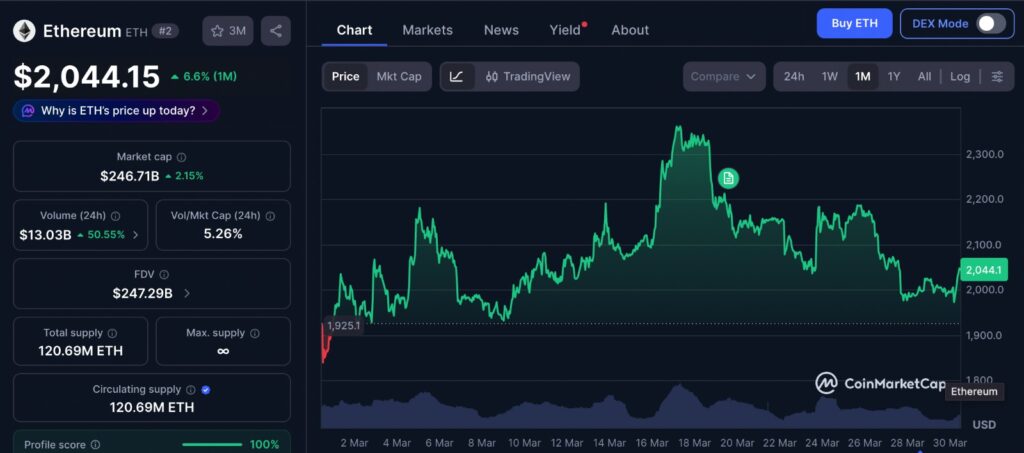
The past month of Ethereum price action reflects a market that is still searching for consistent demand rather than reacting to a single dominant narrative. Price movements have remained sensitive to shifts in liquidity and positioning, suggesting that participants are adjusting exposure rather than building conviction. This kind of behavior often appears when capital is active but not committed, leading to periods where price fluctuates without establishing a clear directional structure. In that sense, the chart captures hesitation more than momentum.
Ethereum Flippening Odds and Market Structure
The increase in Ethereum Flippening Odds is closely tied to how Ethereum generates demand through usage rather than passive holding. Bitcoin’s valuation is largely driven by its scarcity and its role as a monetary asset. Ethereum, in contrast, absorbs demand through transaction fees, smart contract execution, and stablecoin settlement.
This difference matters because usage driven demand behaves differently from narrative driven demand. When users interact with decentralized applications or transfer stablecoins, they create recurring activity that feeds into Ethereum’s economic layer. That activity does not depend on directional price conviction in the same way Bitcoin demand often does.
At the same time, Bitcoin’s strength comes from its predictability. Its supply schedule and limited design reduce uncertainty, which is why it attracts capital seeking stability within crypto. The result is a structural divergence where both assets can expand without directly displacing each other.
Why Ethereum Flippening Odds Do Not Imply Bitcoin Decline
Ethereum Flippening Odds are often misinterpreted as a signal that Bitcoin must lose relevance for Ethereum to gain. That assumption overlooks how capital is segmented. Investors are not reallocating from one asset to the other in a uniform way; they are selecting exposure based on different risk profiles.
Bitcoin is frequently positioned as a reserve asset within crypto portfolios. It absorbs capital that prioritizes liquidity, longevity, and a clear monetary narrative. Ethereum, by contrast, attracts capital that is willing to engage with a more complex system in exchange for exposure to onchain activity.
This separation reduces direct competition. Even if Ethereum grows faster in certain periods, it does not automatically come at Bitcoin’s expense. It simply reflects that different types of demand are expanding at different speeds.
Ethereum Flippening Odds and Institutional Behavior
Institutional participation clarifies why Ethereum Flippening Odds can rise without a direct challenge to Bitcoin. Larger participants rarely treat crypto as a single trade. Instead, they structure exposure across assets based on function.
Bitcoin is typically used as a macro allocation within crypto portfolios. It offers deep liquidity and a relatively stable narrative, which makes it easier to justify within institutional frameworks. Ethereum introduces additional variables, including network upgrades, fee dynamics, and ecosystem growth, which require a different type of risk assessment.
This leads to differentiated positioning. Bitcoin allocations are often static and long term, while Ethereum allocations can be more responsive to changes in network activity. The two assets therefore attract capital under different conditions, which reduces the likelihood of a direct replacement dynamic.
Ethereum Flippening Odds and Network Activity
Ethereum Flippening Odds are also influenced by the scale of activity on its network. Unlike Bitcoin, where transactions primarily represent value transfer, Ethereum transactions often represent interaction with applications.
This creates layered demand. Stablecoin transfers, decentralized finance activity, and token issuance all contribute to Ethereum’s economic throughput. Each of these activities requires users to pay fees, which ties network usage directly to value capture.
However, this structure introduces variability. If activity slows, demand linked to usage can contract quickly. Bitcoin does not face the same sensitivity because its value proposition is less dependent on continuous interaction. This difference explains why Ethereum’s growth can be more dynamic but also less stable.
Rethinking the Ethereum Flippening Odds Narrative
The conventional flippening narrative assumes a clear hierarchy where one asset overtakes another. Current market behavior suggests a different outcome. Ethereum Flippening Odds can increase without leading to a definitive shift in dominance because the underlying drivers of value are no longer identical.
Markets tend to assign value where activity or scarcity creates consistent demand. Bitcoin satisfies one side of that equation, while Ethereum satisfies another. As these drivers operate independently, the need for a single dominant asset becomes less relevant.
This reframing shifts the focus from competition to coexistence. The market is not choosing between two assets; it is distributing capital across different functions within the same ecosystem.
Ethereum Flippening Odds and Long Term Implications
Ethereum Flippening Odds may continue to rise as its ecosystem expands, but that expansion does not inherently displace Bitcoin. Instead, it reflects that the crypto market is accommodating multiple forms of value.
Bitcoin’s role remains anchored in its monetary characteristics, while Ethereum’s role evolves alongside its network activity. These roles are not interchangeable, which is why both assets can maintain significance even as their relative valuations change.
In traditional finance, different asset classes coexist because they serve distinct purposes. Crypto appears to be moving in a similar direction, where differentiation replaces direct competition.
Editor’s View: Ethereum Flippening Odds and Positioning Behavior
Ethereum Flippening Odds often rise during periods when participants are trying to express exposure without committing to a single narrative. What stands out is not just where capital goes, but how cautiously it moves between assets with different risk profiles. When positioning becomes fragmented, it usually signals that conviction is uneven rather than absent. That kind of environment tends to produce shifts in relative valuation that are driven more by allocation adjustments than by strong directional belief.
Conclusion: Ethereum Flippening Odds Reflect Market Maturity
Ethereum Flippening Odds highlight how the crypto market is evolving from a single narrative into a system with multiple layers of value. Bitcoin and Ethereum are no longer competing within the same framework, which reduces the relevance of a binary outcome.
Ethereum’s growth does not signal Bitcoin’s decline. It indicates that demand is being distributed based on utility, activity, and structure. As this process continues, the idea of the flippening may shift from a decisive event to a reflection of how capital organizes itself within an increasingly complex market.
Disclaimer: This content is for informational purposes only and does not constitute financial advice.
Keep yourself updated with the latest crypto news with FYI Gazette
Read more about Memecoins with FYI Gazette
Keep yourself updated with the latest Altcoin News with FYI Gazette
 Bitcoin
  Ethereum
  Tether
  BNB
BNB  XRP
XRP  Solana
  TRON
TRON  Dogecoin
  Litecoin
  Pepe
Pepe