Ethereum Institutional Adoption Defies ETH Slump
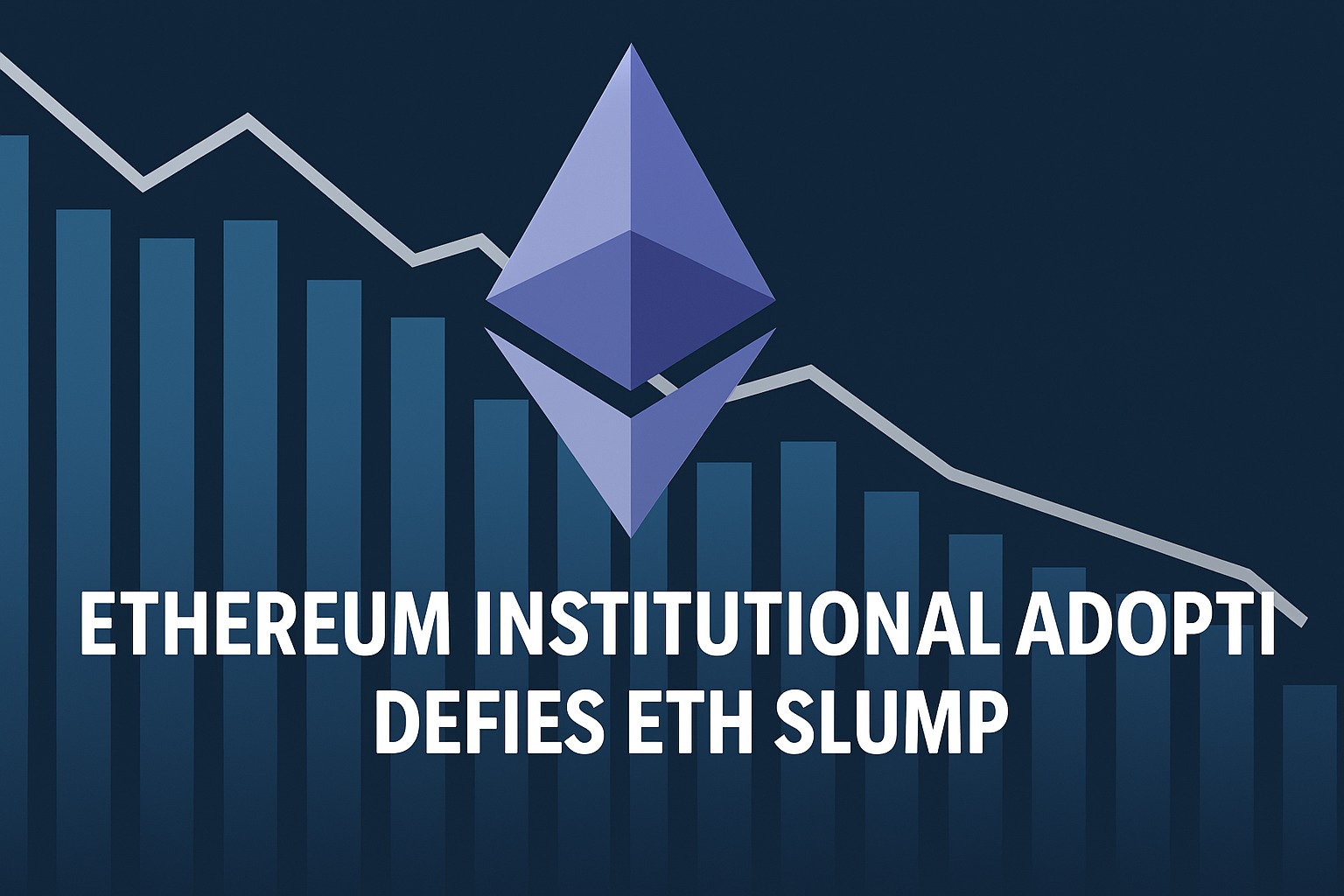
Ethereum Institutional Adoption continues to accelerate even as Ether struggles with disappointing price performance in 2026. ETH has fallen 36% this year and is now trading near the 1,900 dollar level, making the 3,000 dollar target feel increasingly distant. While the price decline has frustrated investors, the underlying structure of the Ethereum network remains resilient.
During the first two months of 2026, Ether underperformed the broader crypto market by 9%. This relative weakness suggests that macro conditions alone do not fully explain the correction. Network activity has also slowed. Decentralized exchange volumes on Ethereum dropped 55% over the past six months, compared with a 21% decline on Solana during the same timeframe.
Ethereum’s monthly DEX volumes fell to 56.5 billion dollars in February 2026, down sharply from 128.5 billion dollars in August 2025. Meanwhile, Solana reached 95.5 billion dollars in monthly volume, down from 120.6 billion dollars during its peak. This contraction in activity has reduced network fees and decentralized application revenue, lowering short term incentives for holding Ether.
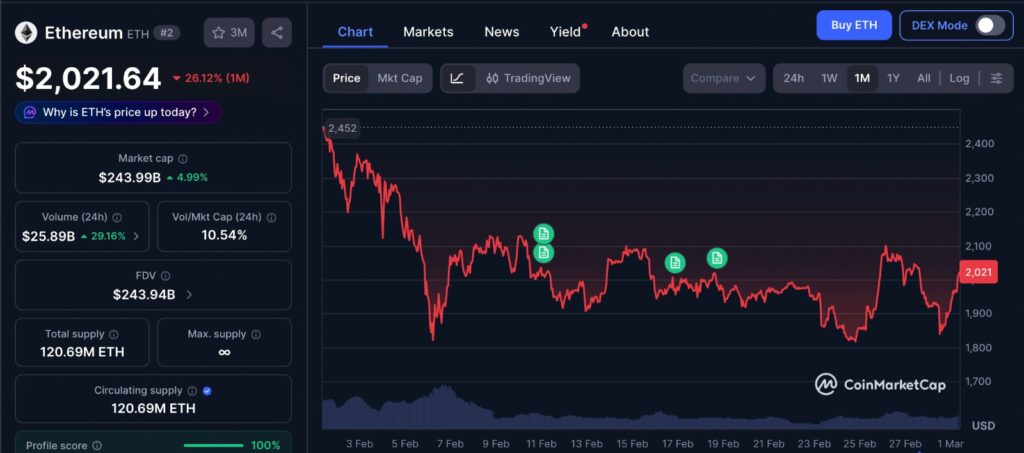
The one month chart highlights how Ether has struggled to establish sustained upward momentum, with rallies fading before reclaiming higher resistance levels. While short term volatility remains elevated, the broader structure shows consolidation rather than extreme capitulation. Price compression near recent lows suggests the market is still searching for equilibrium as traders weigh weakening activity metrics against steady institutional engagement. This balance between caution and accumulation continues to define the current phase.
Ethereum Institutional Adoption outpaces price weakness
Despite declining trading volumes and lower fee generation, Ethereum Institutional Adoption remains strong. Ethereum controls 57% of total value locked, equal to 52.4 billion dollars. When including layer 2 networks such as Base, Arbitrum, Polygon, and Optimism, that dominance rises to 65%.
In comparison, Solana holds 6.4 billion dollars in TVL, while BNB Chain accounts for 5.5 billion dollars locked in smart contracts. These figures reinforce Ethereum’s leadership in decentralized finance infrastructure.
Major financial institutions continue building on Ethereum. JP Morgan Asset Management, Citi, Deutsche Bank, and BlackRock have launched blockchain initiatives tied to the network. These include tokenized funds, dedicated layer 2 rollups, and bank issued stablecoins. Ethereum also commands 68% of the Real World Assets sector, strengthening its position in tokenized financial products.
TVL dominance supports Ethereum Institutional Adoption
While critics focus on declining exchange volumes, total value locked offers a broader perspective. TVL reflects capital committed to lending platforms, staking systems, liquidity pools, and tokenized instruments. Ethereum’s sustained leadership in this metric suggests long term capital remains engaged despite price volatility.
Ethereum’s rollup based scaling strategy has faced criticism. Competing chains such as Tron and Solana currently generate higher network fees in certain periods. However, no competing blockchain has matched Ethereum’s overall monetary value secured onchain. Even highly successful ecosystems such as Hyperliquid maintain roughly 1.5 billion dollars in TVL, far below Ethereum’s scale.
Scalability roadmap strengthens Ethereum Institutional Adoption
Development continues at a steady pace. Ethereum co founder Vitalik Buterin has shifted focus toward strengthening the base layer rather than relying heavily on rollups. Proposed improvements include parallel block verification, aligning gas costs with actual execution time, and implementing a zero knowledge Ethereum Virtual Machine known as ZK EVM.
These upgrades aim to improve scalability, efficiency, and long term security. The rollout will occur gradually, beginning with voluntary participation before expanding toward broader adoption of ZK EVM based confirmation systems.
Ethereum’s roadmap also addresses long term technological risks. Plans are in place to prepare the network for the quantum computing era. Quantum resistant signatures are larger and more complex to verify, but development continues around privacy focused proof systems and recursive signature aggregation. Vectorized math precompiles are being explored to reduce gas costs linked to advanced cryptographic functions.
Editor’s View: Institutional patience versus retail frustration
One noticeable pattern in this cycle is the widening gap between institutional behavior and retail sentiment. Retail participants often anchor their expectations to previous highs, which makes a prolonged drawdown feel like structural weakness. Institutions, by contrast, tend to assess infrastructure durability and regulatory positioning over multi-year horizons rather than quarter-to-quarter performance. The frustration visible in price action does not automatically reflect a loss of confidence at the infrastructure level, and that divergence can persist longer than many expect.
Long term vision behind Ethereum Institutional Adoption
The focus on base layer scalability and quantum readiness reflects a longer horizon. Price performance can fluctuate sharply, but infrastructure development unfolds over multi year timelines. Ethereum’s strategy centers on maintaining decentralization while increasing throughput capacity and security guarantees.
Some observers have labeled the rollup first approach a mistake. However, it allowed scalability experimentation without compromising the base layer. Adjustments to this strategy demonstrate flexibility rather than weakness.
Ether may be down 36% in 2026 and nearly 60% below its prior high, but institutional participation has not retreated proportionally. Traditional finance firms continue embedding Ethereum into tokenization strategies, stablecoin issuance, and onchain settlement systems.
The divergence between price action and infrastructure growth reflects a maturing market dynamic. Retail sentiment reacts quickly to volatility, while institutions evaluate long term positioning. Ethereum Institutional Adoption signals that structural conviction in the network remains intact despite short term weakness.
Disclaimer: This content is for informational purposes only and does not constitute financial advice.
Keep yourself updated with the latest crypto news with FYI Gazette
Read more about Memecoins with FYI Gazette
Keep yourself updated with the latest Altcoin News with FYI Gazette
 Bitcoin
  Ethereum
  Tether
  XRP
XRP  BNB
BNB  Solana
  TRON
TRON  Dogecoin
  Litecoin
  Pepe
Pepe