
Ethereum vs Bitcoin Strength Gap Analysis
Ethereum vs Bitcoin continues to be one of the most important relationships in the cryptocurrency market, shaping how investors interpret both risk and opportunity across the broader digital asset landscape. While Ethereum remains dominant in developer activity and network usage, its price behavior relative to Bitcoin paints a more complex picture. The contrast between strong fundamentals and cautious market sentiment has once again become a defining theme.
Layer 1 networks frequently oscillate between phases driven by conviction and phases dominated by speculation. Ethereum provides a clear illustration of this tension. From a development perspective, Ethereum remains far ahead of competing chains. Deployed contracts reached a record 9.1 million in Q4 2025, a milestone achieved despite significant price weakness. During the same period, Ethereum experienced a 45 percent correction, marking its worst quarterly performance since the prolonged downturn of the 2018 bear market.
This divergence between price and builder activity is notable. Rather than retreating during market stress, developers continued expanding the network. Such resilience often signals long term confidence among participants who focus on infrastructure, applications, and protocol improvements rather than short term volatility. In many cases, sustained developer engagement has historically preceded periods of renewed network growth.
However, strong development metrics alone do not guarantee immediate price appreciation. Markets often respond to a wider set of influences, including liquidity conditions, sentiment shifts, and macro driven narratives. This creates situations where network progress and valuation trends move in different directions for extended periods.
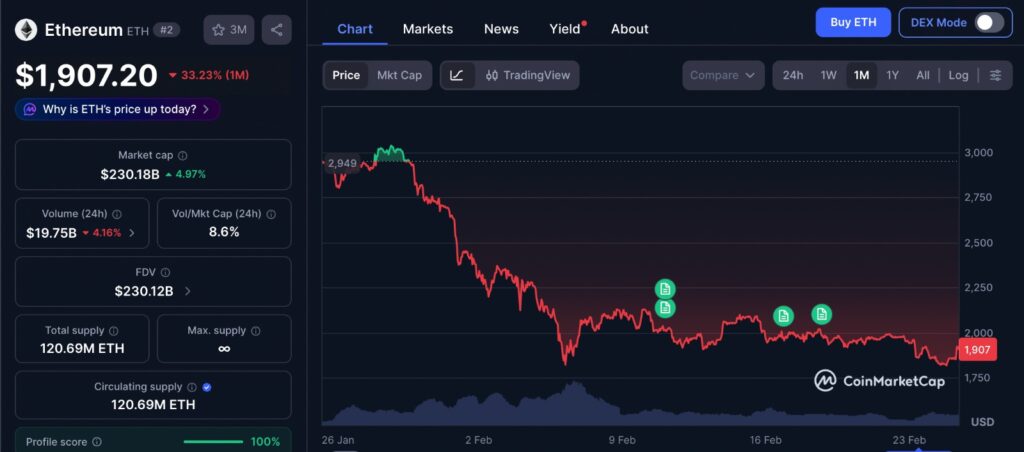
The one month price structure offers a useful snapshot of how Ethereum vs Bitcoin dynamics are currently being interpreted by the market. Short term fluctuations often reflect positioning, risk management, and liquidity shifts rather than changes in underlying network strength. Periods of consolidation or abrupt moves can emerge from leverage adjustments and sentiment rotations, which may not always align with fundamental developments. Viewed in this context, recent price behavior becomes less about directional meaning and more about how participants are recalibrating exposure within a broader risk environment.
Ethereum vs Bitcoin and On Chain Activity
Ethereum’s developer momentum has translated into visible on chain growth. Across multiple usage indicators, the network continues to demonstrate strong engagement. NFT volume, for example, places Ethereum in a leading position, with 12.6 million dollars flowing through the ecosystem. This reflects persistent demand for Ethereum’s settlement and execution environment despite broader market uncertainty.
Decentralized application activity has expanded even more dramatically. Weekly DApp engagement surged by 1,135 percent, reaching 180 billion dollars. Such growth underscores increasing interaction across decentralized finance protocols, smart contract operations, and other network driven services. The scale of this expansion suggests that developer output is directly contributing to real network utilization.
Yet price performance has not fully mirrored these improvements. Ethereum continues to trail Bitcoin by nearly 1.5 times, a gap that stands out when compared to historical rally cycles. In earlier market phases, periods of rising Ethereum network activity often coincided with strengthening relative price performance against Bitcoin. The current environment instead reflects a disconnect between ecosystem growth and investor positioning.
This disparity naturally prompts debate about whether Ethereum can replicate its previous relative outperformance.
Ethereum vs Bitcoin and Market Sentiment
Short term conditions appear to be exerting pressure on Ethereum’s trajectory. Despite robust network metrics, Ethereum’s price has struggled to sustain upward momentum, at times slipping below the 2,000 dollar level. Such movements contribute to a perception of fragility, particularly when contrasted with Bitcoin’s relative stability.
At the same time, broader market indicators point to sentiment dominated by leverage rather than accumulation. On chain data suggest that speculative positioning plays a significant role in current activity, while clear evidence of sustained spot buying remains limited. A leverage heavy environment often amplifies volatility and weakens the durability of price recoveries.
The ETH to BTC ratio further reinforces this cautious outlook. Although the pair continues to trade within a relatively tight range, it still registered a weekly decline of 0.28 percent. Even modest downward adjustments in this ratio carry significance, as they imply that Ethereum is losing ground to Bitcoin rather than attracting rotational capital.
Ethereum vs Bitcoin and Capital Rotation
Rotational flows between major crypto assets are central to relative performance cycles. Historically, strong Ethereum outperformance required meaningful capital movement away from Bitcoin. In the current landscape, such transitions appear limited. Bitcoin continues to dominate attention, liquidity, and narrative strength.
Without decisive BTC to ETH flows, Ethereum’s relative price strength faces structural challenges. The absence of rotation contributes to a market structure where short term speculative trades overshadow conviction driven positioning. Under these conditions, price movements become increasingly sensitive to leverage dynamics instead of fundamental growth narratives.
This framework also shapes expectations regarding past performance patterns. The relative gains observed in Q2 2025 were supported by favorable sentiment shifts and stronger capital rotation. Present indicators suggest a different setup, characterized by hesitation, range bound behavior, and selective risk appetite rather than broad based expansion.
Ethereum vs Bitcoin Conviction vs Speculation
Speculation appears to be exerting a stronger influence than conviction. Traders remain highly responsive to short term fluctuations, while longer term positioning signals remain comparatively muted. Even strong network level metrics struggle to alter price trends when broader sentiment remains cautious.
Such conditions place constraints on Ethereum’s relative outlook. This does not diminish Ethereum’s ecosystem strength or its role within the digital asset economy. Instead, it highlights the persistent influence of behavioral, liquidity, and sentiment driven factors that frequently override fundamentals in the short term.
Markets do not always reward structural growth immediately. In periods of uncertainty, participants often prioritize perceived safety, momentum, and liquidity concentration, dynamics that currently favor Bitcoin.
Editor’s View: Why Market Behavior Often Diverges From Network Growth
One recurring pattern in crypto markets is that participants often struggle to assign value to slow, infrastructure driven progress during periods of uncertainty. Developer growth and rising on chain usage rarely generate the same immediate emotional response as price momentum, which tends to dominate short term decision making. In that environment, even strong network metrics can be overshadowed by caution, profit protection, or simple fatigue after extended volatility. This behavioral imbalance helps explain why assets with improving fundamentals may still experience muted relative performance.
Final Summary on Ethereum vs Bitcoin
Ethereum’s developer activity and on chain growth remain at historically elevated levels, reinforcing the network’s long term resilience and relevance. However, price behavior continues to reflect weaker conviction, with Ethereum trailing Bitcoin by nearly 1.5 times. Leverage driven sentiment and the absence of strong BTC rotation flows suggest that repeating the relative gains seen in Q2 2025 appears unlikely under prevailing conditions.
If current trends persist, Ethereum may continue facing relative weakness against Bitcoin in the near term, even as its underlying ecosystem metrics remain strong.
Disclaimer: This content is for informational purposes only and does not constitute financial advice.
Keep yourself updated with the latest crypto news with FYI Gazette
Read more about Memecoins with FYI Gazette
Keep yourself updated with the latest Altcoin News with FYI Gazette
 Bitcoin
  Ethereum
  Tether
  XRP
XRP  BNB
BNB  Solana
  TRON
TRON  Dogecoin
  Litecoin
  Pepe
Pepe