
Hyperliquid Yield Strategy Drives Whale Confidence in HYPE
Hyperliquid Yield Strategy is becoming a key reason why large investors are accumulating and holding HYPE tokens instead of engaging in short-term speculation. Recent on-chain data shows that whales are making calculated decisions based on staking rewards, liquidity stability, and consistent fee generation rather than quick price swings.
This shift highlights a growing preference for structured yield over volatility-driven trading. Whales appear to be treating HYPE as a long-term asset tied closely to protocol performance, not just market sentiment.
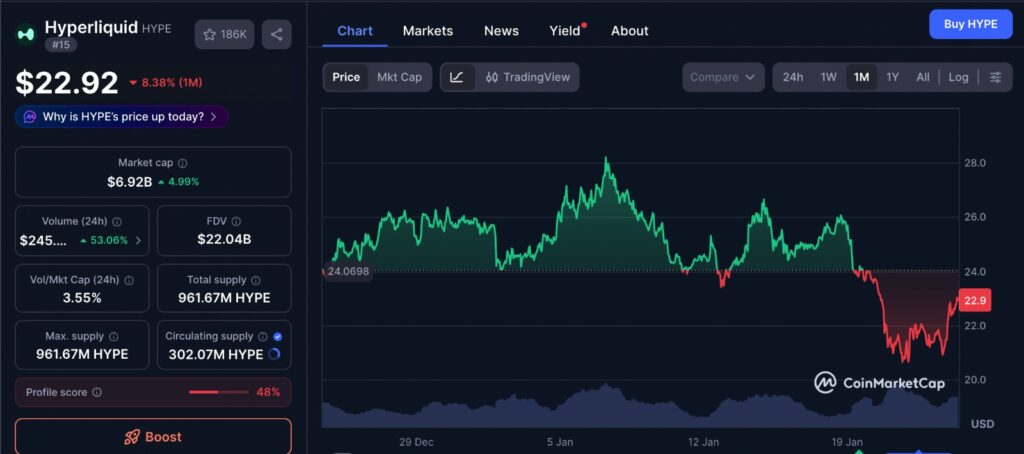
Viewed over the past month, price movement reflects a market that is more patient than reactive. Rather than sharp breakouts or aggressive sell-offs, the chart suggests periods of consolidation where activity cools without collapsing. This kind of behavior often appears when participants are more focused on positioning and yield than on short-term momentum. In practical terms, it signals a market that is waiting for confirmation rather than forcing direction.
Hyperliquid Yield Strategy and Whale Accumulation Patterns
Whale activity around HYPE has shown clear signs of deliberate accumulation. Instead of buying large amounts in a single transaction, whales have been purchasing tokens in smaller, repeated batches. One notable wallet added roughly 20,800 HYPE per transaction, gradually building a position of over 250,000 tokens.
This approach helps reduce price impact while allowing steady exposure. More importantly, these tokens were not quickly sold or moved back to exchanges. Instead, they were held or staked, signaling confidence in the yield mechanics offered by Hyperliquid.
Such accumulation patterns suggest whales are less interested in timing market tops and bottoms. Their focus is on positioning themselves early to benefit from predictable staking rewards and protocol-driven returns.
Hyperliquid Yield Strategy and Declining Exchange Supply
As whales move HYPE into staking contracts or long-term storage, exchange balances continue to decline. This reduction in available supply plays a critical role in market stability.
When fewer tokens are readily available for sale, downside pressure becomes limited. Even during periods of reduced trading activity, the market experiences less aggressive selling. This dynamic supports price consolidation and reduces sudden volatility spikes.
The yield strategy reinforces this behavior. Staking locks tokens for a period of time, discouraging impulsive exits and encouraging longer holding cycles. As more supply shifts away from exchanges, the market structure becomes more resilient.
Hyperliquid Yield Strategy Supported by Liquidity and Fees
One of the strongest pillars behind whale confidence is Hyperliquid’s sustained liquidity growth. Total value locked rose significantly over time, moving from roughly $2 billion to nearly $6 billion before settling into a stable range between $4 billion and $5 billion.
This stability matters. It shows that capital is not simply flowing in and out for short-term gains. Instead, liquidity remains anchored by active users who rely on the platform’s trading volume and fee generation.
Daily fees frequently reached several million dollars, demonstrating consistent usage. These fees directly support staking rewards, making the yield strategy more reliable and attractive for large holders.
For whales, steady fee generation is more important than brief spikes in activity. It provides reassurance that the protocol can continue to reward long-term participants even during quieter market phases.
How Whales Use the Hyperliquid Yield Strategy for Profits
Whales are not just accumulating and staking blindly. They also plan exits carefully. One large holder recently moved over 665,000 HYPE tokens to an exchange, realizing profits exceeding $7 million after previously accumulating at lower average prices.
This profit-taking was not rushed. It followed a long staking period where rewards were earned at an annual yield of around 2.3 percent. Hyperliquid’s staking structure includes short lockups and a seven-day unstaking queue, giving whales flexibility while still encouraging commitment.
These mechanics allow whales to align exits with yield cycles rather than emotional market reactions. Profit realization becomes a calculated step in a broader strategy rather than a response to short-term price changes.
Market Impact of the Hyperliquid Yield Strategy
The yield-focused behavior of whales has mixed implications for the broader market. On one hand, reduced exchange supply and long-term staking improve stability and confidence. On the other hand, whale movements do not always translate into immediate price increases.
There have been instances where large transfers failed to push prices higher. This shows that yield strategies operate independently of short-term price action. Whales may prioritize reward accumulation even if price momentum remains neutral.
For retail participants, this highlights the importance of understanding context. Whale activity driven by yield does not guarantee rapid appreciation, but it does suggest confidence in the protocol’s fundamentals.
Why the Hyperliquid Yield Strategy Signals Long-Term Confidence
The growing reliance on yield marks a broader evolution in how large investors approach decentralized finance. Rather than treating platforms as speculative playgrounds, whales are focusing on sustainability, predictable returns, and liquidity efficiency.
Hyperliquid’s structure supports this shift. With consistent fees, strong liquidity, and flexible staking rules, it offers an environment where long-term strategies can thrive.
That said, yield strategies are not risk-free. Market conditions, protocol changes, and broader crypto sentiment still play a role. However, the disciplined behavior of whales shows a clear preference for stability over speculation.
Editor’s View: Why Yield Changes Whale Behavior
Large holders tend to behave differently when returns are predictable rather than reactive. Yield-based strategies shift decision-making away from short-term price stress and toward operational patience, where timing matters less than consistency. This often results in fewer impulsive moves and more tolerance for sideways markets, even when sentiment weakens. In that context, staking becomes less about maximizing returns and more about reducing the need to constantly be right about price direction.
What to Watch Next in the Hyperliquid Ecosystem
Investors tracking the Hyperliquid yield strategy should monitor several key metrics. Wallet flows can indicate whether whales are accumulating, staking, or preparing to exit. Changes in total value locked and daily fees reveal the health of protocol activity.
Staking yields and lockup conditions also matter, as they influence timing decisions for large holders. Finally, overall market structure and sentiment will shape how yield strategies affect price action over time.
In summary, the Hyperliquid yield strategy explains why whales continue to accumulate, stake, and selectively take profits in HYPE. By prioritizing yield and liquidity over short-term speculation, large holders are reinforcing a more mature and sustainable market dynamic
Disclaimer: This content is for informational purposes only and does not constitute financial advice.
Keep yourself updated with the latest crypto news with FYI Gazette
Read more about Memecoins with FYI Gazette
Keep yourself updated with the latest Altcoin News with FYI Gazette
 Bitcoin
  Ethereum
  Tether
  XRP
XRP  BNB
BNB  Solana
  TRON
TRON  Dogecoin
  Litecoin
  Pepe
Pepe