
Polygon Stablecoin Bet Signals $250M Push Into Payments
Polygon Stablecoin Bet has become a major talking point in the crypto industry as Polygon Labs commits more than $250 million toward expanding stablecoin payment infrastructure. While the move reflects long-term ambition and strategic planning, the market response has been cautious, with the POL token still facing noticeable price pressure.
Polygon Labs recently revealed plans to acquire two crypto-focused companies, Coinme and Sequence, as part of its broader effort to build a strong, regulated payments ecosystem. These acquisitions form the backbone of what Polygon calls its Open Money Stack, an initiative aimed at making stablecoin payments easier, faster, and more accessible for businesses and institutions.
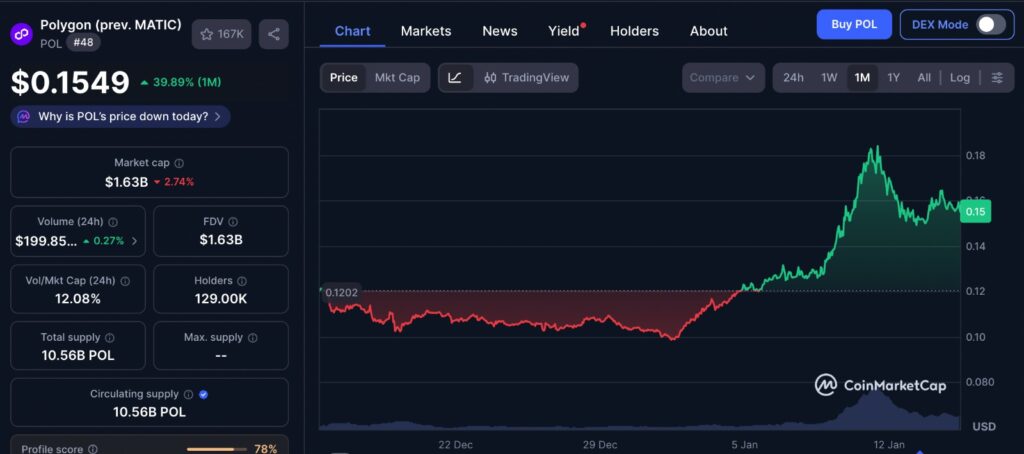
Viewed over a one-month window, POL’s price action reflects consolidation rather than clear directional conviction. The chart shows sharp reactions around news-driven moments, followed by periods where price movement narrows and volume tapers off. This pattern suggests that short-term traders are active, but longer-term participants are still assessing whether recent developments justify repositioning. In practical terms, the chart captures a market that is responsive, but not yet persuaded.
Polygon Stablecoin Bet and the Shift Toward Payments
The Polygon Stablecoin Bet marks a clear shift in focus from pure blockchain scalability toward real-world financial use cases. Stablecoins are increasingly being used for payments, remittances, and settlements, especially as regulatory clarity improves in key markets such as the United States.
Polygon’s leadership believes that stablecoins are positioned to become a core financial tool rather than just a trading instrument. By investing heavily in payment infrastructure, Polygon aims to sit at the center of this transformation and support both traditional businesses and crypto-native firms.
Rather than competing directly with banks or payment giants, Polygon’s strategy focuses on providing the underlying blockchain rails that power these services. This approach emphasizes partnerships and compliance, which are critical for long-term adoption.
Polygon Stablecoin Bet: Breaking Down the $250 Million Acquisitions
Coinme’s Role in the Polygon Stablecoin Bet
Coinme brings regulatory strength and physical infrastructure to Polygon’s ecosystem. It is a licensed money transmitter operating across most U.S. states and connects users to crypto through thousands of retail locations and ATMs.
This acquisition allows Polygon to bridge the gap between traditional finance and blockchain technology. With Coinme’s existing compliance framework, Polygon gains a regulated entry point into fiat-to-crypto and crypto-to-fiat services, which are essential for large-scale stablecoin adoption.
Coinme’s presence also supports Polygon’s ambition to operate within U.S. regulatory boundaries rather than outside them.
Sequence and Wallet Infrastructure
Sequence complements Coinme by focusing on the technical side of blockchain payments. It offers smart wallet solutions and cross-chain capabilities that simplify how users interact with blockchain networks.
For Polygon, this means better user experience, smoother onboarding, and easier integration for developers building payment solutions. Wallet infrastructure is a key piece of the stablecoin puzzle, and Sequence strengthens Polygon’s ability to support high-volume, real-world transactions.
Polygon Stablecoin Bet and the Open Money Stack
The Open Money Stack is designed to combine payments, wallets, identity, compliance, and cross-chain transfers into one unified system. Polygon envisions this stack as a foundation for global money movement powered by stablecoins.
This system aims to reduce friction in cross-border payments, lower costs, and improve transaction speed. For businesses, it offers an alternative to traditional settlement systems that are often slow and expensive.
By owning critical components of this stack through acquisitions, Polygon increases control over its ecosystem and reduces reliance on third-party services.
Polygon Stablecoin Bet: Network Activity Remains Strong
Despite uncertainty around POL’s price, on-chain activity on the Polygon network remains solid. Daily transaction counts have stayed consistently high, averaging millions of transactions per day.
Active addresses also remain strong, indicating continued user engagement. Over the past year, Polygon processed more than one billion transactions, reinforcing its position as one of the most active blockchain networks.
This usage supports the idea that Polygon’s infrastructure is already battle-tested and capable of handling large-scale payment activity.
Polygon Stablecoin Bet and POL Token Performance
While the long-term strategy appears ambitious, the short-term market reaction has been less enthusiastic. Following the acquisition announcement, POL saw a brief price spike but quickly pulled back.
Selling pressure increased as traders took profits, leading to a decline toward key support levels. Technical indicators reflected growing bearish momentum, even though buyers continued to defend important price zones.
If selling pressure continues, POL could revisit lower support levels. On the other hand, renewed confidence in Polygon’s payment strategy could push the token back toward recent highs.
The disconnect between ecosystem growth and token performance highlights a common challenge in crypto markets, where infrastructure progress does not always translate immediately into price appreciation.
Polygon Stablecoin Bet and Broader Industry Trends
Polygon’s move aligns with a broader industry shift toward blockchain-based payment systems. Stablecoins are increasingly viewed as practical tools for everyday financial activity rather than speculative assets.
As regulations evolve and institutions show greater interest in blockchain infrastructure, platforms that prioritize compliance and scalability may gain a competitive advantage.
Polygon’s emphasis on U.S.-based operations and regulated services positions it well within this changing landscape.
Editor’s View: Why the Market Reaction Feels Muted
What stands out is not that POL failed to rally, but that traders treated the news as operational rather than transformational. Large infrastructure moves tend to attract builders first and speculators later, especially when the benefits are indirect and take time to surface. Many market participants still anchor token value to immediate narratives like liquidity, incentives, or hype, not backend payments infrastructure. In that context, the restrained price response reflects caution more than rejection, as capital waits for clearer signs of how these assets translate into measurable on-chain demand.
Final Thoughts on the Polygon Stablecoin Bet
The Polygon Stablecoin Bet represents a calculated push into one of the most promising areas of the crypto industry. With over $250 million committed to infrastructure, Polygon is signaling confidence in the future of stablecoin payments.
Strong network activity and growing adoption support the strategic vision, even as POL’s price struggles in the short term. The success of this bet will depend on execution, regulatory developments, and broader market conditions.
If Polygon can successfully integrate its new acquisitions and deliver on the Open Money Stack, it may emerge as a key player in global digital payments, regardless of short-term market volatility.
Disclaimer: This content is for informational purposes only and does not constitute financial advice.
Keep yourself updated with the latest crypto news with FYI Gazette
Read more about Memecoins with FYI Gazette
Keep yourself updated with the latest Altcoin News with FYI Gazette
 Bitcoin
  Ethereum
  Tether
  XRP
XRP  BNB
BNB  Solana
  TRON
TRON  Dogecoin
  Litecoin
  Pepe
Pepe