
Pump Fun Denies $436M Cash Out Allegations
Pump Fun co-founder Sapijiju has denied claims that the project cashed out more than 436 million dollars in stablecoins, explaining that the large fund movements were part of routine treasury management rather than any kind of sell-off. His comments followed public concern sparked by blockchain analytics reports, which interpreted the transfers as a potential mass liquidation. According to the co-founder, the assumptions were based on misinformation and did not reflect the real purpose behind the transactions.
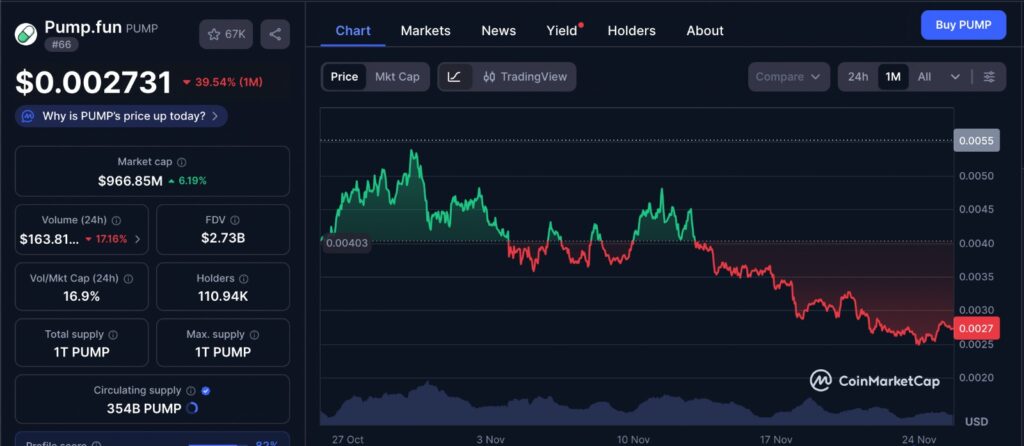
The newly added one-month price chart from CoinMarketCap further illustrates how sentiment around Pump Fun has shifted during this period. The chart shows a steady downward trend, reflecting increasing market caution as questions about treasury movements surfaced. Short-term rallies appear limited, and daily trading activity shows noticeable fluctuations as investors react to ongoing discussions about transparency and fund management. Overall, the visual data reinforces the market’s sensitivity to both project communication and broader memecoin volatility.
Pump Fun treasury management and the source of transferred funds
The central point in the dispute involves the movement of USDC originally obtained through the PUMP token’s initial coin offering. In his statement, Sapijiju clarified that the transfers did not represent a sale. Instead, he described them as a reorganization of the company’s internal wallets. Pump Fun, he said, was distributing its ICO funds across different wallets so the project could better manage its capital, reinvest in its business, and maintain operational stability.
Treasury management for a crypto project generally includes allocating, storing, and moving funds such as reserves, operating capital, or ICO proceeds. These actions do not automatically indicate selling or cashing out. They can simply involve internal fund distribution, long-term planning, and creating a structure that helps the project manage spending. According to the co-founder, this is exactly what occurred.
He also noted that Pump Fun had never directly worked with Circle, the company behind USDC, further rejecting claims that the transfers were tied to a sale or redemption. While his explanation aimed to clarify matters, the community remained divided about how to interpret the activity.
Claims of a $436M cash out spark broader concerns
The controversy began when Lookonchain reported that wallets connected to the Solana-based memecoin launchpad had transferred about 436 million dollars in USDC to the crypto exchange Kraken since mid-October. Because transactions to exchanges are often interpreted as preparation for selling, many observers assumed the project was liquidating a large portion of its treasury.
The timing also contributed to the speculation. Pump Fun’s revenue had fallen below 40 million dollars for the first time since July, dropping to 27.3 million dollars in November according to DefiLlama. Some believed the combination of reduced revenue and massive fund movements suggested the team was repositioning or preparing for market changes.
Despite these concerns, several blockchain data platforms indicated that wallets tagged to Pump Fun still held significant assets. The reported holdings included more than 855 million dollars in stablecoins and over 211 million dollars in Solana, meaning the project retained more than one billion dollars in total accessible funds even after the transfers. For the project’s defenders, this suggested the activities were consistent with treasury management rather than an attempt to drain the treasury.
Analysts interpret the movements differently
The reaction among analysts varied. Nicolai Sondergaard, a research analyst for the crypto intelligence platform Nansen, interpreted the transfers as a possible sign of future selling. From this perspective, moving such a large sum to an exchange could indicate that the project was preparing to offload assets.
On the other hand, the analytics group EmberCN offered a different explanation. They suggested the funds involved were linked to institutional private placements of the PUMP token, not to any immediate dumping. This interpretation implied that the transfers might have been part of standard investment or distribution agreements rather than an effort to cash out on the open market.
These contrasting views contributed to continued debate about whether the transfers were benign or a warning sign for PUMP token holders.
Community reaction shows a split between skepticism and defense
The Pump Fun community reacted strongly to the co-founder’s explanation, and the responses reflected a broad range of opinions. Some individuals believed the statement contained contradictions. One user, Voss, argued that the co-founder denied involvement in the transfer while also describing it as treasury management, suggesting the message was unclear.
Others criticized the platform’s broader actions. One user with the handle EthSheepwhale dismissed the explanation entirely, pointing to what they described as poor management, price manipulation through airdrops, and declining token performance. They argued that the token’s low trading price compared with its offering price reflected deeper issues unrelated to treasury movements.
Token performance data added fuel to these concerns. According to CoinGecko, the PUMP token was trading at 0.002714 dollars, which is 32 percent below its ICO price of 0.004 dollars. It was also nearly 70 percent below its peak price of 0.0085 dollars recorded in September. These declines made some users question the project’s overall health and future prospects.
However, not everyone shared the negative outlook. Some community members defended Pump Fun and stressed that a project has the right to manage its revenue and ICO proceeds however it chooses. User Matty.Sol stated that there was nothing inherently wrong with the movements, even if the reports were true, because the funds belonged to the project.
Another user, Oga NFT, argued that reorganizing USDC after an ICO is a common and legitimate practice. For them, the priority should be whether the project’s reserves genuinely backed the supply of the token. They viewed transparency and reserve verification as more important than wallet movements alone.
Calls for clarity and continued scrutiny
The debate surrounding the transfers shows how quickly large fund movements can trigger concerns among crypto users. Even routine treasury actions can cause uncertainty when communication is unclear or when market conditions are already weakening. For Pump Fun, the incident has strengthened calls for clearer communication and possibly independent audits to reassure token holders.
In the end, the co-founder maintains that the transfers were no more than ordinary treasury management. But the divided community response, the mixed analyst interpretations, and the declining token price mean the conversation is likely to continue as users monitor how the project handles its reserves and communications in the future.
Keep yourself updated with the latest crypto news with FYI Gazette
Read more about Memecoins with FYI Gazette
Keep yourself updated with the latest Altcoin News with FYI Gazette
 Bitcoin
  Ethereum
  Tether
  XRP
XRP  BNB
BNB  Solana
  TRON
TRON  Dogecoin
  Litecoin
  Pepe
Pepe