
Solana DEX Volume Reflects Weakening Activity
Solana DEX Volume is compressing at the same time price is repeatedly leaning on the $80 level, creating a structure where stability depends more on inactivity than active demand. The recent 11% rejection from $93 did not trigger aggressive follow-through selling, but it revealed something more subtle: buyers are not stepping in with urgency. Recent sessions have shown that each bounce from support is becoming less responsive, with price recovering but without expansion in participation.
Price does not break because selling is strong. It breaks because there is not enough liquidity left to absorb it.
Over the past week, this behavior has become clearer as SOL has lagged broader market conditions despite no major structural shift in the network itself. When a high-throughput chain experiences declining execution activity, it signals that traders are reducing exposure rather than rotating capital within the ecosystem. That distinction shifts the focus from price levels to participation quality.
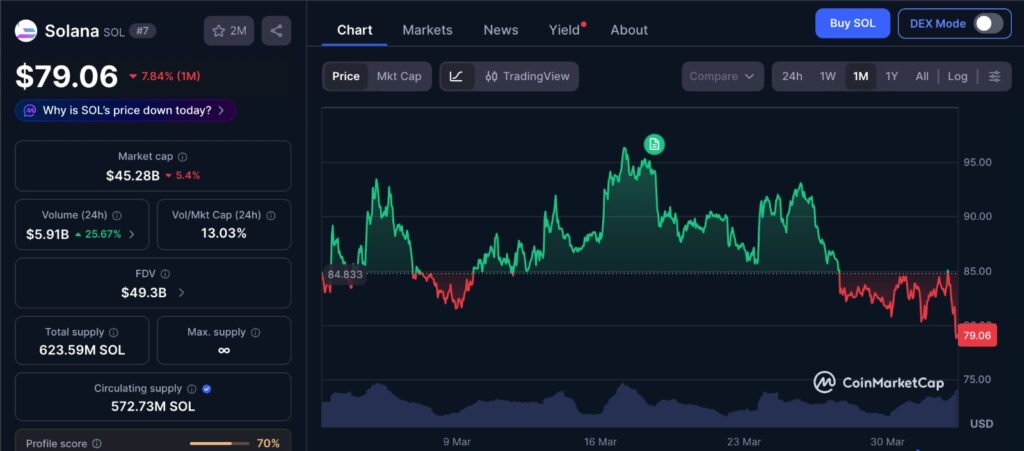
Over the past month, SOL’s price structure has shown a gradual compression following its rejection near $93, with recent sessions drifting back toward the $80 region. The chart reflects a pattern of lower highs combined with repeated support tests, indicating that upward momentum has weakened while downside pressure has not yet fully accelerated. This type of movement typically suggests that liquidity is thinning rather than aggressively exiting, where price stabilizes temporarily but becomes increasingly sensitive to shifts in participation.
Solana DEX Volume and Falling Network Fees
The contraction in Solana DEX Volume is directly reflected in its fee dynamics. Network fees declined from approximately $30 million in January to $18.5 million in March, a 42% reduction that mirrors the drop in transactional activity. On Solana, fees are not constrained by scarcity but by usage intensity, so falling revenue is a direct proxy for declining execution.
Despite this, Solana still generated roughly 80% more fees than Ethereum over the same period. This difference is structural rather than cyclical. Ethereum’s layer-2 ecosystem shifts execution away from the base layer, using rollups and temporary data blobs to minimize costs. As a result, activity is fragmented across multiple layers, diluting fee capture at the main chain level.
Solana operates differently. Execution, settlement, and liquidity are concentrated on a single layer, meaning activity translates directly into measurable revenue. When participation slows, that impact is immediate and visible. There is no abstraction layer masking the decline.
Solana DEX Volume Hits 2024 Lows
Decline in Trading Activity
Solana DEX Volume has fallen to approximately $55.5 billion, its lowest level since September 2024. This is not just a reduction in numbers but a shift in how liquidity behaves. In high-volume conditions, order books are continuously replenished, allowing large flows to be absorbed without significant price disruption. In low-volume conditions, that replenishment weakens.
Current market conditions suggest that liquidity is becoming thinner and more reactive. When fewer participants are actively placing orders, price becomes more sensitive to directional flows. This is why repeated tests of the same support level tend to degrade it over time. Each test consumes available liquidity without fully rebuilding it.
From a market structure perspective, this introduces execution risk. Larger participants cannot deploy capital efficiently in shallow conditions without moving price against themselves. As a result, they either reduce size or delay participation, which further suppresses volume.
Ethereum Layer-2 Competition Rising
At the same time, Ethereum’s position has strengthened through the aggregation of layer-2 networks such as Base, Arbitrum, Polygon, and Optimism. Combined, these networks increased Ethereum’s share of DEX activity from 33% in January to 42% in March.
This shift reflects how liquidity is being redistributed rather than removed from the market. Instead of concentrating on a single venue, capital is dispersing across multiple execution layers where costs are optimized. For market makers, this creates optionality. They can allocate liquidity where spreads, incentives, and execution conditions are most favorable.
For Solana, this means its dominance is no longer just a function of throughput. It is now competing against a system where liquidity is modular and can relocate more easily.
Solana DEX Volume vs Total Value Locked
Solana’s total value locked stands near $6.3 billion, compared to Ethereum’s $54.1 billion. This gap highlights where capital resides, but it does not fully explain how that capital behaves. TVL is largely passive, while DEX volume reflects active positioning and turnover.
Solana’s ability to generate higher fees despite lower TVL indicates that its capital base has been more actively deployed. In practical terms, this means capital on Solana has historically moved faster. As DEX volumes decline, that velocity slows, reducing the efficiency advantage that previously supported fee generation.
This shift matters because markets respond more to active capital than stored capital. When movement slows, price discovery becomes less stable.
Solana DEX Volume and $80 Support
Can Activity Support Price Stability
The $80 level is being tested in an environment where participation is declining. Support is typically reinforced by consistent bid-side liquidity, where buyers absorb incoming supply. In the current structure, fewer participants are actively defending the level.
This creates a fragile equilibrium. Instead of being supported by demand, price is being held by the absence of aggressive selling. That difference becomes visible when support is tested repeatedly without a corresponding increase in volume.
Over the past week, repeated touches of this level have not produced stronger reactions, suggesting that liquidity is not rebuilding between tests.
Risk of Retesting Lower Levels
The potential move toward $75 is tied to liquidity conditions rather than isolated price signals. In a lower volume environment, order books are thinner, and even moderate selling can push price beyond established levels. For larger participants, this creates a dilemma. Entering size in such conditions increases execution cost, which often leads to reduced participation.
Derivatives positioning can further amplify this effect. When spot liquidity is thin, futures-driven moves can have a disproportionate impact on price, especially if hedging flows are not matched by underlying spot demand.
Strong DApp Revenue Supports Solana
Solana’s Developer Advantage
While Solana DEX Volume is declining, the network continues to lead in application-level revenue. Solana currently has 13 decentralized applications generating over $1 million in monthly revenue, compared to 11 on Ethereum and fewer on other networks.
This matters because revenue reflects sustained user interaction beyond speculative trading. Applications such as Pump, Helium Network, and ORE Protocol continue to attract usage, indicating that the ecosystem retains functional demand.
From a structural perspective, this creates a different type of support. Instead of relying purely on trading activity, the network benefits from ongoing usage that generates consistent economic output.
Revenue vs Activity Dynamics
DEX volume and application revenue capture different layers of behavior. Volume reflects trading intensity, while revenue reflects utility and engagement. When volume declines but revenue remains relatively strong, it suggests that speculative activity is cooling while core usage persists.
For institutional participants, this distinction is important. Trading-driven liquidity can disappear quickly, but revenue-generating ecosystems tend to retain longer-term interest. This does not stabilize price directly, but it influences how capital is allocated over time.
Editor’s View: When Participation Quietly Disappears
What stands out here is not the drop in volume itself, but how quietly participation fades before price reacts. Traders often assume weakness becomes obvious through sharp declines, but in reality, activity tends to thin out first while price still appears stable. This creates a period where markets feel balanced, even though fewer participants are actually engaging. By the time price begins to move decisively, the underlying shift in behavior has already been in place for some time.
What Solana DEX Volume Decline Really Means
The decline in Solana DEX Volume reflects a reduction in active participation at a time when price is testing key levels. Liquidity has become thinner, execution risk has increased, and competition from Ethereum’s layer-2 ecosystem has intensified. At the same time, strong application revenue indicates that the network continues to generate economic value beyond trading activity.
This creates a split structure where price is influenced by declining participation while the ecosystem remains functionally active. Markets do not move based on a single metric. They move based on how liquidity, participation, and utility interact, and in this case, those components are no longer aligned.
Disclaimer: This content is for informational purposes only and does not constitute financial advice.
Keep yourself updated with the latest crypto news with FYI Gazette
Read more about Memecoins with FYI Gazette
Keep yourself updated with the latest Altcoin News with FYI Gazette
 Bitcoin
  Ethereum
  Tether
  XRP
XRP  BNB
BNB  Solana
  TRON
TRON  Dogecoin
  Litecoin
  Pepe
Pepe