
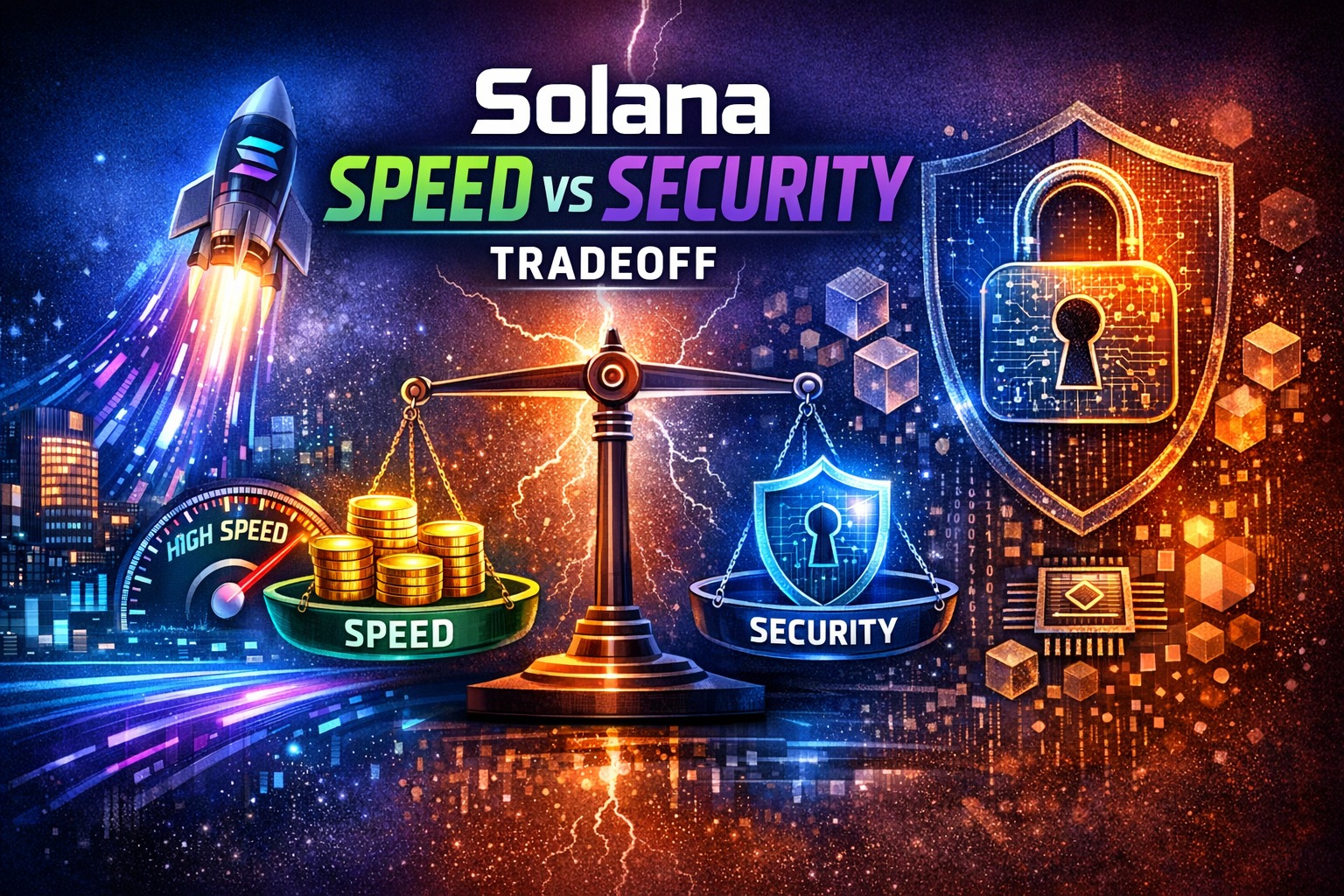
Solana Speed Tradeoff raises security concerns
Solana Speed Tradeoff becomes visible not when transactions slow, but when execution starts to feel less dependable under pressure. Markets don’t react to speed itself, they react to how much friction exists in moving capital at the exact moment it’s needed. When validation costs rise, that friction increases, and strategies built on timing begin to adjust quietly in the background. What looks like a technical limitation is often a shift in how confidently participants can rely on the system’s consistency.
Put simply, making Solana safer could make it slower.
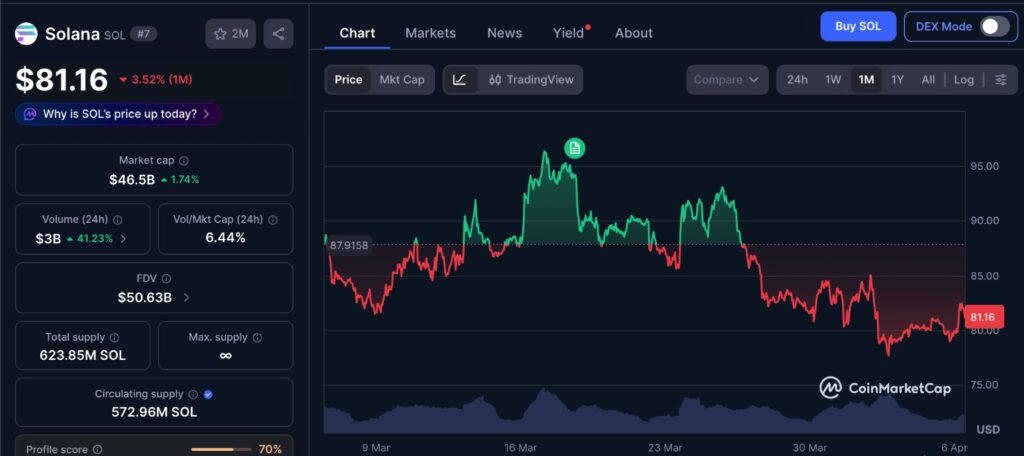
The 1-month chart shows that price has moved within a relatively tight range after earlier volatility, suggesting that activity is stabilizing rather than expanding. Recent sessions indicate that upward moves are being met with consistent selling, while downside moves are quickly absorbed, pointing to balanced positioning rather than strong directional conviction. This type of structure often reflects a market where liquidity is present but not aggressively deployed, aligning with conditions where execution remains active but momentum is limited.
What Happened
Solana has been working with Project Eleven to test quantum-safe signatures. These are designed to protect the network from future threats, especially from quantum computing.
However, early results revealed a major drawback. These signatures are much larger than current ones, increasing the amount of data each transaction carries. As a result, the network becomes heavier to run.
During testing, this led to a sharp slowdown in performance, with transaction speeds dropping by around 90 percent.
Why the Market Moved
Solana’s strength has always been its speed. The network can process far more transactions than most competitors, which helped it grow quickly in areas like DeFi and stablecoins.
According to available data, Solana has processed over 100 billion transactions, far ahead of Ethereum. Its real-time throughput is also significantly higher, allowing it to handle large volumes efficiently.
This is why the slowdown matters. If speed drops, the network could lose the advantage that made it attractive in the first place.
Speed doesn’t matter until it disappears, and then it becomes the only thing that matters.
What’s Driving the Reaction
The reaction is not just about performance numbers. It is about what those numbers represent.
Quantum-safe security introduces more complex validation, which means each transaction takes more effort to process. This naturally reduces how many transactions the network can handle at once.
At the same time, Solana has been seeing growth in its stablecoin ecosystem. Unique users interacting with non-USD stablecoins like EURC and BRZ have increased significantly over the past year.
This shows that the network has been attracting more diverse activity. But that growth depends on fast and reliable execution.
Broader Market Context
Over the past day, crypto markets have been sensitive to any changes in network performance and infrastructure. In recent sessions, traders have been paying closer attention to how networks handle scaling and security together.
Solana’s situation reflects a wider challenge across the industry. Faster networks tend to reduce validation complexity, while more secure networks add extra layers of verification.
This creates a natural trade-off. Improving one side often affects the other.
What This Means
Solana now faces a balancing act. It needs to improve security without losing the speed that supports its ecosystem.
If the network slows too much, it could affect how efficiently users move capital and interact with applications. At the same time, ignoring security upgrades is not a long-term option.
In simple terms, Solana is trying to stay fast while preparing for future risks.
Editor’s View: Solana Speed Tradeoff and how traders adjust to change
What often gets missed is how participants quietly adjust before any visible shift in metrics. When execution slows, traders don’t immediately exit, they reduce size, widen timing, or avoid strategies that depend on precision. This kind of behavior doesn’t show up clearly on charts, but it changes how liquidity moves through the network. Speed is not just a feature, it’s something strategies are built around, and when that foundation changes, behavior adapts first, long before volume does.
Conclusion
Solana Speed Tradeoff highlights a core challenge in blockchain design. The same changes that improve security can reduce speed, forcing networks to choose how they balance both.
For Solana, this is a critical moment. Its ability to maintain performance while adapting to new security demands will shape how it competes going forward.
Disclaimer: This content is for informational purposes only and does not constitute financial advice.
Keep yourself updated with the latest crypto news with FYI Gazette
Read more about Memecoins with FYI Gazette
Keep yourself updated with the latest Altcoin News with FYI Gazette
 Bitcoin
  Ethereum
  Tether
  XRP
XRP  BNB
BNB  Solana
  TRON
TRON  Dogecoin
  Litecoin
  Pepe
Pepe