
Stablecoin De-pegs: USDe, xUSD & October Crash Fallout
Stablecoin De-pegs triggered a dramatic shock to the cryptocurrency ecosystem in October. Two synthetic dollar-tokens, USDe and xUSD, lost their 1:1 peg to the U.S. dollar under stress, triggering forced liquidations, contagion across DeFi, and a broader market crash. This article explains what happened, why it matters, and what lessons arise for the future.
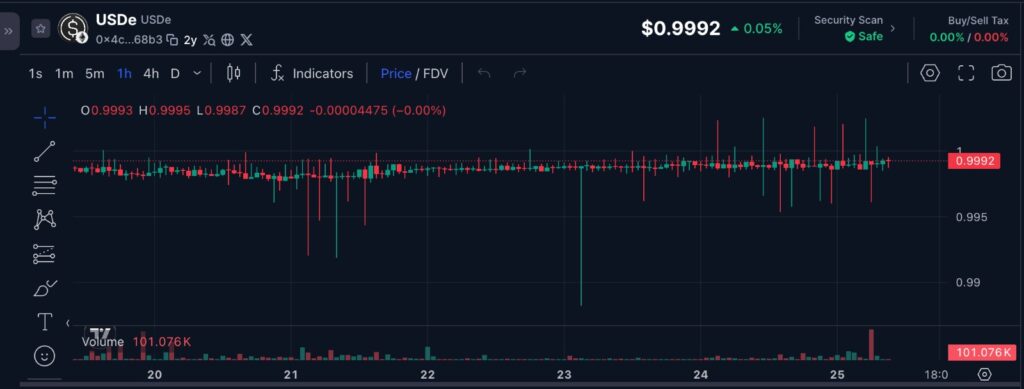
The latest one-hour price chart for USDe highlights the token’s short-term volatility following recent market stress. While the movement remains relatively narrow, the fluctuations reflect ongoing efforts by traders to re-establish confidence after the earlier de-peg event. Short-term price action like this often shows how quickly sentiment shifts in the synthetic stablecoin market, especially as liquidity and trading volume adjust in response to broader market conditions.
What caused the Stablecoin De-pegs?
How USDe’s peg broke
USDe is a synthetic dollar token issued by Ethena Labs, intended to maintain a 1 : 1 ratio with the U.S. dollar. On October 10 it slipped sharply – on a major exchange it dropped to around US$0.65, about a 40 % drop from the intended peg. Since many futures traders used USDe as collateral, the plunge triggered automatic liquidations (ADL) and unleashed a cascade of forced position closures. The protocol on decentralised exchanges remained solvent, but the exchange-specific breakdown exposed market structure vulnerability: when liquidity dried, the peg collapsed.
How xUSD followed suit
Just a few weeks later, xUSD – a synthetic, yield-bearing stablecoin issued by Stream Finance – also de-pegged. The yield-bearing strategy had deployed funds into leveraged strategies. Losses of about US$93 million in the fund backing xUSD froze withdrawals and wiped out the peg. xUSD never recovered the US$1 target, leaving users with severe losses and eroding trust in high-yield stablecoin models.
The Market Impact of Stablecoin De-pegs
Forced Liquidations and a DeFi Bank Run
The USDe collapse acted like a trigger: the sudden drop caused positions to fall below collateral thresholds and forced auto-deleveraging. Liquidity providers and market-makers were unable to intervene in time. This resulted in roughly US$20 billion worth of positions wiped out in minutes, marking one of the largest trading losses in crypto history. The de-peg acted like a bank run in DeFi: confidence unraveled, liquidity vanished, and the system faltered.
Synthetic Stablecoins Losing Ground
After these events synthetic stablecoins lost massive value. USDe’s market cap halved since the October crash. Investors pulled out of yield-bearing and synthetic dollar models, shifting toward simpler, fiat-backed stablecoins. xUSD’s failure accelerated the flight from riskier stablecoin formats and triggered a re-evaluation of “stable” token concepts.
Broader Crypto Market Fallout
The de-pegs did not happen in isolation. They fueled a broader market downturn: major cryptocurrencies cracked key levels (for example, Bitcoin fell below US$110 000 then US$100 000), altcoins collapsed, and leveraged positions across the ecosystem were liquidated. The de-peg event exacerbated existing stress in the market and added a structural risk dimension that many traders had underestimated.
Why Did These Models Fail?
Synthetic stablecoins are vulnerable under stress
Unlike fiat-backed stablecoins, synthetic ones rely on hedging, derivatives, collateral that is sensitive to market shocks and exchange mechanics. USDe’s architecture functioned until a structural event exposed its weakness: when the peg failed on a major exchange, it triggered collateral failure and liquidations.
Centralisation and exchange risk
Even though the underlying protocol may remain solvent, when the peg breaks on a major exchange and liquidity providers can’t respond, the market effect becomes chaotic. The USDe event highlighted that peg stability is not just about protocol design but about market microstructure, exchange depth, liquidity, and resilience.
Yield-bearing stablecoins carry added risk
xUSD offered high yields, which drew capital. But the strategy relied on complex yield-generating activities and leverage. When the backing fund lost nearly US$93 m, confidence evaporated, withdrawals froze, and the peg collapsed. Yield enticed users, but it also masked structural fragility.
What Happens Now? Responses & Lessons
Market reactions
Investors are now much more cautious about synthetic stablecoins and yield-bearing models. The total value locked (TVL) in these segments has fallen significantly. DeFi participants are reassessing risk, and regulators are paying renewed attention to stablecoin models, collateralisation, transparency and hidden leverage.
Operational lessons
For exchanges: ensure greater liquidity, diversify collateral, improve oracle resilience, monitor risk across pairs used as collateral.
For protocols: maintain clear and transparent reserves, stress test for cascading failures, avoid concentration of risk or reliance on one exchange.
For users: recognise that “stable” does not mean risk-free. Understand the backing and mechanism of any stablecoin used as collateral or yield source.
What This Means for Crypto Stability
Reassessing stablecoin risk
The term “stablecoin” implies safety, but the events show systemic risks lurking under the surface. A de-peg triggers forced liquidations, contagion, and structural instability. Traders and protocols alike must recognise that stablecoins depend not just on design but on market infrastructure and trust.
Contagion risks grow
The de-pegs of USDe and xUSD triggered wider market effects. It was not a standalone incident; the ripple spread through DeFi, futures, derivatives, and trading platforms. This shows how intertwined synthetic dollar issuance is in the crypto ecosystem and how a failure can propagate quickly.
Regulatory and institutional implications
Regulators may increasingly treat synthetic stablecoins, yield-bearing tokens and complex DeFi structures as systemic risk areas. We may see tighter oversight, reserve audits, strengthened disclosure requirements, and frameworks aimed at preventing similar cascades going forward.
Key Takeaways
• Stablecoin de-pegs of USDe and xUSD triggered forced liquidations and a broader market crash.
• Synthetic dollar models remain vulnerable under extreme stress, particularly when backed by leverage or concentrated on one exchange.
• The ecosystem must rethink what “stable” means – emphasising transparency, market depth, resilience and structural design.
• For users and protocols alike: yield does not override risk. Make sure you understand the structure of what you’re using or deploying.
The recent wave of stablecoin de-pegs demonstrates that even assets built for safety can become lightning rods when markets implode. For anyone in crypto, trader, protocol builder, or regulator, the cases of USDe and xUSD are a stark reminder: stability takes more than a peg. It demands robust infrastructure, clear risk controls and preparation for the unexpected.
Keep yourself updated with the latest crypto news with FYI Gazette
Read more about Memecoins with FYI Gazette
Keep yourself updated with the latest Altcoin News with FYI Gazette
 Bitcoin
  Ethereum
  Tether
  XRP
XRP  BNB
BNB  Solana
  TRON
TRON  Dogecoin
  Litecoin
  Pepe
Pepe