
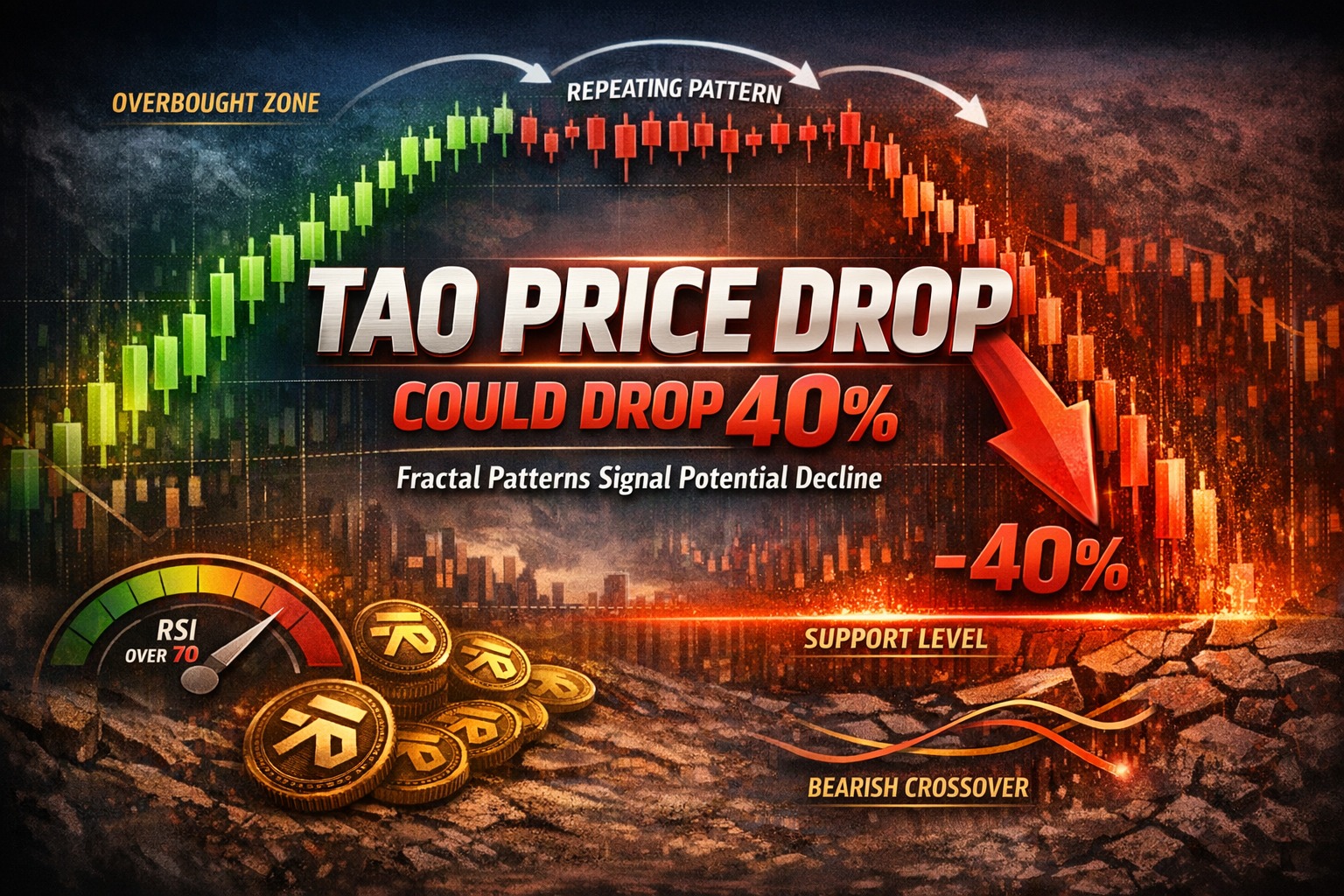
TAO Price Drop Signals Potential 40% Decline
TAO Price Drop setups like this tend to form not when the market is weak, but when it still looks stable enough to attract late participation. What changes beneath the surface is not price direction immediately, but the quality of demand, where buying becomes less aggressive and more reactive. Early participants begin to distribute into that stability, using strength as an exit rather than a continuation signal. This creates a phase where price appears controlled, but the structure quietly shifts toward imbalance.
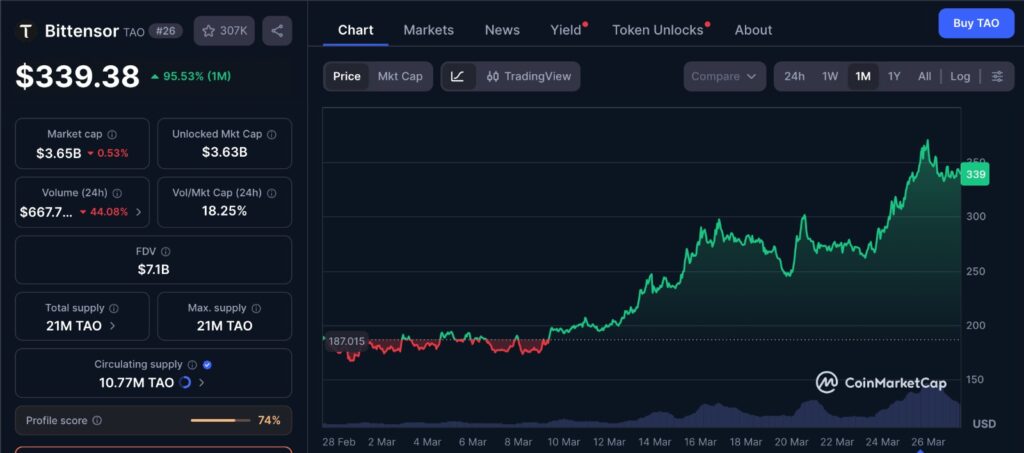
The 1-month TAO price chart reflects a phase where upward momentum has begun to slow, even if price has not yet fully broken down. Moves higher appear less decisive, while pullbacks are starting to carry slightly more weight, suggesting a shift in participation rather than a clear reversal. This kind of structure often indicates that buying pressure is becoming more selective, with fewer participants willing to commit at elevated levels. As a result, the chart captures a transition period where stability in price can mask underlying changes in market behavior.
TAO Price Drop and the Fractal Pattern Setup
The TAO Price Drop narrative is built around a recurring pattern that has appeared in previous cycles. After a strong expansion phase, the asset formed a similar structure where price initially stabilized before entering a multi-week decline. This is not random repetition but a reflection of how positioning resets after extended rallies.
In both past and present cases, the pattern emerges after a period of strong upside where late participants enter near elevated levels. As early buyers begin reducing exposure, the market loses its ability to sustain higher highs. The result is a structure that looks stable on the surface but gradually weakens underneath.
What makes this setup relevant is the consistency of the outcome. Previous occurrences of the same pattern led to declines in the range of 30 to 45 percent within a similar time window. The current formation mirrors that structure closely enough to warrant attention, not because patterns guarantee outcomes, but because they reflect repeated behavior under comparable conditions.
Technical Indicators Supporting the TAO Price Drop
The TAO Price Drop is reinforced by a cluster of indicators that point toward stretched conditions rather than fresh strength. The relative strength index has moved above 70, placing it in overbought territory where previous rallies have historically lost momentum.
An elevated RSI does not immediately reverse price, but it signals that buyers have already committed significant capital. At this stage, additional upside requires new demand entering at higher levels, which becomes progressively harder to sustain. This is why overbought conditions often lead to slower price movement followed by eventual correction.
Another signal comes from a moving average crossover that, in most contexts, is interpreted as bullish. However, in TAO’s historical behavior, this crossover has appeared near the later stages of upward moves rather than at the beginning. This suggests that the signal may reflect lagging confirmation of a move that has already matured, rather than the start of a new trend.
TAO Price Drop Could Reach 40 Percent
The projected TAO Price Drop of up to 40 percent is derived from prior instances of the same setup. In those cases, once the pattern completed its initial phase, price declined sharply over approximately five weeks.
This type of projection is not based on isolated data points but on repeated outcomes under similar structural conditions. The significance lies in the alignment between pattern formation, momentum indicators, and timing. When these elements converge, the probability of a comparable move increases.
It is also worth noting that previous occurrences did not result in immediate declines. In several cases, price continued to rise modestly after the signal, with gains averaging around 20 percent before reversing. This reflects how markets often extend slightly beyond equilibrium before correcting, as late buyers enter just before momentum fades.
Market Sentiment and the TAO Price Drop
Sentiment surrounding TAO has increased, with higher levels of social engagement and attention. However, the absence of extreme euphoria is notable. In past cycles, major tops were often accompanied by excessive optimism and saturation in participation.
The current environment suggests that interest is elevated but not exhausted. This creates a condition where the market can still move higher in the short term, even as underlying strength weakens. It also indicates that positioning is not yet fully crowded, which can delay the onset of a sharp decline.
From a structural perspective, this phase represents a transition rather than a peak. Attention is building, but conviction is becoming uneven, with early participants reducing exposure while newer entrants continue to engage.
External Context Shaping the TAO Price Drop
The TAO Price Drop setup is developing alongside broader market conditions that influence risk appetite. When liquidity tightens or macro uncertainty increases, assets that have recently outperformed tend to face pressure as capital rotates or exits.
This does not require a direct catalyst. Instead, it reflects how market participants reassess risk after extended gains. In such environments, even technically strong assets can experience corrections as positioning becomes more defensive.
For TAO, the alignment between internal technical signals and external conditions adds weight to the current setup. It suggests that the structure is not forming in isolation, but within a broader context that may reinforce downside pressure.
Key Levels to Watch in the TAO Price Drop
The progression of the TAO Price Drop will depend on how price interacts with key structural levels. Support zones will indicate whether the market can absorb selling pressure or whether further downside is likely.
If these levels begin to fail, it would confirm that the distribution phase is transitioning into a more active decline. On the other hand, sustained strength above resistance would suggest that the pattern is weakening and that buyers are still in control.
Short-term fluctuations within this range should be expected. They represent the process of repositioning rather than a clear directional shift, and often occur before a more decisive move develops.
Editor’s View: Where Late Buyers Quietly Set the Exit for Early Ones
The TAO Price Drop setup reflects a familiar handoff that happens late in trends, where early participants begin reducing exposure into strength while newer entrants interpret stability as confirmation. What appears as continued resilience is often just enough demand to absorb distribution, not enough to sustain expansion. This creates a period where price holds up, but the quality of buying changes, shifting from conviction to reaction. By the time this imbalance becomes visible on the chart, the underlying positioning has already adjusted.
Disclaimer: This content is for informational purposes only and does not constitute financial advice.
Keep yourself updated with the latest crypto news with FYI Gazette
Read more about Memecoins with FYI Gazette
Keep yourself updated with the latest Altcoin News with FYI Gazette
 Bitcoin
  Ethereum
  Tether
  BNB
BNB  XRP
XRP  Solana
  TRON
TRON  Dogecoin
  Litecoin
  Pepe
Pepe