Tezos Tallinn upgrade improves speed and efficiency
Tezos Tallinn upgrade marks a major step forward for the Tezos blockchain by significantly improving speed, efficiency, and network performance. The upgrade was successfully activated through Tezos’ on-chain governance process, continuing the project’s tradition of upgrading without disruptive hard forks. As the 20th protocol upgrade on Tezos, Tallinn focuses on faster block times, improved validator participation, and better on-chain storage management.
The most notable improvement introduced by the Tezos Tallinn upgrade is the reduction of base-layer block time from eight seconds to six seconds. This change directly improves how quickly transactions are processed and confirmed on the network. For users and developers alike, faster blocks mean smoother interactions, lower waiting times, and a more responsive blockchain experience.
Key performance changes in the Tezos Tallinn upgrade
Faster blocks and quicker finality
The reduction in block time is a core achievement of the Tezos Tallinn upgrade. By moving to six-second blocks, Tezos can now reach finality faster than before. Since Tezos finality is achieved after two blocks, transactions can now be considered final in roughly 12 seconds instead of 16.
This improvement benefits decentralized applications that rely on rapid confirmation, such as decentralized finance platforms, gaming applications, and real-time digital marketplaces. Faster blocks also enhance the experience for users who expect near-instant feedback when sending transactions or interacting with smart contracts.
Broader validator participation
Another major component of the Tezos Tallinn upgrade is the introduction of full validator participation in block attestations. Previously, only a subset of validators, known as bakers, were responsible for attesting each block. With Tallinn, all active bakers will be able to attest blocks once enough validators adopt the new cryptographic standard.
This change relies on BLS signatures, which allow multiple validator signatures to be combined into a single compact signature. This approach reduces network overhead while allowing more validators to participate directly in consensus. As a result, the network becomes more decentralized and secure without increasing technical complexity for node operators.
The feature is designed to activate once at least half of bakers upgrade their addresses to support BLS signatures, ensuring a smooth and gradual transition.
Improved storage efficiency
The Tezos Tallinn upgrade also introduces the Address Indexing Registry, a system designed to optimize how addresses are stored on-chain. By reducing repeated address data inside blocks, the network can significantly cut down storage requirements for smart contracts and transactions.
This improvement can lead to dramatically better storage efficiency, especially for applications that rely on frequent address usage. Lower storage requirements help reduce costs for developers and make it easier to build complex applications directly on the Tezos blockchain.
Why the Tezos Tallinn upgrade is important
Better user experience
For everyday users, the Tezos Tallinn upgrade delivers a noticeably faster and smoother blockchain experience. Shorter confirmation times reduce friction when sending tokens, interacting with decentralized applications, or managing digital assets. This makes Tezos more competitive with other modern blockchains that emphasize speed and responsiveness.
Faster blocks also help reduce congestion and improve reliability during periods of high activity, ensuring the network remains usable as demand grows.
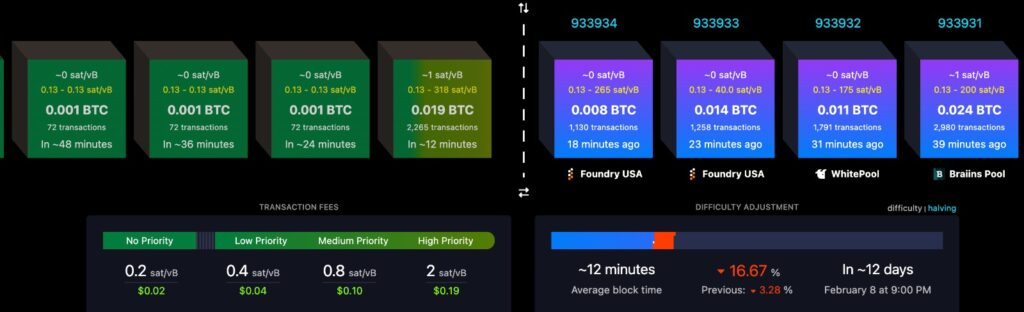
Visual snapshots like this help illustrate why block timing and throughput matter beyond protocol specifications. When blocks are produced more predictably, fee pressure tends to stabilize and transaction backlogs become easier to manage, even during short bursts of activity. Users rarely track these mechanics in detail, but they feel the effects through smoother confirmations and fewer sudden delays. Over time, these small operational improvements influence how reliable a network feels in everyday use.
Stronger security and decentralization
Allowing more validators to participate in block attestations strengthens Tezos’ security model. Broader participation means the network does not rely on a limited group of validators, which helps distribute influence more evenly and reduces systemic risk.
At the same time, the use of aggregated signatures ensures that increased participation does not create performance bottlenecks. This balance between decentralization and efficiency is a central goal of the Tezos Tallinn upgrade.
Developer-friendly improvements
Storage efficiency is a critical concern for blockchain developers. By lowering storage overhead, the Tezos Tallinn upgrade makes it easier and more affordable to deploy sophisticated smart contracts and data-heavy applications.
These changes support long-term scalability and help position Tezos as a platform suitable for enterprise use cases, decentralized finance, and complex on-chain logic.
Governance and upgrade process
The Tezos Tallinn upgrade once again highlights the network’s self-amending governance model. Token holders and bakers were able to propose, test, and approve the upgrade without splitting the network or causing downtime. This approach allows Tezos to evolve continuously while maintaining stability and community alignment.
Such a governance system reduces uncertainty around protocol changes and encourages long-term participation from developers, validators, and users.
What comes next after the Tezos Tallinn upgrade
With Tallinn now live, attention will shift to how the network performs under real-world conditions. Key factors to watch include validator adoption of BLS addresses, network throughput, and developer activity following the storage improvements.
The Tezos Tallinn upgrade lays a strong foundation for future enhancements, including further scalability improvements and refinements to consensus participation. As adoption grows, these changes may help Tezos support a broader range of applications and users.
Editor’s View: Why incremental speed changes still matter
One subtle aspect of the Tezos Tallinn upgrade is how small reductions in block time can influence behavior over time, even if users do not consciously notice the change. Faster confirmation does not usually create excitement on its own, but it quietly reduces friction, especially for developers testing applications and users interacting repeatedly with smart contracts. In practice, these marginal gains can shape which networks feel reliable enough to build on, particularly when combined with predictable governance and low disruption. Over long periods, consistency and responsiveness often matter more than headline-grabbing performance claims.
Conclusion
The Tezos Tallinn upgrade represents a meaningful evolution of the Tezos blockchain. By reducing block times, improving validator participation, and optimizing storage, the upgrade strengthens the network’s performance without sacrificing decentralization or security.
As Tezos continues to refine its protocol through on-chain governance, the Tallinn upgrade stands out as a key milestone in building a faster, more efficient, and more developer-friendly blockchain ecosystem.
Disclaimer: This content is for informational purposes only and does not constitute financial advice.
Keep yourself updated with the latest crypto news with FYI Gazette
Read more about Memecoins with FYI Gazette
Keep yourself updated with the latest Altcoin News with FYI Gazette
 Bitcoin
  Ethereum
  Tether
  XRP
XRP  BNB
BNB  Solana
  TRON
TRON  Dogecoin
  Litecoin
  Pepe
Pepe