Trump Iran Address Drives Market Reaction Across Assets
Trump Iran Address is not being priced for what it confirms, but for how it stretches uncertainty over time. When a conflict is described as nearly complete while escalation is still scheduled, markets are forced to operate without a clear endpoint. That creates a condition where participants reduce conviction rather than increase exposure, even if underlying narratives remain intact. The result is not panic or optimism, but a quieter shift toward caution that reshapes how liquidity moves across assets.
Trump Iran Address and Oil Price Surge
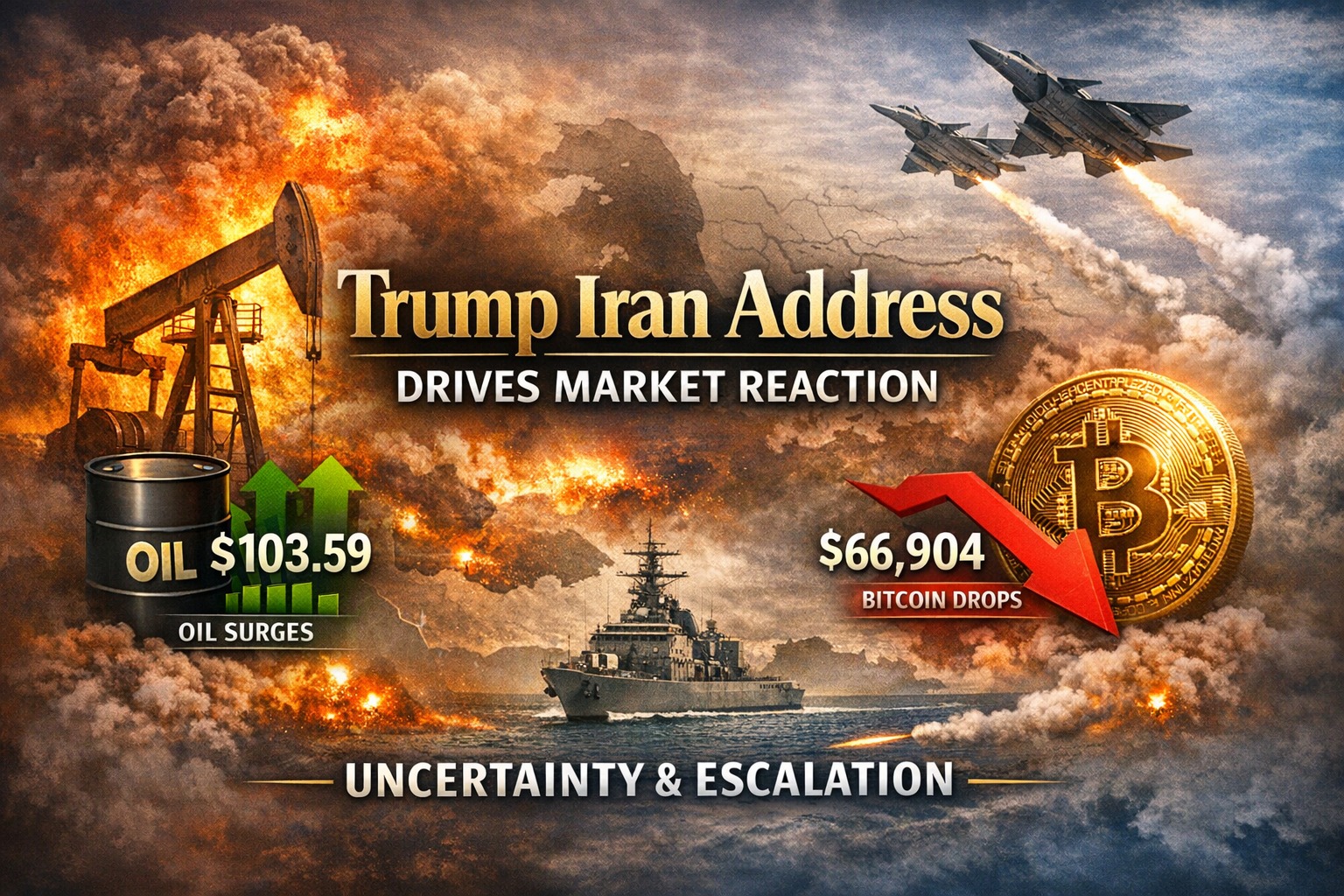
Crude oil moved back above $100 per barrel, reaching around $103.59, reversing the brief decline seen when expectations of a near-term end had softened pricing. That reversal was not about current supply disruption, but about the reintroduction of forward risk.
Oil markets are structurally forward-looking. Pricing reflects not barrels lost today, but barrels that may not be delivered tomorrow. By signaling additional strikes over the next two to three weeks, the address extended the window of uncertainty around supply routes, particularly in a region already operating under tension.
What changed was not the physical flow of oil, but the probability distribution of disruption. That is enough to move price.
Trump Iran Address and Bitcoin Decline
Bitcoin declined by roughly 2%, falling to around $66,904 during and after the address. This move reflects how capital behaves under stress rather than a shift in Bitcoin’s underlying narrative.
In periods of geopolitical escalation, liquidity tends to compress before it reallocates. Participants reduce exposure to assets that require conviction and move toward positions that preserve optionality. Bitcoin, despite its long-term positioning, still sits within that liquidity hierarchy.
The decline is not a rejection of crypto. It is a temporary repricing of risk tolerance.
Trump Iran Address and Military Progress Claims
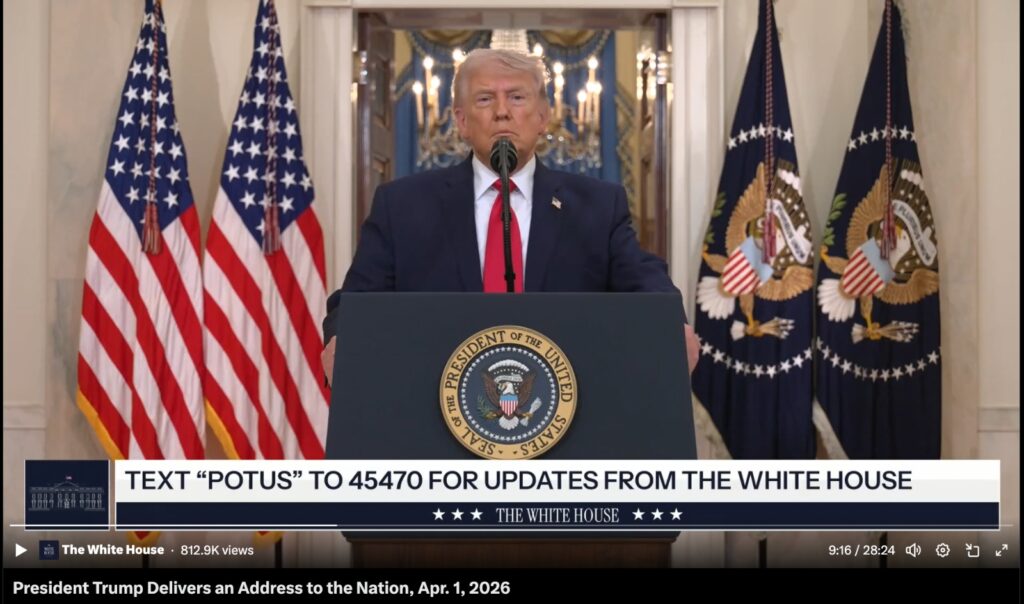
This broadcast shows the tone and structure of the Trump Iran Address more clearly than written summaries alone. The emphasis on nearing completion while outlining further strikes reflects a message designed to maintain pressure rather than signal closure. What stands out is not just the content, but the delivery, which balances confidence with conditional escalation. That balance helps explain why markets reacted with caution instead of direction.
The address centered on claims that the United States is “very close” to completing its objectives under “Operation Epic Fury.” According to Trump, Iran’s nuclear infrastructure, naval capabilities, and weapons production systems have been significantly degraded.
At a surface level, this suggests a conflict approaching its endpoint. But the structure of the message introduces a contradiction. Progress was framed alongside a commitment to intensified strikes over the next two to three weeks.
This dual messaging reveals a familiar strategic pattern. Declaring proximity to completion manages perception, while maintaining escalation preserves leverage. The outcome is not clarity, but controlled ambiguity.
Trump Iran Address and Ongoing Negotiations
Alongside military positioning, the Trump Iran Address confirmed that negotiations are ongoing. Each side has outlined conditions that reflect fundamentally different objectives.
The United States is pushing for structural concessions, including dismantling Iran’s nuclear program, reopening commercial shipping routes, and ending support for proxy groups. These demands are designed to reshape long-term regional dynamics rather than simply end hostilities.
Iran’s demands focus on finality and compensation, including a permanent end to the war, financial recovery, and removal of US military presence. These are not incremental adjustments. They represent opposing end states.
Trump’s reference to newer, less radical groups within Iran suggests a potential shift in negotiation dynamics. However, the simultaneous warning of additional strikes indicates that diplomatic progress is still conditional.
Trump Iran Address and Strait of Hormuz Impact
The Strait of Hormuz remains the central pressure point in this conflict. Iran’s blockade of this route introduced a direct constraint on global oil flow, turning a regional conflict into a global pricing event.
This is not just a supply issue. It is a distribution issue. Even the perception that shipments could be delayed or rerouted creates friction across the entire energy system.
Trump’s assertion that the blockade will “naturally” resolve once the conflict ends is based on economic necessity. Iran’s ability to rebuild depends on its ability to export oil. Reopening the strait is not a concession, but a requirement for recovery.
Until that transition occurs, the market must price the risk that it does not.
Trump Iran Address and Broader Market Behavior
The reaction across oil, Bitcoin, and equities reflects a broader structural behavior. Markets are not responding to confirmed outcomes, but to shifting probabilities.
Recent sessions have shown that price movements are increasingly driven by narrative adjustments rather than data releases. When geopolitical signals dominate, traditional valuation frameworks become secondary.
Price does not move because new information appears. It moves because existing assumptions are invalidated faster than positions can adjust.
Trump Iran Address and Market Expectations
The Trump Iran Address leaves markets in a state where resolution is suggested but not defined. This creates a feedback loop where participants continuously reassess positioning without committing fully in either direction.
A clearly defined endpoint reduces volatility because it anchors expectations. An undefined timeline extends volatility because it forces continuous repricing.
Current positioning reflects this uncertainty. Participants are not reacting to what has already been achieved, but to how the next two to three weeks could unfold.
Editor’s View: Why Markets React Before Outcomes Are Clear
What often gets overlooked in moments like this is how quickly participants shift from reacting to facts to reacting to tone. The content of the address matters less than how it reshapes perceived risk over the next few weeks. When language signals both progress and escalation, it forces traders into a position where waiting becomes the default strategy. That hesitation is not visible on charts, but it shows up in reduced conviction and uneven price movement across assets.
Disclaimer: This content is for informational purposes only and does not constitute financial advice.
Keep yourself updated with the latest crypto news with FYI Gazette
Read more about Memecoins with FYI Gazette
Keep yourself updated with the latest Altcoin News with FYI Gazette
 Bitcoin
  Ethereum
  Tether
  XRP
XRP  BNB
BNB  Solana
  TRON
TRON  Dogecoin
  Litecoin
  Pepe
Pepe