

USDC Revenue Growth and Coinbase Revenue Dynamics
USDC Revenue Growth is becoming a central component of Coinbase’s evolving revenue structure as stablecoins continue gaining traction across the digital asset economy. Analysts from Bloomberg Intelligence project that Coinbase’s stablecoin revenue could increase between two and seven times if USDC adoption in payments accelerates. This outlook reflects a broader transformation in how crypto platforms generate income and how stablecoins are used within financial systems.
Stablecoins Reshaping Exchange Economics
The growing importance of USDC Revenue Growth highlights a shift away from traditional exchange dependency on trading fees. Historically, crypto exchanges generated most of their revenue from transaction activity, which fluctuates alongside market volatility and speculative interest. Stablecoin related revenue behaves differently because it is primarily driven by reserve balances and interest income rather than trading volume.
This distinction matters during periods of subdued market activity. Lower volatility often leads to weaker trading engagement, reducing fee generation for exchanges. Stablecoin based income streams introduce a more consistent financial mechanism, where revenue correlates with the scale of assets held rather than short term market sentiment.
Coinbase’s Changing Revenue Composition
Stablecoin revenue already represents a meaningful share of Coinbase’s financial performance. In 2025, stablecoins accounted for approximately 19 percent of Coinbase’s total revenue. This proportion signals a structural change in the company’s business model, where interest income and reserve economics are becoming more influential.
According to Coinbase’s shareholder disclosures, the company generated approximately 1.35 billion dollars in stablecoin revenue during 2025. This figure marked a substantial increase compared with the 911 million dollars reported in the previous year. The expansion underscores how USDC Revenue Growth is altering the company’s revenue mix.
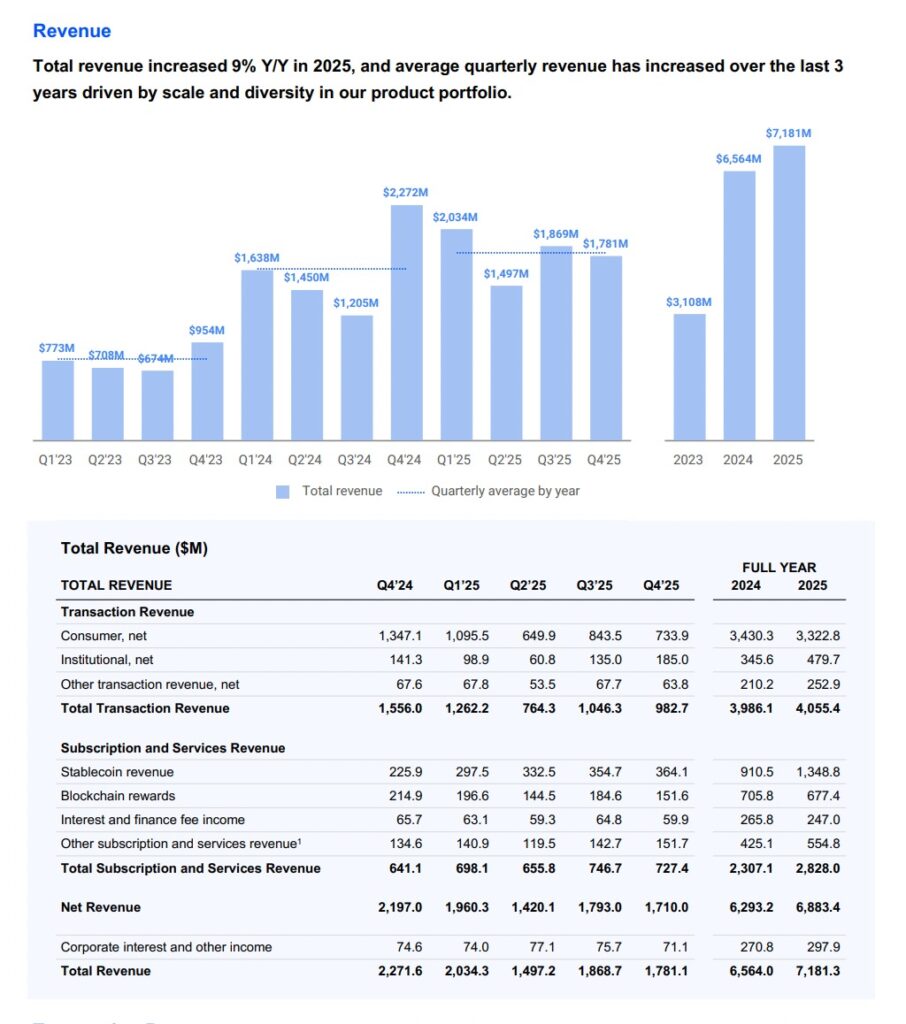
The revenue breakdown provides useful context for understanding why stablecoins have become strategically important for Coinbase. While transaction revenues continue to fluctuate across quarters, subscription and services revenue shows greater consistency, with stablecoin-related income forming a visibly expanding component. This distinction highlights how different revenue streams respond to market conditions, particularly during periods of changing trading activity. Viewed this way, stablecoin revenue growth is not just a scale story, but also a shift in earnings stability dynamics.
Understanding Stablecoin Revenue Mechanics
Stablecoin revenue for exchanges like Coinbase is closely linked to interest income earned on reserve assets. USDC reserves typically consist of cash and short duration instruments designed to maintain price stability. As reserve balances grow, the associated interest income can become a significant source of earnings.
In the fourth quarter of 2025 alone, Coinbase reported 364 million dollars in stablecoin revenue. Interest income from USDC balances has increasingly been characterized as a high margin business line. Unlike transaction driven fees, which depend on user activity, reserve based income scales with asset size and prevailing rate conditions.
Net Loss Versus Revenue Growth
Despite the strength of stablecoin revenue, Coinbase reported a net loss of 667 million dollars in the fourth quarter of 2025. This outcome illustrates that growth in one segment does not automatically translate into overall profitability. Crypto firms often face cost pressures, market fluctuations, and operational expenses that influence earnings.
Still, stablecoin performance remains one of the more stable components of Coinbase’s business. While other revenue lines may fluctuate with market cycles, stablecoin income is tied more closely to balance sheet dynamics and macroeconomic rate environments.
Stablecoins Entering Mainstream Usage
The trajectory of USDC Revenue Growth cannot be separated from the broader rise of stablecoins in global finance. In 2025, total stablecoin transaction volume reached a record 33 trillion dollars. This figure reflects expanding adoption across payments, transfers, decentralized finance, and cross border settlement use cases.
Stablecoins are increasingly used as transactional tools rather than purely trading instruments. Their price stability makes them attractive for value transfer, liquidity management, and onchain financial operations. As usage expands, platforms connected to stablecoin ecosystems experience changing revenue opportunities.
USDC’s Position in Transaction Volume
Within the stablecoin sector, USDC recorded approximately 18.3 trillion dollars in transaction volume. By this metric, USDC surpassed Tether’s USDt, although Tether continues to lead in overall market capitalization. The difference between these measures reveals how dominance can vary depending on the lens applied.
Market capitalization reflects total supply, while transaction volume emphasizes practical usage. High transaction volume suggests strong utility, particularly in payments and settlement flows. This dynamic supports the narrative surrounding USDC Revenue Growth and its relevance to Coinbase.
Regulatory Tensions Around Yield
The expansion of stablecoin activity has intensified regulatory debates, particularly regarding yield and interest distribution. Policymakers have questioned whether stablecoin issuers or affiliated platforms should be allowed to pass reserve generated income to holders. These discussions directly affect the sustainability of USDC Revenue Growth models.
The GENIUS Act, signed into law in July 2025, established a federal framework for payment stablecoins and explicitly bars issuers from paying interest or yield. The provision reflects concerns that yield bearing stablecoins could compete with traditional bank deposits and alter funding structures within the financial system.
Why Yield Restrictions Matter
Yield restrictions influence how reserve generated income is distributed within stablecoin ecosystems. Preventing issuers from paying interest does not eliminate reserve income itself. Instead, it changes who can receive or retain that value, reshaping incentives across platforms, issuers, and users.
Banking sector advocates argue that yield bearing stablecoins may attract deposits away from regulated institutions. Stablecoins offering interest like features could resemble deposit products without operating under identical regulatory frameworks. This concern has driven continued legislative scrutiny.
CLARITY Act and Policy Evolution
Draft Senate language associated with the Digital Asset Market Clarity Act proposes extending yield related prohibitions to non issuer affiliates. The objective is to prevent third parties, including exchanges, from distributing reserve derived income through rewards programs. Such provisions could have direct implications for Coinbase.
Coinbase withdrew its support for the legislation after raising objections to potential restrictions on stablecoin rewards. The company’s stance highlights the tension between regulatory policy and competitive product strategies within crypto markets.
Coinbase’s Economic Incentive Structure
Coinbase earns a share of interest income from USDC reserves through its partnership with Circle. Revenue distribution depends on USDC distribution dynamics, making adoption levels financially significant. Stablecoin rewards programs have functioned as user engagement mechanisms, influencing asset flows.
Company leadership has suggested that banning rewards could increase Coinbase’s retained income from reserve economics. In that scenario, profitability might improve at the platform level even as users lose yield opportunities. This outcome illustrates the complex interplay between regulation and business incentives.
Editor’s View: Revenue Quality Often Matters More Than Revenue Size
One subtle shift worth noting is how investors tend to reassess exchanges when revenue composition changes, not just when totals rise or fall. Stablecoin interest income is typically perceived as less reflexive than trading activity, which is heavily influenced by volatility and speculative cycles. This alters how market participants interpret earnings stability, even if headline numbers remain sensitive to external factors like rates and regulation. In that sense, the discussion around USDC revenue is also a discussion about how the market values durability versus cyclical upside.
Future Drivers of USDC Revenue Growth
The long term trajectory of USDC Revenue Growth will likely depend on both adoption patterns and regulatory outcomes. Continued expansion of stablecoin usage in payments could increase reserve balances and associated interest income. At the same time, legislative decisions may define how that income is shared.
Stablecoins are becoming embedded within broader digital finance infrastructure, increasing their systemic relevance. As policymakers refine regulatory frameworks, the balance between innovation, competition, and consumer protection will remain central to market evolution.
Disclaimer: This content is for informational purposes only and does not constitute financial advice.
Keep yourself updated with the latest crypto news with FYI Gazette
Read more about Memecoins with FYI Gazette
Keep yourself updated with the latest Altcoin News with FYI Gazette
 Bitcoin
  Ethereum
  Tether
  XRP
XRP  BNB
BNB  Solana
  TRON
TRON  Dogecoin
  Litecoin
  Pepe
Pepe