
XRP Short Squeeze Signals Rising Market Pressure
XRP short squeeze conditions are becoming more visible as the market shows signs of renewed strength near the $2.00 price zone. After a long period of sideways movement and cautious sentiment, XRP is now trading in an environment where short sellers may be forced to exit their positions. This shift is drawing attention from traders who see growing pressure building beneath the surface.
For much of the past year, XRP struggled to maintain upward momentum. During this period, many traders positioned themselves on the short side, expecting further downside or prolonged consolidation. This led to extended periods of negative funding rates in the derivatives market, a clear signal that bearish sentiment dominated. However, such conditions often set the stage for a sharp reversal when price begins to rise.
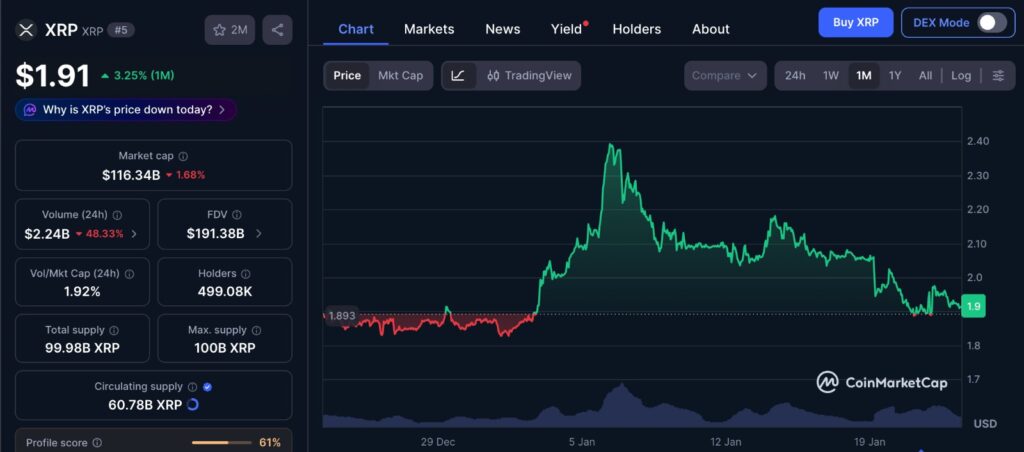
The one-month price chart shows XRP moving within a relatively tight range, with volatility compressing rather than expanding. Despite several attempts to push lower, price has repeatedly stabilized near the same support area, suggesting that selling pressure is being absorbed rather than accelerating. This type of price behavior often reflects balance between buyers and sellers, where neither side is willing to act aggressively. In this context, the chart helps explain why short positions have accumulated without a decisive breakdown, setting up the conditions discussed earlier without relying on sharp directional moves.
XRP Short Squeeze Pressure Near Key Levels
The current XRP short squeeze setup is closely tied to price behavior around the $1.95 to $2.05 range. This area has acted as both support and resistance in recent trading sessions. As XRP approaches this zone, data shows a concentration of short positions sitting just above the current price. These positions become vulnerable if price continues to climb.
Short sellers rely on price staying below key resistance levels. When price pushes higher, their losses increase, forcing some traders to close positions early. This creates buying pressure, which can then push the price even higher. In XRP’s case, this process could unfold quickly if momentum builds above $2.00.
Funding Rates and XRP Short Squeeze Signals
Funding rates play a major role in identifying short squeeze potential. Negative funding rates indicate that short sellers are dominant and are paying less to hold their positions. XRP experienced extended negative funding throughout previous consolidation phases, reflecting widespread caution and low confidence in upside moves.
Recently, funding rates have started to stabilize. While they remain slightly negative, the trend suggests weakening bearish conviction. If funding rates flip positive, it would signal that long traders are regaining control. Historically, such flips often occur near the beginning of stronger price trends, especially when combined with rising spot demand.
Liquidation Zones That Could Trigger a Squeeze
Liquidation data reveals clear zones where leveraged short positions are clustered. For XRP, the most significant liquidation area sits between $1.98 and $2.05. If price moves into this range, a chain reaction could begin.
When one short position is liquidated, it results in a market buy order. This pushes price higher and increases pressure on other short positions nearby. As more shorts are forced to close, buying pressure accelerates. This is the core mechanism behind an XRP short squeeze.
Because XRP is currently trading just below this zone, even a modest price increase could be enough to trigger liquidations. Traders are watching this range closely as a potential ignition point for increased volatility.
Why This XRP Short Squeeze Is Different
This XRP short squeeze setup differs from previous cycles due to improved market structure. Earlier rallies were often driven by speculation or legal uncertainty. Those conditions created sharp but unstable price movements.
Now, regulatory clarity has removed a major source of risk. This has allowed broader participation from institutional investors and long-term holders. In addition, spot market demand has increased, tightening available supply and reducing the ability of short sellers to control price.
Another important factor is the introduction of regulated investment products that steadily absorb XRP from the market. These inflows do not react quickly to price fluctuations, which adds stability and supports higher price floors.
Market Sentiment and Short Seller Fatigue
Extended periods of bearish sentiment often lead to what traders call short seller fatigue. When price fails to drop despite heavy short positioning, confidence among bears weakens. XRP appears to be entering this phase.
As price holds firm near key support levels, short sellers face rising opportunity costs. Some begin to close positions simply to reduce risk, even before price breaks resistance. This gradual covering can slowly lift price, setting the stage for a more aggressive squeeze later.
Negative sentiment alone does not cause a squeeze, but when combined with stable price action and improving fundamentals, it increases the likelihood of a reversal.
What Traders Should Watch Next
For an XRP short squeeze to fully develop, several signals are worth monitoring. A decisive break above $2.00 would be the most obvious confirmation. This move would push price directly into known liquidation zones.
Funding rates turning positive would further confirm shifting market control. Rising open interest alongside price increases would suggest that new long positions are entering the market with confidence.
Volume is another key factor. A squeeze driven by low volume may fade quickly, while strong spot buying can sustain upward momentum beyond initial resistance levels.
Editors View: Market behavior behind the XRP short squeeze
Price charts and funding data often miss the human layer that drives short squeezes. When a market like XRP holds firm despite heavy short positioning, it creates quiet psychological pressure rather than panic. Short sellers start questioning their thesis not because price is exploding, but because it is refusing to fall. Over time, this hesitation leads to defensive positioning and early exits, which subtly shifts order flow before any technical breakout appears. This is usually how squeeze conditions mature, slowly and unnoticed, before volatility expands.
Conclusion
XRP short squeeze risk is rising as multiple technical and market factors align. Persistent short positioning, visible liquidation clusters, stabilizing funding rates, and stronger market structure all contribute to growing upside pressure.
While caution is always necessary in volatile markets, current conditions suggest that short sellers are increasingly exposed. If price moves decisively above key resistance, forced liquidations could drive a rapid price expansion. For traders and investors, the coming sessions may prove critical in determining whether XRP enters a sustained squeeze phase or continues to consolidate just below resistance.
Disclaimer: This content is for informational purposes only and does not constitute financial advice.
Keep yourself updated with the latest crypto news with FYI Gazette
Read more about Memecoins with FYI Gazette
Keep yourself updated with the latest Altcoin News with FYI Gazette
 Bitcoin
  Ethereum
  Tether
  XRP
XRP  BNB
BNB  Solana
  TRON
TRON  Dogecoin
  Litecoin
  Pepe
Pepe