
XRP Price Dynamics as $16.4M Inflows Fail to Lift Price
XRP Price Dynamics continue to draw attention as the asset recorded $16.4 million in net inflows while its price remained stuck near the $2 level. For many investors, inflows of this size typically signal bullish momentum, yet XRP failed to show a meaningful breakout. This disconnect highlights how capital movement, technical structure, and market behavior do not always align in the short term.
Despite the steady flow of funds into XRP-related products, price action stayed compressed. This suggests that while interest in XRP remains strong, other market forces are limiting upward movement. Understanding these XRP Price Dynamics requires a closer look at both technical indicators and broader market structure.
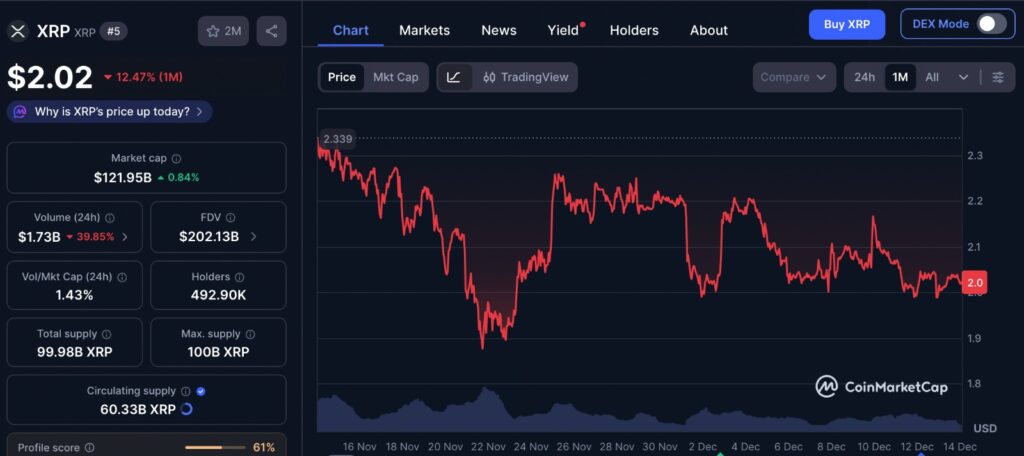
The one-month price chart for XRP highlights the consolidation phase shaping current XRP Price Dynamics. Over the past several weeks, price action has remained largely range-bound, with XRP struggling to establish sustained momentum in either direction. This sideways movement aligns with broader market indecision, where buying interest has been present but insufficient to drive a clear breakout. The chart visually reinforces how XRP has absorbed steady inflows while maintaining relatively stable price levels, suggesting a period of accumulation rather than expansion. Such behavior is common during transitional phases, as markets reassess value before making a decisive move.
XRP Price Dynamics and Market Structure
XRP Price Dynamics currently reflect a market in consolidation rather than expansion. The price hovered near the 50 percent Fibonacci retracement level around $2.02, a zone commonly associated with indecision. At this level, buyers and sellers tend to balance each other out, preventing strong directional movement.
From a technical perspective, XRP formed an ascending triangle pattern. This structure often appears when price volatility narrows, signaling that a larger move may follow once pressure builds. However, until that breakout occurs, price tends to remain range-bound. This explains why inflows alone have not yet translated into price acceleration.
Volume distribution further supports this view. Much of the trading activity has remained concentrated within a tight range, indicating that incoming capital is being absorbed rather than driving price higher. In such conditions, sellers appear willing to offload XRP at current levels, neutralizing buying pressure.
Momentum Indicators in XRP Price Dynamics
Momentum indicators offer additional insight into XRP Price Dynamics. The Relative Strength Index hovered around 42, which sits below the neutral midpoint of 50. This reading suggests weak bullish momentum without signaling strong bearish conditions. In other words, buyers are present, but not aggressive.
The Moving Average Convergence Divergence indicator also showed compressed movement, reflecting low momentum and a lack of strong trend direction. When both RSI and MACD flatten simultaneously, it usually indicates that traders are waiting for confirmation before committing to larger positions.
This hesitation helps explain why inflows did not immediately lift the price. Capital entering the market does not always chase price higher if sentiment remains cautious or if participants expect better entry points.
Capital Inflows and XRP Price Dynamics
The $16.4 million in net inflows occurred over nearly three weeks, signaling consistent interest rather than a one-time spike. Inflows of this nature are generally viewed as constructive, particularly when they persist over multiple sessions.
However, XRP Price Dynamics show that inflows alone are not enough to trigger rallies. If inflows are matched by equivalent sell pressure, price can remain stagnant. In this case, existing holders may be using periods of increased demand to exit positions, keeping price capped.
Another factor influencing inflows was the introduction of a spot XRP exchange-traded product. This product expanded access to XRP through regulated channels, allowing more traditional investors to gain exposure. While such products typically support long-term demand, their short-term price impact can be muted if markets have already anticipated their launch.
Inflows Versus Immediate Price Reaction
XRP Price Dynamics highlight an important distinction between accumulation and price expansion. Accumulation phases often occur quietly, with capital flowing in while price remains stable. These phases can last longer than expected, frustrating short-term traders but appealing to long-term participants.
The lack of an immediate price response does not invalidate the significance of inflows. Instead, it suggests that the market is still digesting new positions. Once selling pressure weakens or demand increases beyond current levels, price may respond more decisively.
Fundamentals Supporting XRP Price Dynamics
Beyond technicals, XRP Price Dynamics are supported by ongoing developments in Ripple’s ecosystem. Ripple has continued to expand its infrastructure and product offerings, strengthening its role in cross-border payments and financial settlement.
One major development was the completion of an acquisition aimed at enhancing stablecoin and payments infrastructure. This move improved Ripple’s ability to support enterprise-level financial solutions. Additionally, a European bank adopted Ripple’s payment technology, marking a significant step in regulated institutional usage.
These developments reinforce XRP’s long-term utility narrative. However, fundamental growth often influences price gradually rather than instantly. Markets tend to wait for sustained adoption metrics before revaluing assets significantly.
Fundamentals Versus Market Timing
XRP Price Dynamics illustrate how fundamentals and timing do not always align. While adoption and infrastructure improvements support long-term value, short-term price behavior remains driven by liquidity, sentiment, and technical levels.
In many cases, fundamentals act as a floor rather than an immediate catalyst. They reduce downside risk and attract steady capital, but price expansion usually requires a shift in market psychology or a breakout from established technical ranges.
What Comes Next for XRP Price Dynamics
Looking ahead, XRP Price Dynamics will likely depend on whether inflows continue and whether price can break above key resistance levels. Sustained volume expansion would signal stronger conviction among buyers, increasing the likelihood of a breakout.
Traders will continue to monitor how XRP behaves around the $2 zone. A decisive move above resistance could confirm that accumulation has transitioned into expansion. Conversely, failure to hold support could extend consolidation.
Broader market conditions also play a role. XRP does not trade in isolation, and sentiment across the cryptocurrency market will influence how quickly capital shifts into risk assets. Until then, XRP Price Dynamics suggest patience rather than momentum.
In summary, XRP’s stalled price despite strong inflows reflects a market in balance. Capital is entering, fundamentals are improving, but technical and sentiment factors are delaying price response. This phase may be quiet, but historically, such periods often precede larger moves once conditions align.
Keep yourself updated with the latest crypto news with FYI Gazette
Read more about Memecoins with FYI Gazette
Keep yourself updated with the latest Altcoin News with FYI Gazette
 Bitcoin
  Ethereum
  Tether
  BNB
BNB  XRP
XRP  Solana
  TRON
TRON  Dogecoin
  Litecoin
  Pepe
Pepe