
Dogecoin Whale Outflows Signal Smart Money Exit
Dogecoin Whale Outflows have once again taken center stage as large holders moved nearly 500 million DOGE to centralized exchanges, triggering fresh concerns across the crypto market. This major transaction comes at a time when Dogecoin is struggling to reclaim key resistance levels, raising the question of whether whales are simply repositioning or quietly exiting before further downside.
Dogecoin recently experienced a short-lived rally that briefly lifted the broader memecoin market. However, most of those gains were quickly erased, highlighting how fragile sentiment remains. DOGE itself dropped roughly 14 percent from its yearly high near $0.15, wiping billions from its market capitalization in just days. Against this backdrop, whale behavior has become increasingly important to monitor.
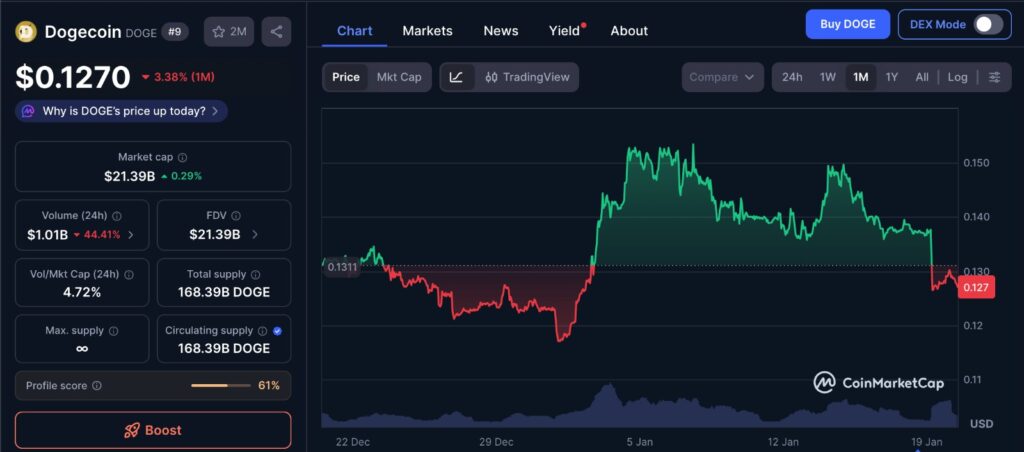
Over the past month, Dogecoin’s price action reflects hesitation rather than conviction, with momentum fading as rallies approach familiar resistance zones. The chart shows multiple attempts to move higher that stall quickly, suggesting traders are less willing to chase upside at current levels. This kind of structure often appears when short-term participants dominate activity while longer-term holders step back. Instead of a clear trend, price movement has become more reactive, responding to levels rather than driving through them.
Dogecoin Whale Outflows and Market Timing
The latest Dogecoin whale outflows occurred close to the $0.15 resistance zone, a price level that has repeatedly blocked upward momentum. This level has acted as a ceiling since late 2025, with multiple failed attempts by bulls to push above it. The timing of the 500 million DOGE transfer has therefore drawn attention, as whales often reduce exposure near strong resistance.
Large holders typically have more resources, longer investment horizons, and better risk management strategies than retail traders. When they move large amounts of tokens to exchanges, it often signals preparation to sell or hedge positions. While not every whale transfer leads to a price drop, repeated outflows near resistance can reinforce bearish expectations.
Why Resistance Levels Matter for Dogecoin Whale Outflows
Resistance zones are psychological and technical barriers where selling pressure tends to increase. In Dogecoin’s case, the $0.15 level has become a critical point of interest. Each rejection strengthens the belief that upside potential is limited in the short term. When whales act near these levels, it can amplify negative sentiment and discourage new buyers from entering the market.
This behavior can create a feedback loop. As prices fail to break higher, confidence weakens. Whales reduce exposure, which adds selling pressure, keeping prices capped. Over time, this cycle can trap Dogecoin in a narrow trading range.
Support Levels Under Pressure From Dogecoin Whale Outflows
While resistance has limited upside, the $0.13 zone has emerged as an important support area. Recent price action suggests buyers are stepping in around this level to prevent deeper losses. However, continued whale selling could test the strength of this support.
If Dogecoin fails to hold above $0.13, it could signal that larger players are no longer willing to defend current prices. Support breakdowns often trigger additional selling as stop-loss orders are hit and traders rush to protect capital. This makes whale activity particularly relevant when prices hover near critical levels.
Smart Money or Routine Liquidity Movement?
Not all Dogecoin whale outflows should be viewed as bearish. In some cases, whales move funds for liquidity management, over-the-counter deals, or internal transfers. However, context matters. The size of the transfer, combined with repeated resistance failures, suggests this move deserves closer scrutiny.
Smart money tends to act early rather than react late. By reducing exposure near resistance, whales may be managing risk rather than predicting a major crash. Still, their actions can influence market psychology, especially in speculative assets like memecoins.
Memecoin Volatility and Whale Behavior
Dogecoin exists in a highly volatile segment of the crypto market. Memecoins are driven largely by sentiment, momentum, and social attention rather than fundamentals. This makes them especially sensitive to large transactions and sudden shifts in confidence.
The recent decline across the memecoin sector reinforces this reality. After a brief surge in market value, most gains evaporated quickly, reminding traders how fast conditions can change. Dogecoin whale outflows during such periods can act as early warning signs of cooling enthusiasm.
How Retail Traders React to Dogecoin Whale Outflows
Retail traders often track whale movements as indicators of future price action. When large outflows occur, fear of further declines can spread quickly. This can lead to reduced buying pressure or even panic selling, which benefits whales that exited earlier.
However, it is important to avoid overreacting to single events. One whale transfer does not guarantee a trend reversal. Patterns over time matter more than isolated transactions.
What to Watch Next After Dogecoin Whale Outflows
Going forward, traders should closely watch how Dogecoin behaves around its key technical levels. A strong break above $0.15, supported by rising volume and reduced exchange inflows, would weaken the bearish narrative. That would suggest buyers are absorbing selling pressure effectively.
On the other hand, continued whale outflows combined with a loss of $0.13 support could point to further downside or prolonged consolidation. Exchange inflow data, trading volume, and price reactions to resistance will remain crucial indicators.
On-Chain Data as a Decision Tool
On-chain metrics provide valuable insight into what large holders are doing behind the scenes. Monitoring wallet movements, exchange balances, and large transfers can help traders understand whether smart money is accumulating or distributing.
Used correctly, this data can complement technical analysis rather than replace it. Combining price levels with whale behavior offers a clearer picture of market dynamics.
Editor’s View: Why Whale Behavior Often Precedes Sentiment Shifts
Large holders tend to act before sentiment visibly changes, not because they can predict price, but because they manage exposure differently from most traders. When price stalls near resistance, whales often reduce risk quietly rather than wait for confirmation. This does not mean they expect a sharp drop, but it reflects a preference for capital preservation over upside speculation. In markets driven heavily by narrative, that subtle shift in behavior can matter more than any single technical indicator.
Final Thoughts on Dogecoin Whale Outflows
Dogecoin whale outflows highlight the ongoing tug-of-war between buyers and sellers in a highly speculative market. The recent 500 million DOGE transfer suggests caution among large holders as price struggles near resistance. Whether this move represents a full exit or a temporary adjustment remains uncertain.
What is clear is that whale behavior continues to play a major role in shaping Dogecoin’s short-term outlook. Traders who pay attention to these signals, while managing risk carefully, will be better positioned to navigate the volatility ahead.
Dogecoin Whale Outflows remain a key factor to watch as the market searches for direction.
Disclaimer: This content is for informational purposes only and does not constitute financial advice.
Keep yourself updated with the latest crypto news with FYI Gazette
Read more about Memecoins with FYI Gazette
Keep yourself updated with the latest Altcoin News with FYI Gazette
 Bitcoin
  Ethereum
  Tether
  BNB
BNB  XRP
XRP  Solana
  TRON
TRON  Dogecoin
  Litecoin
  Pepe
Pepe